National University Polyclinics, National University Health System, Singapore, Singapore.
Department of Family Medicine, Yong Loo Lin School of Medicine, National University of Singapore, Singapore, Singapore.
BMC Prim Care. 2022 Apr 15;23(1):81. doi: 10.1186/s12875-022-01693-z.
Factors affecting COVID-19 vaccine acceptance and hesitancy among primary healthcare workers (HCW) remain poorly understood. This study aims to identify factors associated with vaccine acceptance and hesitancy among HCW.
A multi-centre online cross-sectional survey was performed across 6 primary care clinics from May to June 2021, after completion of staff vaccination exercise. Demographics, profession, years working in healthcare, residential status, presence of chronic medical conditions, self-perceived risk of acquiring COVID-19 and previous influenza vaccination were collected. HCW who accepted vaccine were then asked to rank their top 5 reasons for vaccine acceptance; HCW who were vaccine hesitant had to complete the 15-item 5C scale on psychological antecedents of vaccination.
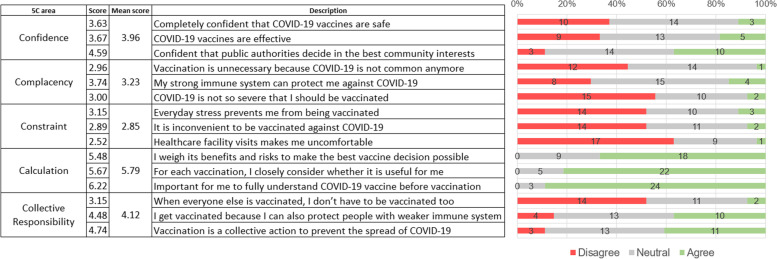
Five hundred fifty seven out of 1182 eligible HCW responded (47.1%). Twenty nine were excluded due to contraindications. Among 528 respondents, vaccine acceptance rate was 94.9% (n = 501). There were no statistically significant differences in COVID-19 vaccine acceptance between sex, age, ethnicity, profession, number of years in healthcare, living alone, presence of chronic diseases, self-perceived risk or previous influenza vaccination. The top 3 reasons for COVID-19 vaccine acceptance ranked by 501 HCW were to protect their family and friends, protect themselves from COVID-19 and due to high risk of acquiring COVID-19 because of their jobs. HCW with suspected or confirmed COVID-19 exposure were 3.4 times more likely to rank 'high risk at work' as one of the top reasons for vaccine acceptance (χ = 41.9, p < 0.001, OR = 3.38, 95%C.I. 2.32-4.93). High mean scores of 'Calculation' (5.79) and low scores for 'Constraint' (2.85) for 5C components among vaccine hesitant HCW (n = 27) highlighted that accessibility was not a concern; HCW took time to weigh vaccine benefits and consequences.
COVID-19 vaccine hesitancy is a minute issue among Singapore primary HCW, having achieved close to 95% acceptance rate. COVID-19 exposure risk influences vaccine acceptance; time is required for HCW to weigh benefits against the risks. Future studies can focus on settings with higher hesitancy rates, and acceptance of booster vaccinations with the emergence of delta and omicron variants.
影响初级保健工作者(HCW)对 COVID-19 疫苗接受度和犹豫的因素仍知之甚少。本研究旨在确定与 HCW 疫苗接受度和犹豫相关的因素。
2021 年 5 月至 6 月,在完成工作人员疫苗接种运动后,在 6 个初级保健诊所进行了一项多中心在线横断面调查。收集人口统计学、职业、在医疗保健行业工作年限、居住状况、是否存在慢性疾病、自我感知感染 COVID-19 的风险以及之前是否接种过流感疫苗。接受疫苗的 HCW 被要求列出他们接受疫苗的前 5 个原因;对疫苗犹豫不决的 HCW 必须完成 15 项 5C 疫苗接种心理前置因素量表。
在 1182 名符合条件的 HCW 中,有 557 名(47.1%)做出了回应。由于禁忌症,有 29 人被排除在外。在 528 名受访者中,疫苗接种率为 94.9%(n=501)。在性别、年龄、种族、职业、在医疗保健行业工作年限、独居、是否存在慢性疾病、自我感知风险或之前是否接种过流感疫苗方面,COVID-19 疫苗接种的接受率在统计学上没有显著差异。501 名 HCW 对 COVID-19 疫苗接种的前 3 个原因是保护家人和朋友、保护自己免受 COVID-19 感染以及由于工作感染 COVID-19 的高风险。疑似或确诊 COVID-19 接触的 HCW 将“工作高风险”列为疫苗接种原因的可能性高 3.4 倍(χ=41.9,p<0.001,OR=3.38,95%CI 2.32-4.93)。疫苗犹豫的 HCW(n=27)的 5C 成分“计算”的平均高分数(5.79)和“约束”的低分数(2.85)突出表明,可及性不是一个问题;HCW 需要时间权衡疫苗的益处和后果。未来的研究可以集中在接受率较高的环境,以及随着 delta 和 omicron 变体的出现,对接种加强针的接受度。