Qu Ling, Cheng Qing, Wang Yan, Mu Hui, Zhang Yunfeng
Department of Respiratory and Critical Care Medicine, Shanghai Putuo District Liqun Hospital, Shanghai, China.
Department of Science and Education, Shanghai Putuo District Liqun Hospital, Shanghai, China.
Front Microbiol. 2022 Apr 1;13:868086. doi: 10.3389/fmicb.2022.868086. eCollection 2022.
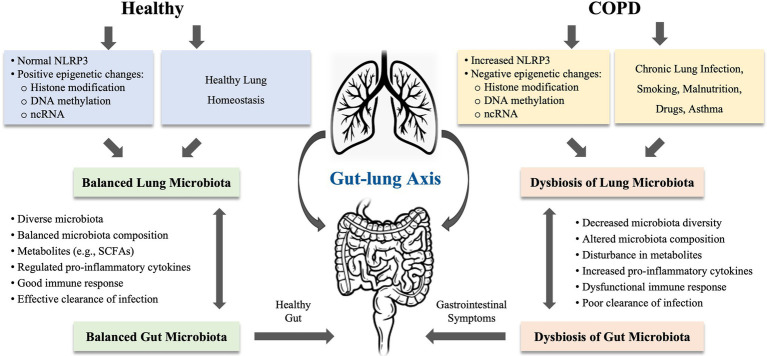
The exact pathogenesis of chronic obstructive pulmonary disease (COPD) remains largely unknown. While current management strategies are effective at stabilizing the disease or relief the symptoms, new approaches are required to target underlying disease process and reverse lung function deterioration. Recent research showed that pneumonia bacteria is critical in disease progression and gut microbiome is likely perturbed in COPD, which is usually accompanied by a decreased intestinal microbial diversity and a disturbance in immune system, contributing to a chronic inflammation. The cross-talk between gut microbes and lungs, termed as the "gut-lung axis," is known to impact immune response and homeostasis in the airway. Although the gut and respiratory microbiota exhibit compositional differences, the gut and lung showed similarities in the origin of epithelia of both gastrointestinal and respiratory tracts, the anatomical structure, and early-life microbial colonization. Evidence showed that respiratory infection might be prevented, or at least dampened by regulating gut microbial ecosystem; thus, a promising yet understudied area of COPD management is nutrition-based preventive strategies. COPD patient is often deficient in nutrient such as antioxidant, vitamins, and fiber intake. However, further larger-scale randomized clinical trials (RCTs) are required to establish the role of these nutrition-based diet in COPD management. In this review, we highlight the important and complex interaction of microbiota and immune response on gut-lung axis. Further research into the modification and improvement of the gut microbiota and new interventions through diet, probiotics, vitamins, and fecal microbiota transplantation is extreme critical to provide new preventive therapies for COPD.
慢性阻塞性肺疾病(COPD)的确切发病机制在很大程度上仍不清楚。虽然目前的管理策略在稳定疾病或缓解症状方面有效,但需要新的方法来针对潜在的疾病进程并逆转肺功能恶化。最近的研究表明,肺炎细菌在疾病进展中至关重要,而COPD患者的肠道微生物群可能受到干扰,通常伴随着肠道微生物多样性的降低和免疫系统的紊乱,从而导致慢性炎症。肠道微生物与肺部之间的相互作用,即所谓的“肠-肺轴”,已知会影响气道中的免疫反应和内环境稳定。尽管肠道和呼吸道微生物群在组成上存在差异,但肠道和肺部在胃肠道和呼吸道上皮的起源、解剖结构以及生命早期的微生物定植方面表现出相似性。有证据表明,通过调节肠道微生物生态系统可以预防或至少减轻呼吸道感染;因此,基于营养的预防策略是COPD管理中一个有前景但研究不足的领域。COPD患者通常缺乏抗氧化剂、维生素和纤维等营养素的摄入。然而,需要进一步的大规模随机临床试验(RCT)来确定这些基于营养的饮食在COPD管理中的作用。在这篇综述中,我们强调了微生物群与肠道-肺轴上免疫反应之间重要而复杂的相互作用。进一步研究肠道微生物群的修饰和改善以及通过饮食、益生菌、维生素和粪便微生物群移植进行的新干预措施对于为COPD提供新的预防疗法极为关键。