
医院诊断的子宫内膜异位症发病率的时间和地域差异:一项丹麦基于人群的研究。
Temporal and regional differences in the incidence of hospital-diagnosed endometriosis: a Danish population-based study.
机构信息
Department of Public Health, Aarhus University, Aarhus, Denmark.
Department of Obstetrics and Gynecology, Aarhus University Hospital, Aarhus, Denmark.
出版信息
Acta Obstet Gynecol Scand. 2022 Jul;101(7):737-746. doi: 10.1111/aogs.14364. Epub 2022 Apr 17.
INTRODUCTION
Due to diagnostic challenges, normalization of symptoms and an overall lack of awareness among both patients and physicians, endometriosis is an underdiagnosed disease. This can result in delayed treatment and potentially worsening of the disease. Despite initiatives, such as patients' support organizations and specialized endometriosis referral centers, differences in awareness, socioeconomic factors and lifestyle, combined with varying distances to specialized referral centers, could result in regional differences in the degree of underdiagnosing. This study aims to explore temporal and regional variations in the incidence of endometriosis based on the Danish hospital discharge register, and shed light on the degree of underdiagnosing of endometriosis in Denmark.
MATERIAL AND METHODS
This registry-based cohort study included all women aged 15-55 living in Denmark from 1990-2017. Participants were identified through the Danish Civil Registration system and endometriosis diagnoses received at a hospital were obtained from the Danish National Patient Registry. Incidence rates of diagnosed endometriosis were calculated for each year of the study period and for each municipality in Denmark. A Cox regression analysis, stratified by calendar time and adjusted for ethnic origin, household composition, highest educational level and family socioeconomic status, was performed to estimate the association between residence and likelihood of receiving a hospital-based diagnosis of endometriosis.
RESULTS
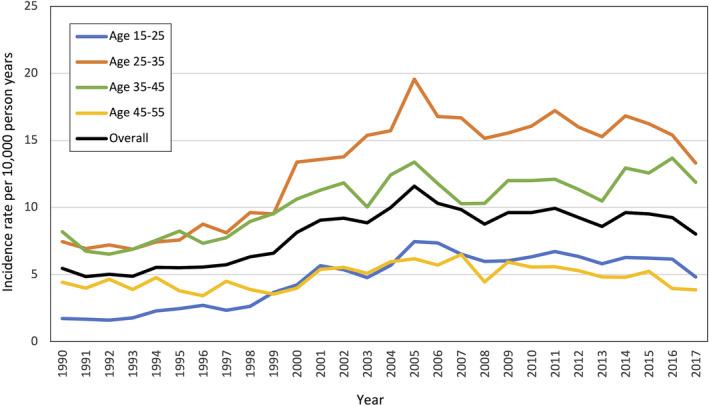
The nationwide incidence rate of hospital-diagnosed endometriosis was 7.89 (95% confidence interval [CI] 7.80-7.99) per 10 000 person-years and the prevalence in 2017 was 1.63%. The results showed an overall increase in the incidence of diagnosed endometriosis of 46.8% (95% CI 32.9-62.2) during the study period and also displayed significant regional differences. After adjustments, women living in northern Jutland had the highest probability of receiving a hospital-based diagnosis of endometriosis (hazard ratio 1.13, 95% CI 1.09-1.18), whereas women living in northern Zealand had the lowest probability (hazard ratio 0.63, 95% CI 0.60-0.67) compared with eastern Jutland. These regional differences have become more evident over time.
CONCLUSIONS
Our results reveal significant regional differences in the incidence of hospital-diagnosed endometriosis, suggesting that a significant number of women may be left behind without a diagnosis. Further studies are needed to assess the underlying reasons for the significant regional differences.
简介
由于诊断方面的挑战,以及患者和医生普遍缺乏认识,子宫内膜异位症是一种未被充分诊断的疾病。这可能导致治疗延误,病情恶化。尽管采取了患者支持组织和专门的子宫内膜异位症转诊中心等举措,但由于意识、社会经济因素和生活方式的差异,以及与专门转诊中心的距离不同,可能导致该病在不同地区的诊断不足程度存在差异。本研究旨在通过丹麦医院出院登记处,探讨子宫内膜异位症发病率的时间和地区差异,并阐明丹麦子宫内膜异位症的诊断不足程度。
材料和方法
这项基于登记的队列研究纳入了 1990 年至 2017 年期间居住在丹麦的 15-55 岁所有女性。通过丹麦民事登记系统识别参与者,并从丹麦国家患者登记处获取在医院接受的子宫内膜异位症诊断。计算了研究期间每年和丹麦每个市的诊断性子宫内膜异位症的发病率。采用 Cox 回归分析,按日历时间分层,并根据种族、家庭构成、最高教育水平和家庭社会经济状况进行调整,以估计居住地与接受医院诊断为子宫内膜异位症的可能性之间的关联。
结果
全国范围内,医院诊断的子宫内膜异位症发病率为 7.89(95%置信区间 [CI] 7.80-7.99)/10000 人年,2017 年的患病率为 1.63%。结果显示,研究期间诊断性子宫内膜异位症的发病率总体增加了 46.8%(95% CI 32.9-62.2),且存在显著的地区差异。调整后,居住在日德兰北部的女性接受医院诊断为子宫内膜异位症的可能性最高(风险比 1.13,95% CI 1.09-1.18),而居住在西兰北部的女性接受诊断的可能性最低(风险比 0.63,95% CI 0.60-0.67)与东日德兰相比。这些地区差异随着时间的推移变得更加明显。
结论
我们的研究结果显示,医院诊断的子宫内膜异位症发病率存在显著的地区差异,这表明大量女性可能没有得到诊断。需要进一步研究以评估这些显著地区差异的潜在原因。



 Zotero 插件