Department of Psychological and Brain Sciences, Indiana University, Bloomington, IN, 47405, USA.
Program in Neuroscience, Indiana University, Bloomington, IN, 47405, USA.
Nat Commun. 2022 Apr 19;13(1):2053. doi: 10.1038/s41467-022-29770-y.
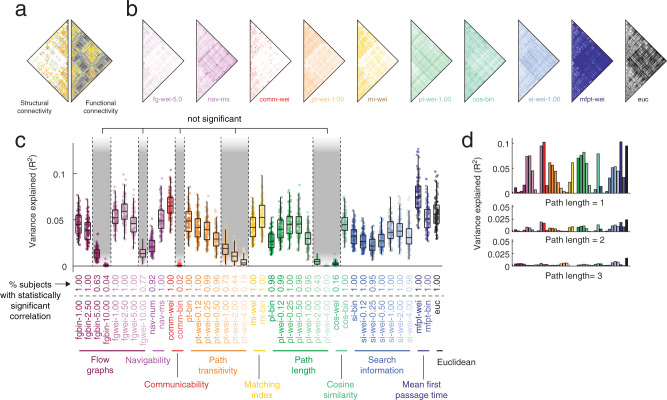
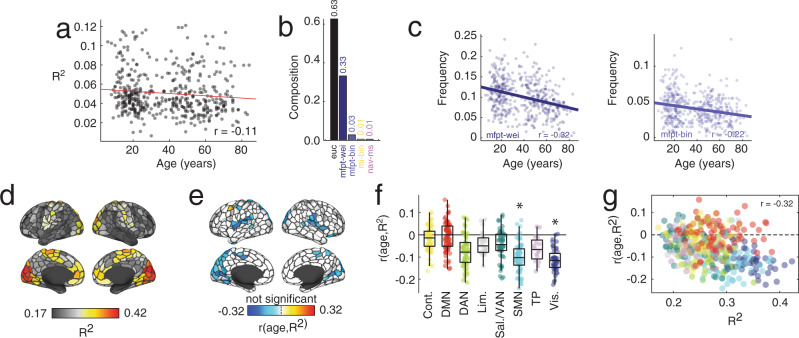
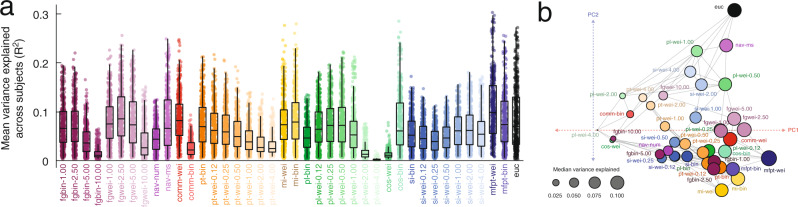
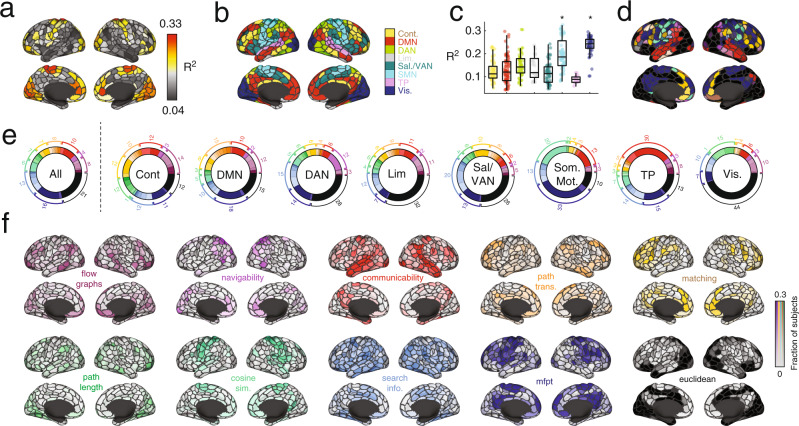
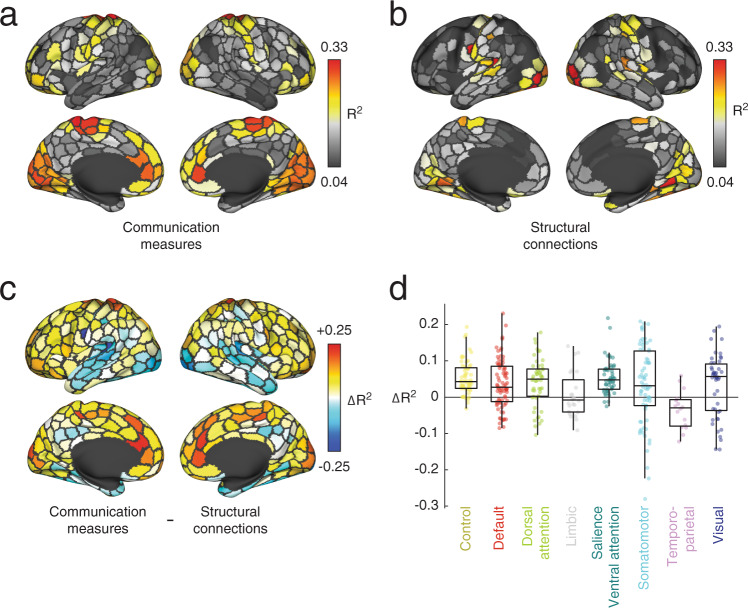
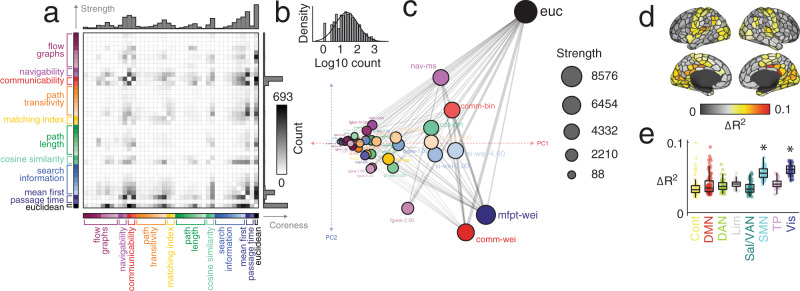
A growing number of studies have used stylized network models of communication to predict brain function from structure. Most have focused on a small set of models applied globally. Here, we compare a large number of models at both global and regional levels. We find that globally most predictors perform poorly. At the regional level, performance improves but heterogeneously, both in terms of variance explained and the optimal model. Next, we expose synergies among predictors by using pairs to jointly predict FC. Finally, we assess age-related differences in global and regional coupling across the human lifespan. We find global decreases in the magnitude of structure-function coupling with age. We find that these decreases are driven by reduced coupling in sensorimotor regions, while higher-order cognitive systems preserve local coupling with age. Our results describe patterns of structure-function coupling across the cortex and how this may change with age.
越来越多的研究使用了经过简化的网络通信模型,以便根据大脑结构预测大脑功能。大多数研究都集中在少数几种全局应用的模型上。在这里,我们在全局和区域两个层面上比较了大量的模型。我们发现,全局上大多数预测器的表现都很差。在区域层面上,表现有所提高,但在解释方差和最佳模型方面都存在异质性。接下来,我们通过使用成对方法来共同预测 FC,从而揭示预测器之间的协同作用。最后,我们评估了人类一生中大脑全局和区域耦合的年龄相关性差异。我们发现,随着年龄的增长,大脑结构与功能的耦合程度整体下降。我们发现,这些下降是由感觉运动区域的耦合减少驱动的,而高阶认知系统随着年龄的增长保持了局部耦合。我们的研究结果描述了整个大脑皮层的结构与功能耦合模式,以及这种模式可能随着年龄的变化而发生的变化。