McConnell Brain Imaging Centre, Montréal Neurological Institute, McGill University, Montréal, Canada.
Psychological and Brain Sciences, Program in Neuroscience, Cognitive Science Program, Network Science Institute, Indiana University, Bloomington, IN, USA.
Commun Biol. 2022 Jun 2;5(1):532. doi: 10.1038/s42003-022-03466-x.
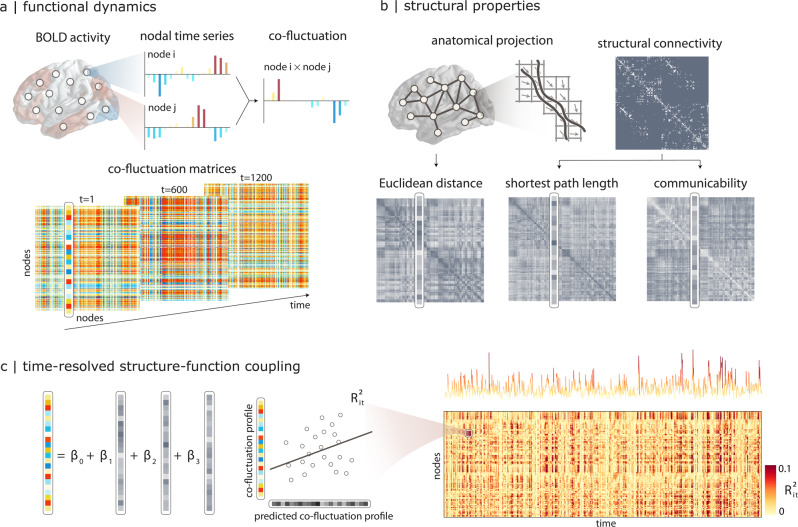
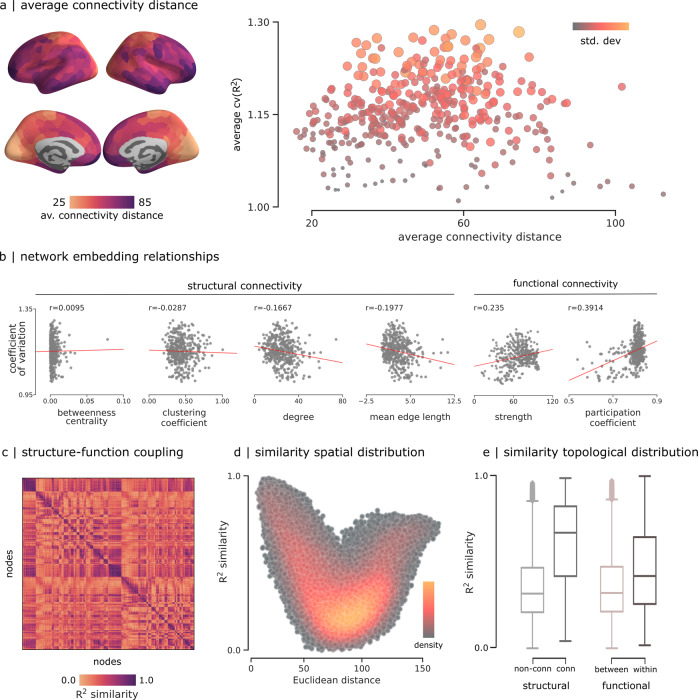
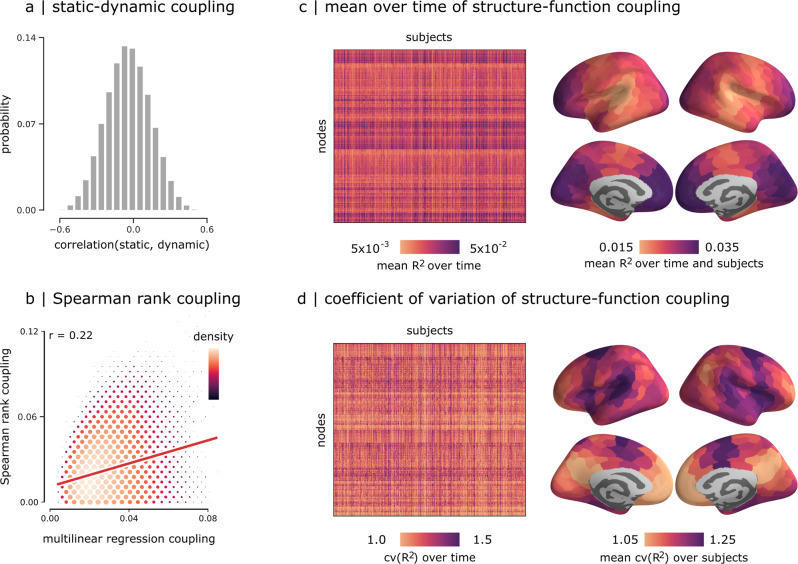
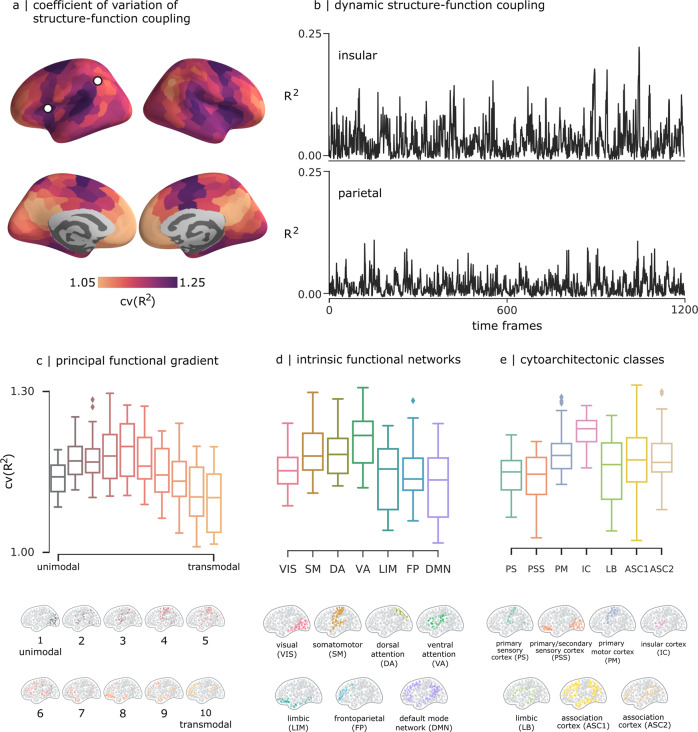
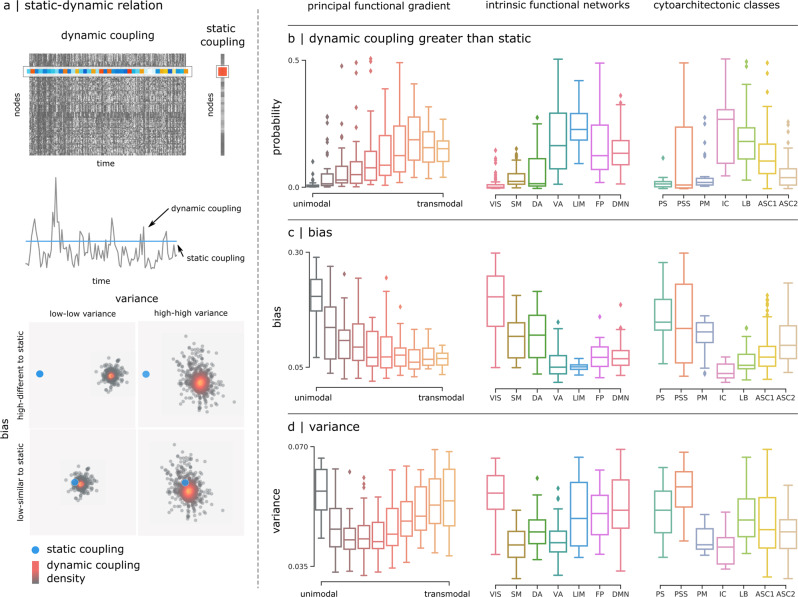
The relationship between structural and functional connectivity in the brain is a key question in systems neuroscience. Modern accounts assume a single global structure-function relationship that persists over time. Here we study structure-function coupling from a dynamic perspective, and show that it is regionally heterogeneous. We use a temporal unwrapping procedure to identify moment-to-moment co-fluctuations in neural activity, and reconstruct time-resolved structure-function coupling patterns. We find that patterns of dynamic structure-function coupling are region-specific. We observe stable coupling in unimodal and transmodal cortex, and dynamic coupling in intermediate regions, particularly in insular cortex (salience network) and frontal eye fields (dorsal attention network). Finally, we show that the variability of a region's structure-function coupling is related to the distribution of its connection lengths. Collectively, our findings provide a way to study structure-function relationships from a dynamic perspective.
大脑结构连接和功能连接之间的关系是系统神经科学的一个关键问题。现代理论假设存在一种单一的、随时间保持不变的全局结构-功能关系。在这里,我们从动态的角度研究结构-功能耦合,并表明它具有区域异质性。我们使用时间展开过程来识别神经活动的随时间变化的共波动,并重建时间分辨的结构-功能耦合模式。我们发现,动态结构-功能耦合的模式是特定于区域的。我们观察到单模态和跨模态皮层的稳定耦合,以及中间区域(特别是脑岛皮层(突显网络)和额眼区(背侧注意网络))的动态耦合。最后,我们表明一个区域的结构-功能耦合的可变性与其连接长度的分布有关。总的来说,我们的发现为从动态角度研究结构-功能关系提供了一种方法。