Key Laboratory of Infection and Immunity, Institute of Biophysicsgrid.418856.6, Chinese Academy of Sciences, Beijing, China.
University of Chinese Academy of Sciences, Beijing, China.
J Virol. 2022 May 11;96(9):e0010522. doi: 10.1128/jvi.00105-22. Epub 2022 Apr 20.
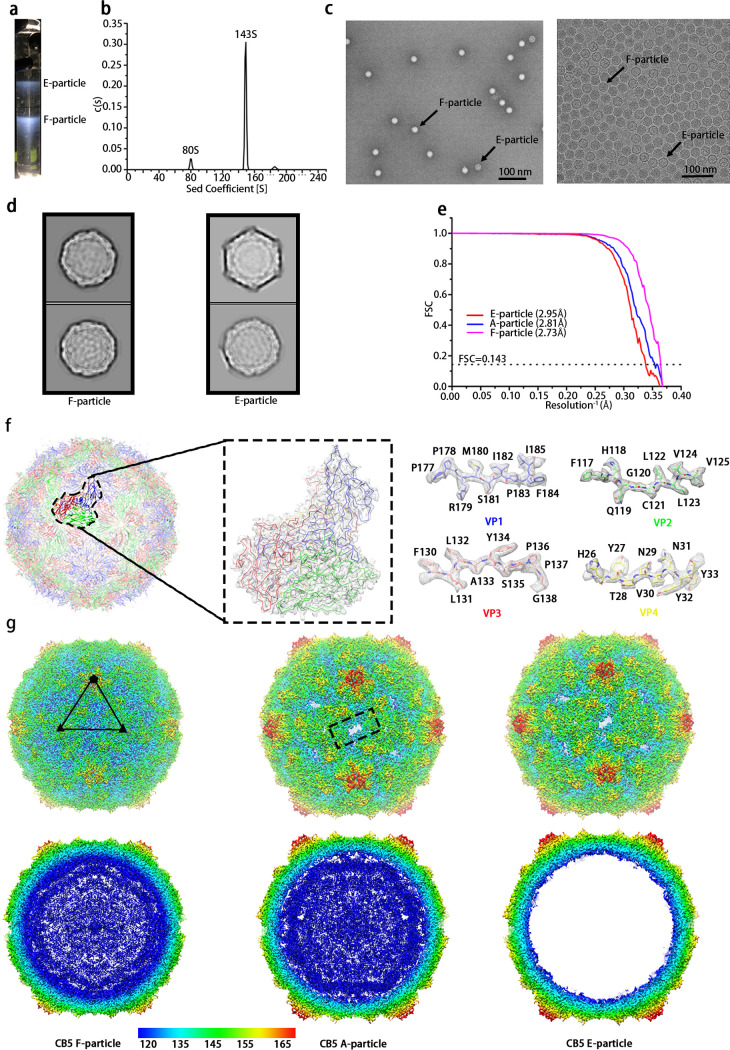
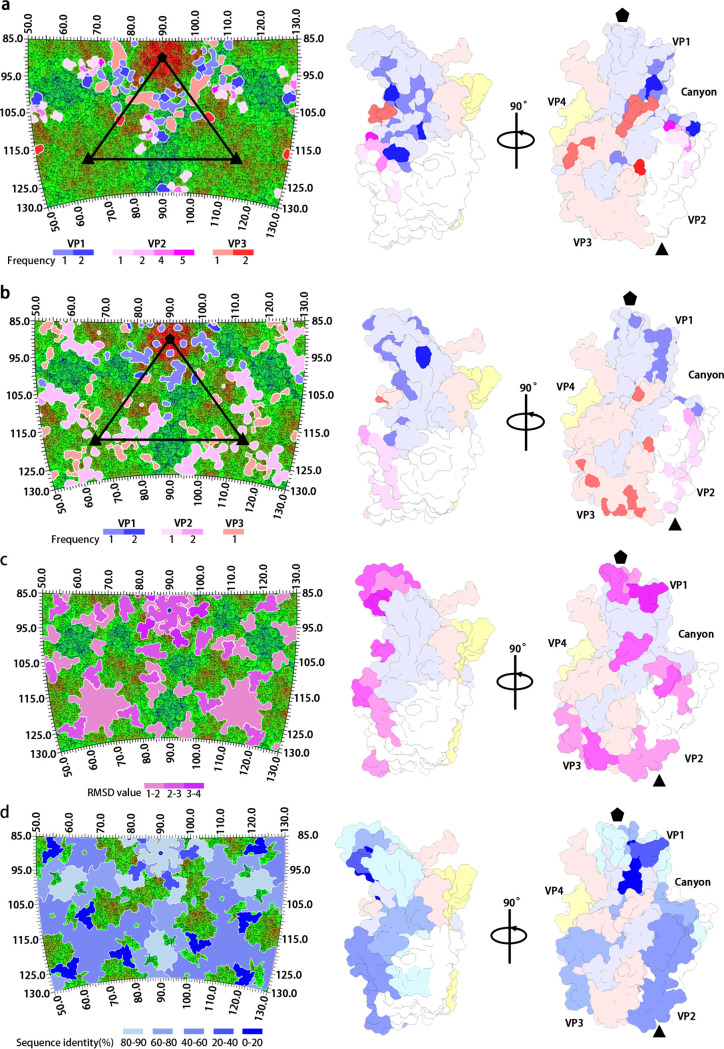
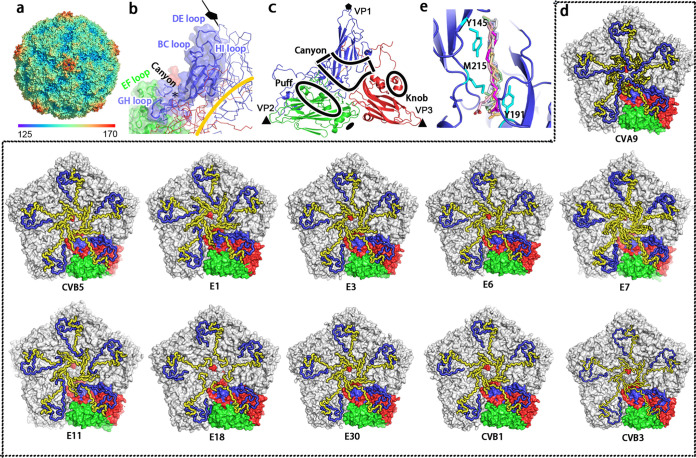
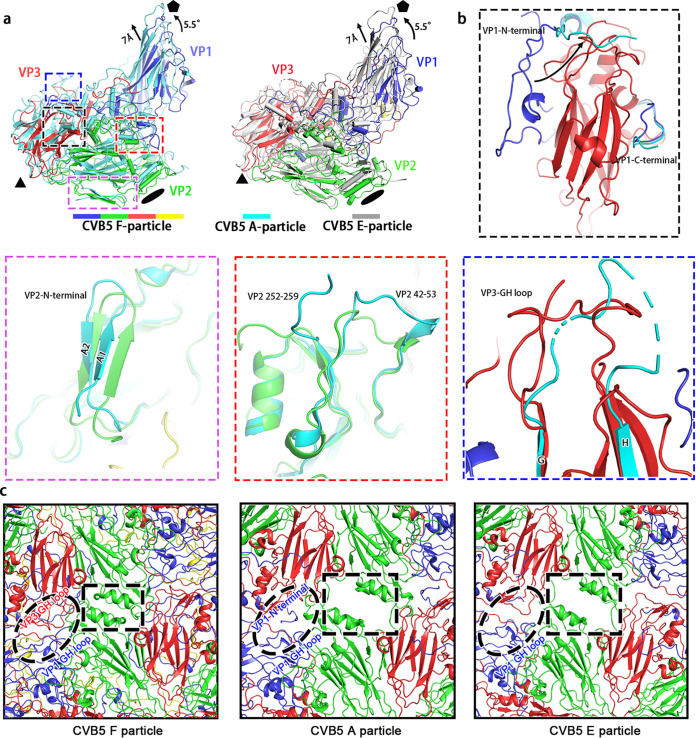
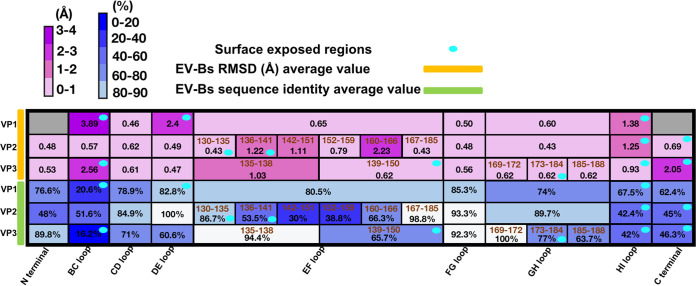
Coxsackie virus B5 (CVB5), a main serotype in human Enterovirus B (EVB), can cause severe viral encephalitis and aseptic meningitis among infants and children. Currently, there is no approved vaccine or antiviral therapy available against CVB5 infection. Here, we determined the atomic structures of CVB5 in three forms: mature full (F) particle (2.73 Å), intermediate altered (A) particle (2.81 Å), and procapsid empty (E) particle (2.95 Å). Structural analysis of F particle of CVB5 unveiled similar structures of "canyon," "puff," and "knob" as those other EV-Bs. We observed structural rearrangements that are alike during the transition from F to A particle, indicative of similar antigenicity, cell entry, and uncoating mechanisms shared by all EV-Bs. Further comparison of structures and sequences among all structure-known EV-Bs revealed that while the residues targeted by neutralizing MAbs are diversified and drive the evolution of EV-Bs, the relative conserved residues recognized by uncoating receptors could serve as the basis for the development of antiviral vaccines and therapeutics. As one of the main serotypes in Enterovirus B, CVB5 has been commonly reported in recent years. The atomic structures of CVB5 shown here revealed classical features found in EV-Bs and the structural rearrangement occurring during particle expansion and uncoating. Also, structure- and sequence-based comparison between CVB5 and other structure-known EV-Bs screened out key domains important for viral evolution and survival. All these provide insights into the development of vaccine and therapeutics for EV-Bs.
柯萨奇病毒 B5(CVB5)是人类肠道病毒 B(EVB)的主要血清型之一,可导致婴幼儿严重病毒性脑炎和无菌性脑膜炎。目前,尚无针对 CVB5 感染的批准疫苗或抗病毒疗法。在这里,我们确定了 CVB5 的三种形式的原子结构:成熟全(F)颗粒(2.73Å)、中间改变的(A)颗粒(2.81Å)和无壳空(E)颗粒(2.95Å)。CVB5 F 颗粒的结构分析揭示了与其他 EV-B 相似的“峡谷”、“膨胀”和“旋钮”结构。我们观察到在从 F 到 A 颗粒的转变过程中发生了类似的结构重排,表明所有 EV-B 都具有相似的抗原性、细胞进入和脱壳机制。进一步比较所有结构已知的 EV-B 的结构和序列表明,虽然中和 MAb 靶向的残基多样化并推动 EV-B 的进化,但脱壳受体识别的相对保守残基可以作为开发抗病毒疫苗和治疗剂的基础。
作为肠道病毒 B 的主要血清型之一,CVB5 近年来已被广泛报道。这里显示的 CVB5 原子结构揭示了 EV-B 中发现的典型特征,以及颗粒膨胀和脱壳过程中发生的结构重排。此外,CVB5 与其他结构已知的 EV-B 之间的结构和序列比较筛选出了对病毒进化和生存至关重要的关键结构域。所有这些都为 EV-B 的疫苗和治疗剂的开发提供了思路。