Huzhou Center for Disease Control and Prevention, Huzhou, China.
PLoS One. 2022 Apr 21;17(4):e0265987. doi: 10.1371/journal.pone.0265987. eCollection 2022.
Severe acute respiratory infections (SARI) threaten human health and cause a large number of hospitalizations every year. However, as one of the most common pathogen that cause acute respiratory tract infection, the molecular epidemiological information relating to human adenoviruses (HAdVs) among patients with SARI is limited. Here, we evaluate the epidemiological and molecular characteristics of HAdV infections among hospitalized patients with SARI from January 2017 to December 2019 in Huzhou, China.
From January 2017 to December 2019, a total of 657 nasopharyngeal swabs collected from inpatients with SARI were screened for HAdV and other common respiratory viruses by multiplex real-time PCR. All samples that tested positive for HAdV were further typed by sequencing partial sequences of hexon gene. Genotypes of HAdV were confirmed by phylogenetic analysis. Epidemiological data were analyzed using Microsoft Excel 2010 and service solutions (SPSS) 21.0 software.
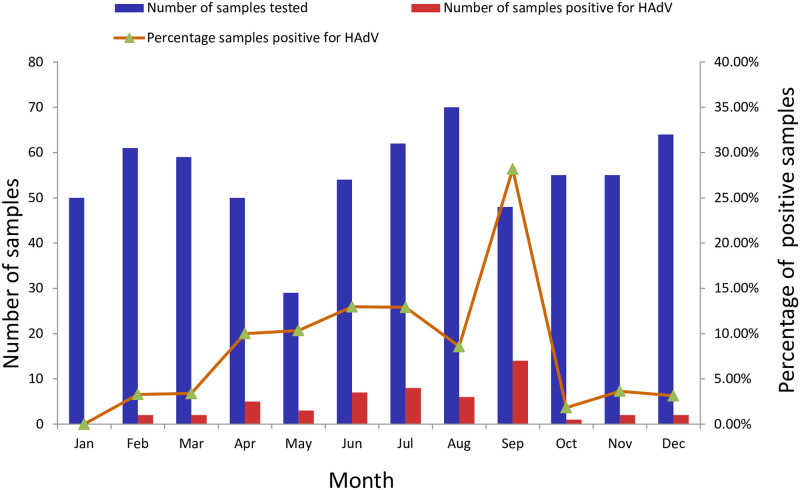
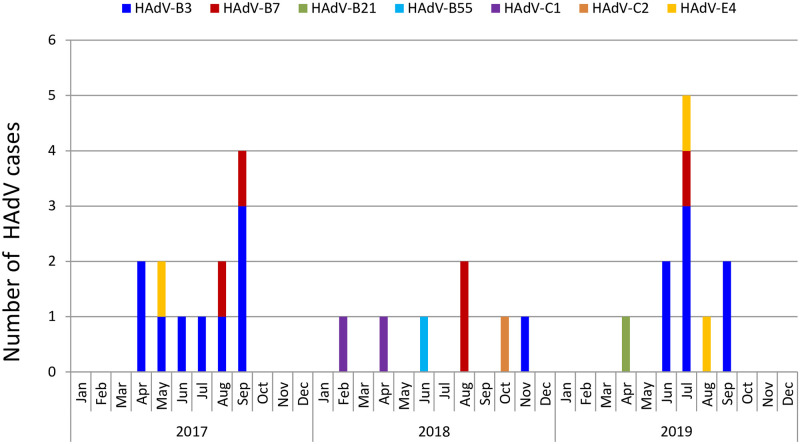
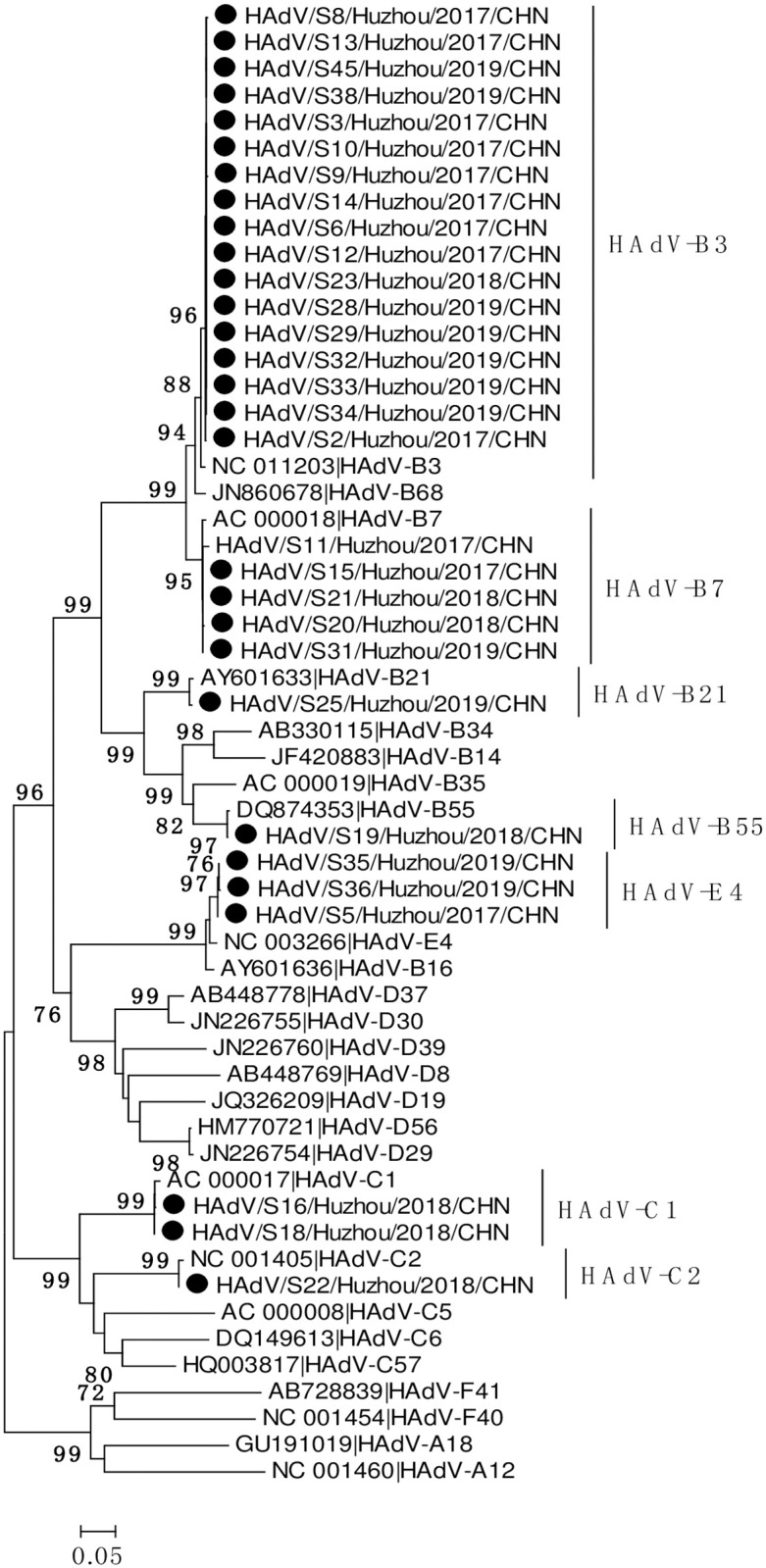
251 (38.20%) samples were positive for at least one respiratory virus. HAdV was the second common viral pathogen detected, with a detection rate of 7.08%. Infection with HAdV was found in all age groups tested (0<2, 2<5, 5<15, 15<50, 50<65, ≥65). Children under 15 years old accounted for 84.62% (44/52) of the infections. Higher activity of HAdV infection could be seen in spring-early autumn season. Seven different types of HAdV belonging to 4 species (HAdV-A, B, C, E) were identified in hospitalized SARI cases, with HAdV-B3 as the most prevalent HAdV types, followed by HAdV-B7 and HAdV-E4. HAdV-B3 was the most frequently detected genotype in 2017 and 2019, accounting for 75.00% (9/12) and 63.64% (7/11) of typed HAdV infections in 2017 and 2019, respectively. No predominant strain was responsible for HAdV infections in 2018, although HAdV-B7 (28.57%, 2/7) and HAdV-C1 (28.57%, 2/7) were the major causative genotypes.
This study revealed the prevalence and the molecular epidemiological characteristics of HAdV infections among hospitalized patients with SARI in Huzhou from January 2017 to December 2019. The HAdV prevalence is related to age and season. As the most prevalent HAdV types, HAdV-B3 was co-circulating with other types and presented an alternate prevalence pattern.
严重急性呼吸道感染(SARI)威胁着人类健康,每年导致大量住院治疗。然而,腺病毒(HAdV)是导致急性呼吸道感染的最常见病原体之一,关于住院 SARI 患者中 HAdV 的分子流行病学信息有限。在此,我们评估了 2017 年 1 月至 2019 年 12 月期间中国湖州住院 SARI 患者中 HAdV 感染的流行病学和分子特征。
2017 年 1 月至 2019 年 12 月,采用多重实时 PCR 法对 657 例 SARI 住院患者的鼻咽拭子进行了 HAdV 和其他常见呼吸道病毒的检测。对 HAdV 检测阳性的所有样本,进一步通过测序六邻体基因的部分序列进行分型。通过系统发育分析确定 HAdV 基因型。使用 Microsoft Excel 2010 和服务解决方案(SPSS)21.0 软件分析流行病学数据。
251(38.20%)份样本至少检测到一种呼吸道病毒。HAdV 是检测到的第二常见病毒病原体,检出率为 7.08%。在所有检测的年龄组中均发现 HAdV 感染(0<2、2<5、5<15、15<50、50<65、≥65)。15 岁以下儿童占 84.62%(44/52)。春季至早秋季节 HAdV 感染活动较高。在住院 SARI 病例中鉴定出属于 4 种(HAdV-A、B、C、E)的 7 种不同类型的 HAdV,其中 HAdV-B3 是最常见的 HAdV 类型,其次是 HAdV-B7 和 HAdV-E4。HAdV-B3 是 2017 年和 2019 年最常检测到的基因型,分别占 2017 年和 2019 年 HAdV 感染分型的 75.00%(9/12)和 63.64%(7/11)。2018 年没有优势株引起 HAdV 感染,尽管 HAdV-B7(28.57%,2/7)和 HAdV-C1(28.57%,2/7)是主要的致病基因型。
本研究揭示了 2017 年 1 月至 2019 年 12 月期间湖州住院 SARI 患者中 HAdV 感染的流行率和分子流行病学特征。HAdV 的流行率与年龄和季节有关。作为最常见的 HAdV 类型,HAdV-B3 与其他类型共同流行,并呈现出交替流行模式。