Park Jun-Kyu, Do Yuno
Department of Biological Science, Kongju National University, Gongju 32588, Korea.
Biology (Basel). 2022 Mar 27;11(4):516. doi: 10.3390/biology11040516.
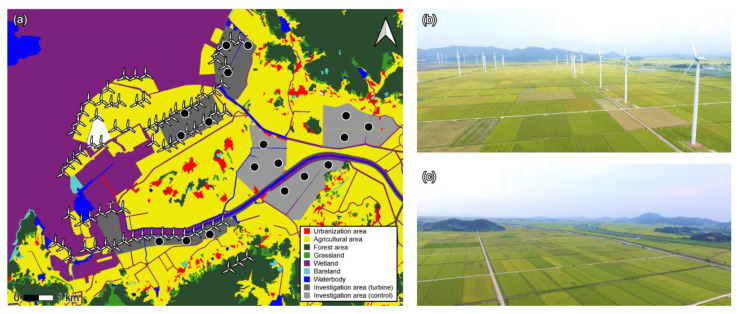
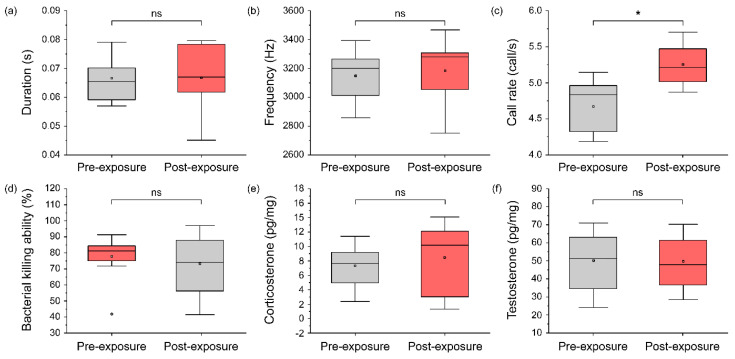
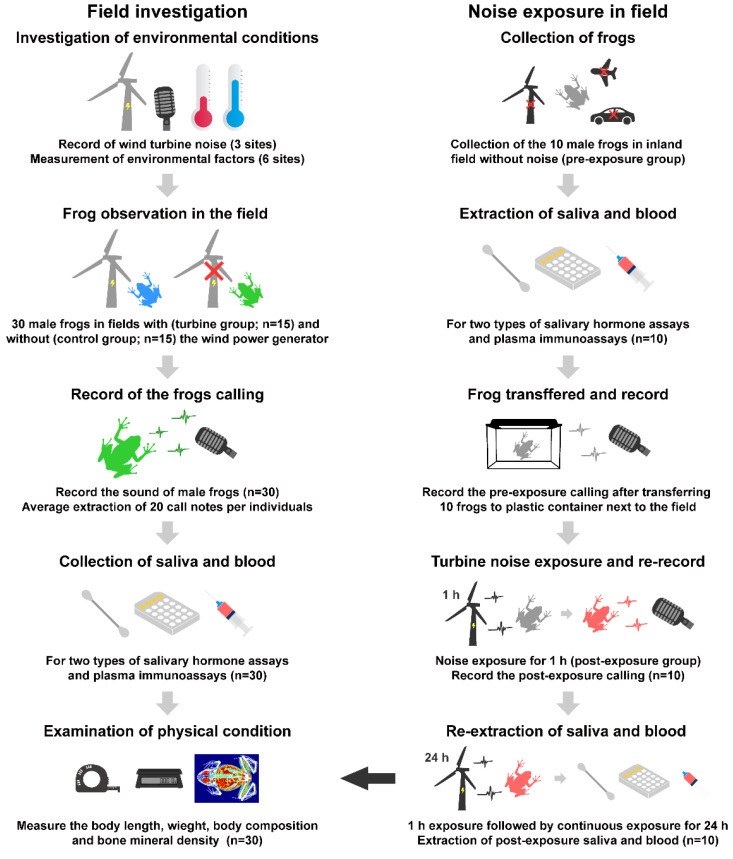
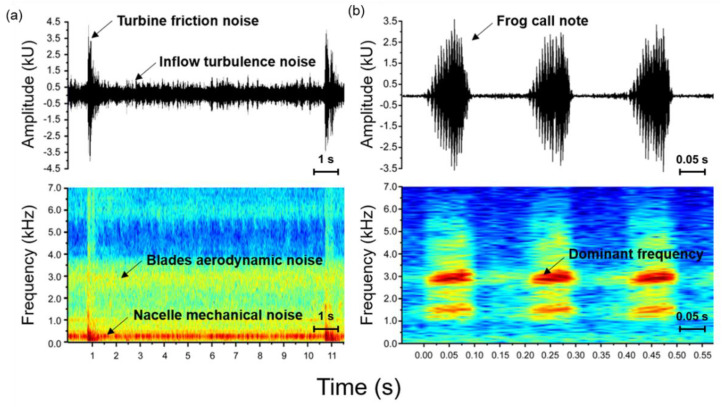
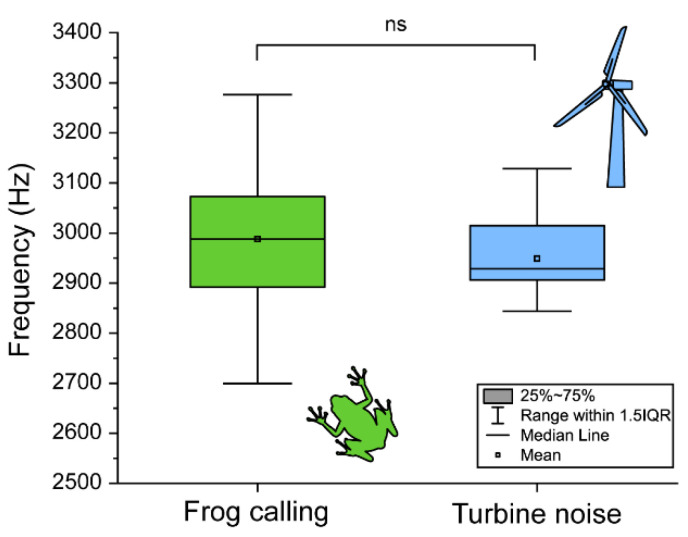
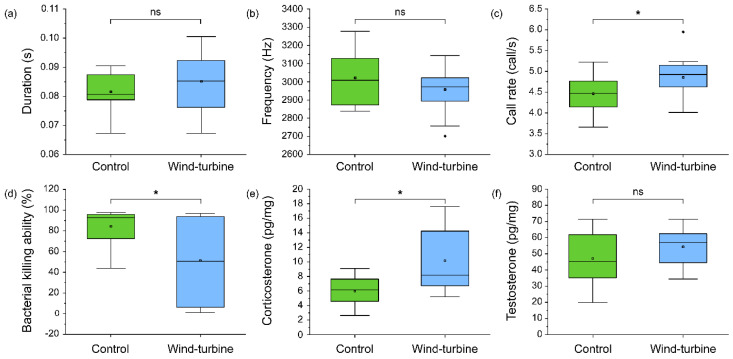
As the advantages of wind energy as an eco-friendly strategy for power generation continue to be revealed, the number of offshore wind farms also increases worldwide. However, wind turbines can induce behavioral and physiological responses in animals by emitting various types of noises. In this study, we investigated the behavioral, physiological, and immunological responses of male Japanese tree frogs () when exposed to wind turbine noise. To determine the effects during the breeding season, frogs were collected from areas with and without wind turbines. Additionally, we exposed the frogs to recorded wind turbine noise at a site without a wind generator for 1 h to 24 h to analyze the short-term effects. Three types of calling patterns (dominant frequency, note duration, and call rate) were analyzed to investigate behavioral responses. Physiological responses were assessed using two steroid hormones assays, namely testosterone and corticosterone detection in the saliva. The immunity of each individual was assessed using a bacterial killing assay. The wind turbine group in the field had a higher call rate and corticosterone levels and lower immunity than the group in the field without turbines present, and all three of these variables were correlated with each other. Conversely, in the noise exposure experiment, a higher call rate was only observed post-exposure compared to pre-exposure. Thus, turbine noise seems to induce decreased immunity in Japanese tree frogs as an increase in energy investment that triggers a behavioral response rather than acting as a sole physiological response that leads to a direct increase in corticosterone. This decreased immunity due to energy tradeoff or physiological response can change the disease epidemiology of the population and create new adaptive patterns in these habitats.
随着风能作为一种环保发电策略的优势不断显现,全球海上风电场的数量也在增加。然而,风力涡轮机发出的各种噪音会引起动物的行为和生理反应。在本研究中,我们调查了雄性日本树蛙()暴露于风力涡轮机噪音时的行为、生理和免疫反应。为了确定繁殖季节的影响,从有和没有风力涡轮机的地区收集青蛙。此外,我们将青蛙暴露在没有风力发电机的地点录制的风力涡轮机噪音中1至24小时,以分析短期影响。分析了三种鸣叫模式(主频、音符持续时间和鸣叫率)以研究行为反应。使用两种类固醇激素检测方法评估生理反应,即检测唾液中的睾酮和皮质酮。使用细菌杀伤试验评估每个个体的免疫力。与没有涡轮机的野外组相比,野外的风力涡轮机组鸣叫率和皮质酮水平更高,免疫力更低,并且这三个变量相互关联。相反,在噪音暴露实验中,与暴露前相比,仅在暴露后观察到较高的鸣叫率。因此,涡轮机噪音似乎会导致日本树蛙免疫力下降,这是能量投资增加引发行为反应的结果,而不是作为导致皮质酮直接增加的唯一生理反应。由于能量权衡或生理反应导致的免疫力下降会改变种群的疾病流行病学,并在这些栖息地创造新的适应模式。