Sengupta Anirban, Azharuddin Mohammad, Al-Otaibi Noha, Hinkula Jorma
Division of Molecular Medicine and Virology, Department of Biomedical and Clinical Sciences, Linköping University, 58185 Linkoping, Sweden.
King Abdulaziz City for Science and Technology (KACST), Riyadh 11442, Saudi Arabia.
Vaccines (Basel). 2022 Mar 24;10(4):505. doi: 10.3390/vaccines10040505.
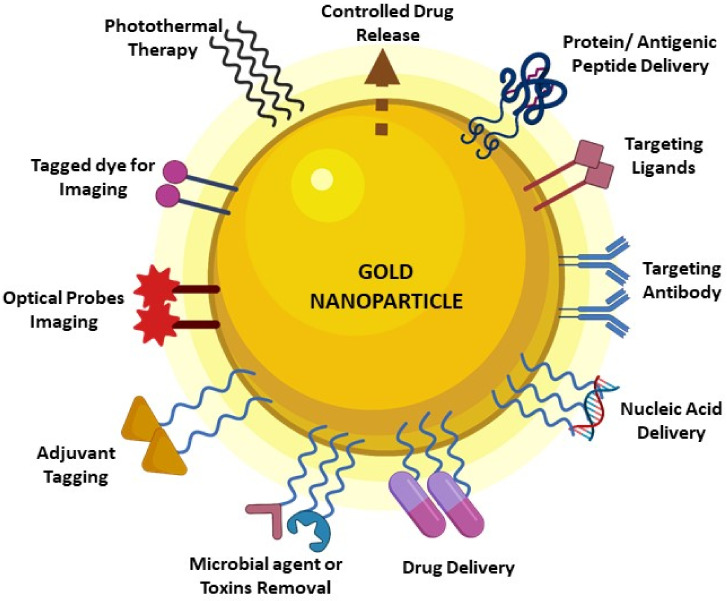
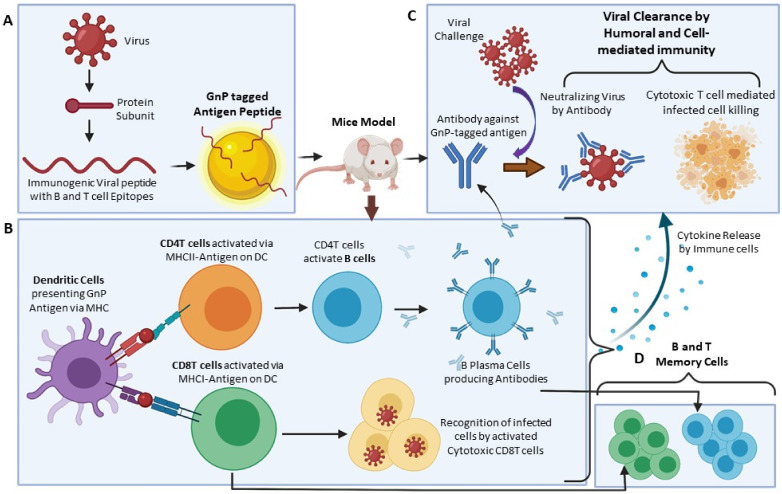
The use of nanoparticles for developing vaccines has become a routine process for researchers and pharmaceutical companies. Gold nanoparticles (GNPs) are chemical inert, have low toxicity, and are easy to modify and functionalize, making them an attractive choice for nanovaccine development. GNPs are modified for diagnostics and detection of many pathogens. The biocompatibility and biodistribution properties of GNPs render them ideal for use in clinical settings. They have excellent immune modulatory and adjuvant properties. They have been used as the antigen carrier for the delivery system to a targeted site. Tagging them with antibodies can direct the drug or antigen-carrying GNPs to specific tissues or cells. The physicochemical properties of the GNP, together with its dynamic immune response based on its size, shape, surface charge, and optical properties, make it a suitable candidate for vaccine development. The clear outcome of modulating dendritic cells, T and B lymphocytes, which trigger cytokine release in the host, indicates GNPs' efficiency in combating pathogens. The high titer of IgG and IgA antibody subtypes and their enhanced capacity to neutralize pathogens are reported in multiple studies on GNP-based vaccine development. The major focus of this review is to illustrate the role of GNPs in developing nanovaccines against multiple infectious agents, ranging from viruses to bacteria and parasites. Although the use of GNPs has its shortcomings and a low but detectable level of toxicity, their benefits warrant investing more thought and energy into the development of novel vaccine strategies.
对于研究人员和制药公司而言,使用纳米颗粒开发疫苗已成为一个常规流程。金纳米颗粒(GNPs)具有化学惰性、低毒性,且易于修饰和功能化,这使其成为纳米疫苗开发的一个有吸引力的选择。GNPs被修饰用于多种病原体的诊断和检测。GNPs的生物相容性和生物分布特性使其非常适合用于临床环境。它们具有出色的免疫调节和佐剂特性。它们已被用作抗原载体,用于将递送系统输送到靶向部位。用抗体标记它们可以将携带药物或抗原的GNPs引导至特定组织或细胞。GNP的物理化学性质,以及基于其大小、形状、表面电荷和光学性质的动态免疫反应,使其成为疫苗开发的合适候选者。调节树突状细胞、T淋巴细胞和B淋巴细胞从而触发宿主细胞因子释放的明确结果,表明GNPs在对抗病原体方面的有效性。在多项基于GNP的疫苗开发研究中,均报道了高滴度的IgG和IgA抗体亚型及其增强的中和病原体能力。本综述的主要重点是阐述GNPs在开发针对多种感染因子(从病毒到细菌和寄生虫)的纳米疫苗中的作用。尽管使用GNPs存在缺点且有低但可检测到的毒性水平,但其益处值得在新型疫苗策略的开发中投入更多的思考和精力。