Pai Che-Sheng, Wang Cheng-Yuan, Hung Wei-Wen, Hung Wei-Chun, Tsai Hui-Ju, Chang Chen-Chia, Hwang Shang-Jyh, Dai Chia-Yen, Ho Wen-Yu, Tsai Yi-Chun
Department of Internal Medicine, Division of Endocrinology and Metabolism, Kaohsiung Medical University Hospital, Kaohsiung Medical University, Kaohsiung 807, Taiwan.
Department of Internal Medicine, Division of General Medicine, Kaohsiung Medical University, Kaohsiung Medical University Hospital, Kaohsiung 807, Taiwan.
J Pers Med. 2022 Apr 11;12(4):617. doi: 10.3390/jpm12040617.
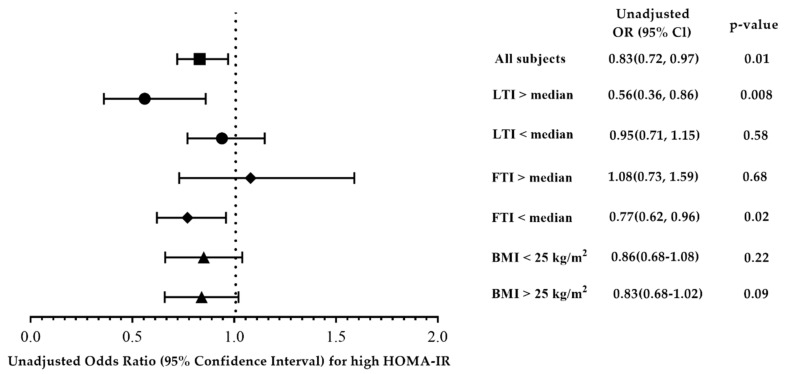
Metabolic syndrome (MS) has been an important health issue in the world, and insulin resistance (IR) is one of the characteristics of MS, increasing the risk for the onset and poor prognosis of type 2 diabetes mellitus (T2D). However, the interactional effect of obesity or abnormal body composition on the correlation between gut microbiota and IR in T2D patients is not well-explored. This cross-sectional study used a body composition monitor to evaluate lean tissue mass and fat tissue mass. IR was calculated using homeostatic model assessment-insulin resistance (HOMA-IR). Eight pairs of 16S rRNA gene primers specific to , , group, , , , , and were utilized to measure their abundance by qPCR. One hundred and fifty-four T2D patients were enrolled and stratified by the median HOMA-IR (2.5) and body mass index (BMI) of 25 kg/m. A lower abundance of was found in T2D patients with high HOMA-IR and BMI respectively. HOMA-IR and BMI had a synergistic effect on the reduction of the abundance of . After adjusting metabolic factors, the low abundance of significantly increased the risk for greater severity of IR. Furthermore, the negative correlation between and IR was only found in T2D patients with high lean tissue. In conclusion, decreased abundance of fecal enhanced the severity of IR in Asians with T2D, especially those having lean mass, and this significant relationship was independent of obesity.
代谢综合征(MS)一直是全球重要的健康问题,胰岛素抵抗(IR)是MS的特征之一,会增加2型糖尿病(T2D)发病及预后不良的风险。然而,肥胖或身体成分异常对T2D患者肠道微生物群与IR之间相关性的交互作用尚未得到充分研究。这项横断面研究使用身体成分监测仪评估瘦组织质量和脂肪组织质量。采用稳态模型评估胰岛素抵抗(HOMA-IR)计算IR。使用八对分别针对 、 、 组、 、 、 、 、 和 的16S rRNA基因引物,通过qPCR测量它们的丰度。纳入154例T2D患者,并根据HOMA-IR中位数(2.5)和体重指数(BMI)25 kg/m²进行分层。分别在HOMA-IR和BMI较高的T2D患者中发现 丰度较低。HOMA-IR和BMI对 丰度的降低具有协同作用。调整代谢因素后, 丰度低显著增加了IR更严重的风险。此外,仅在瘦组织含量高的T2D患者中发现 与IR呈负相关。总之,粪便中 丰度降低会加重亚洲T2D患者的IR严重程度,尤其是那些瘦体重者,且这种显著关系独立于肥胖。