Hagan John Elvis, Quansah Frank, Frimpong James Boadu, Ankomah Francis, Srem-Sai Medina, Schack Thomas
Department of Health, Physical Education and Recreation, University of Cape Coast, Cape Coast PMB TF0494, Ghana.
Neurocognition and Action-Biomechanics-Research Group, Faculty of Psychology and Sports Science, Bielefeld University, Postfach 10 01 31, 33501 Bielefeld, Germany.
Healthcare (Basel). 2022 Apr 6;10(4):687. doi: 10.3390/healthcare10040687.
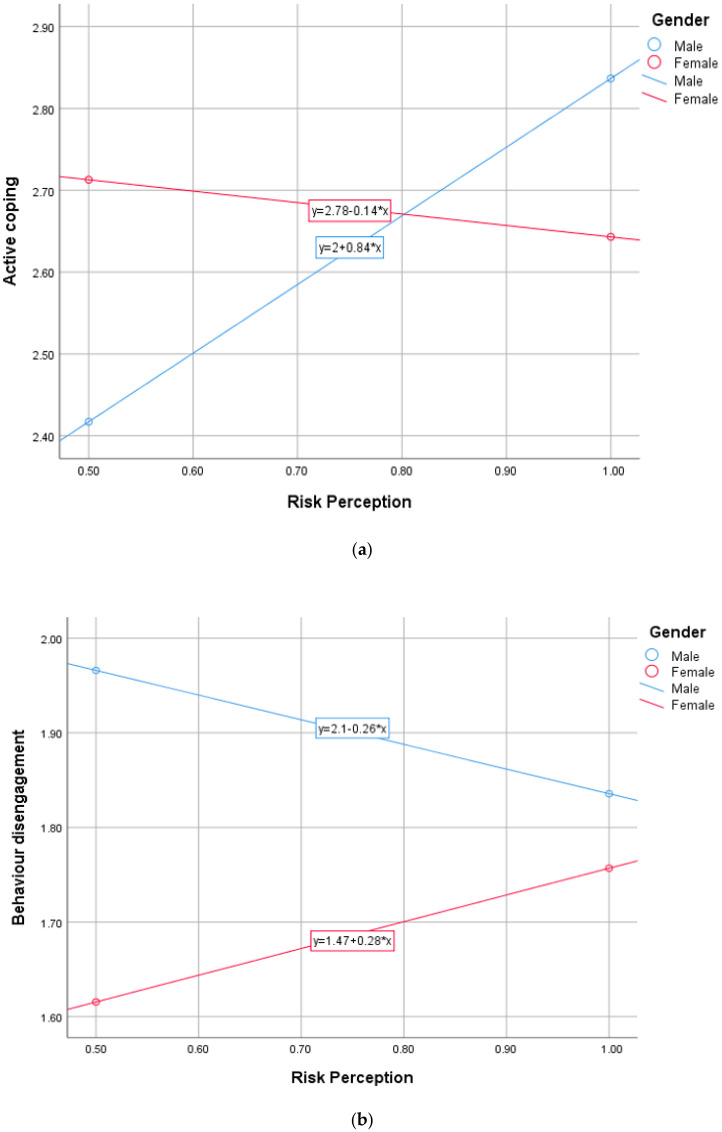
Recent research has shown that gender is an important driver of the risk of mortality and morbidity rates for people with COVID-19, with case fatality rates being higher for women than men. Despite this pattern, research is sparse on gender risk perception and potential coping mechanisms. This study examined the role gender plays in the relationship between COVID-19 risk perception and coping mechanisms among university students. Through the adoption of traditional and online surveys, 859 students from two public universities in Ghana were conveniently selected to respond to the survey instrument. The results from the multivariate regression analysis revealed that COVID-19 risk perception was positively related to active coping. The outcome of the moderation analysis showed that while males were more likely than females to adopt active and emotional support coping with heightened risk perception, a contrary outcome was observed for behaviour disengagement. This result is an indication that female students are likely to be overwhelmed with a high level of risk perception and easily give up trying to adopt effective strategies to reduce the effect of the COVID-19 pandemic situation. The findings highlight the need for different forms of intervention for male and female students for dealing with the effect of COVID-19.
近期研究表明,性别是新冠病毒感染者死亡风险和发病率的一个重要驱动因素,女性的病死率高于男性。尽管存在这种模式,但关于性别风险认知和潜在应对机制的研究却很少。本研究考察了性别在大学生对新冠病毒风险认知与应对机制之间的关系中所起的作用。通过采用传统调查和在线调查的方式,从加纳两所公立大学方便地选取了859名学生来回答调查问卷。多元回归分析结果显示,对新冠病毒的风险认知与积极应对呈正相关。调节分析结果表明,虽然在风险认知增强时,男性比女性更有可能采用积极应对和情感支持应对方式,但在行为脱离方面却观察到相反的结果。这一结果表明,女学生可能会因高度的风险认知而不堪重负,并容易放弃尝试采用有效策略来减轻新冠疫情形势的影响。研究结果凸显了针对男女生采取不同形式干预措施以应对新冠疫情影响的必要性。