Hartson Kimberly R, Della Lindsay J, King Kristi M, Liu Sam, Newquist Paige N, Rhodes Ryan E
School of Nursing, University of Louisville, Louisville, KY 40202, USA.
Department of Communication, University of Louisville, Louisville, KY 40292, USA.
Healthcare (Basel). 2022 Apr 9;10(4):700. doi: 10.3390/healthcare10040700.
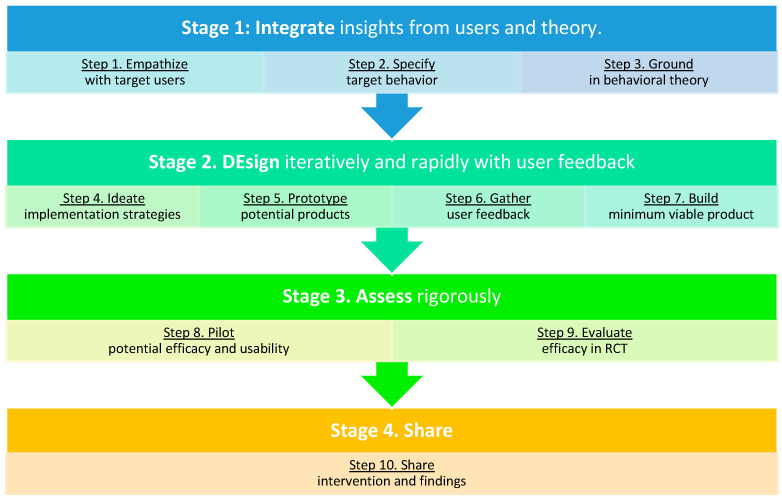
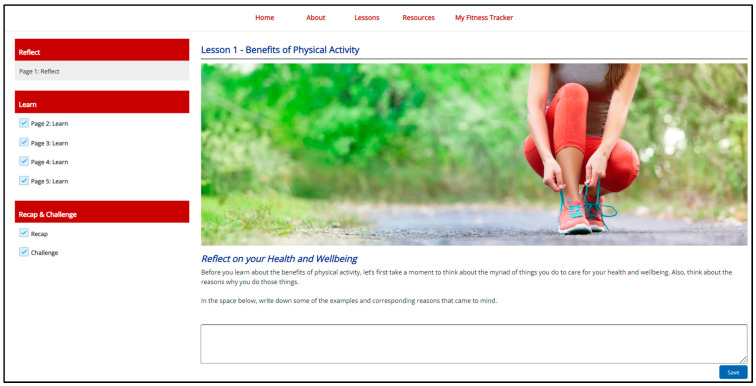
User-centered developmental processes are critical to ensuring acceptability of e-health behavioral interventions, and yet physical activity research continues to be inundated with top-down developmental approaches. The IDEAS (Integrate, Design, Assess, and Share) framework outlines a user-centered process for development of e-health interventions. The purpose of this manuscript is to describe the application of the IDEAS framework in adapting a web-based physical activity intervention for young adult college students. Steps 1-3 emphasized and Steps 4-7 focused on . Data were collected via repeat qualitative interviews with young adult college students ( = 7). Resulting qualitative metathemes were engagement, accountability, and cultural fit. Therefore, intervention modifications focused on strategies to foster ongoing engagement with the program (e.g., increase interactivity), support personal and social accountability (e.g., private social media group), and provide a cultural fit within the college lifestyle (e.g., images relevant to student life). The resulting web-based intervention included eight weekly lessons, an expanded resource library, "how-to" videos, step and goal trackers, and a private social media group to be led by a wellness coach. In conclusion, the IDEAS framework guided an efficient, user-centered adaptation process that integrated empirical evidence and behavior change theory with user preferences and feedback. Furthermore, the process allowed us to address barriers to acceptability during the design and build stages rather than at later stages of pilot and efficacy testing.
以用户为中心的开发过程对于确保电子健康行为干预措施的可接受性至关重要,然而体育活动研究仍然充斥着自上而下的开发方法。IDEAS(整合、设计、评估和分享)框架概述了一种以用户为中心的电子健康干预措施开发过程。本手稿的目的是描述IDEAS框架在为年轻成年大学生改编基于网络的体育活动干预措施中的应用。步骤1至3强调 ,步骤4至7关注 。通过对年轻成年大学生(n = 7)进行重复定性访谈收集数据。产生的定性元主题是参与度、责任感和文化适应性。因此,干预措施的修改侧重于促进与该计划持续互动的策略(例如,增加互动性)、支持个人和社会责任感(例如,私人社交媒体群组)以及在大学生活方式中提供文化适应性(例如,与学生生活相关的图片)。最终形成的基于网络的干预措施包括八节每周课程、一个扩充的资源库、“操作方法”视频、步数和目标追踪器以及一个由健康教练领导的私人社交媒体群组。总之,IDEAS框架指导了一个高效的、以用户为中心的改编过程,该过程将实证证据和行为改变理论与用户偏好和反馈相结合。此外,该过程使我们能够在设计和构建阶段而非试点和效果测试的后期阶段解决可接受性方面的障碍。