Freebairn Louise, Song Yun Ju Christine, Occhipinti Jo-An, Huntley Samantha, Dudgeon Pat, Robotham Julie, Lee Grace Yeeun, Hockey Samuel, Gallop Geoff, Hickie Ian B
Brain and Mind Centre, Faculty of Medicine and Health, University of Sydney, 94 Mallett Street, Camperdown, Sydney, NSW, 2050, Australia.
Research School of Public Health, Australian National University, Canberra, Australia.
Int J Ment Health Syst. 2022 Apr 25;16(1):20. doi: 10.1186/s13033-022-00530-1.
There is a significant push to change the trajectory of youth mental ill-health and suicide globally. Ensuring that young people have access to services that meet their individual needs and are easily accessible is a priority. Genuine stakeholder engagement in mental health system design is critical to ensure that system strengthening is likely to be successful within these complex environments. There is limited literature describing engagement processes undertaken by research teams in mental health program implementation and planning. This protocol describes the methods that will be used to engage local communities using systems science methods to mobilize knowledge and action to strengthen youth mental health services.
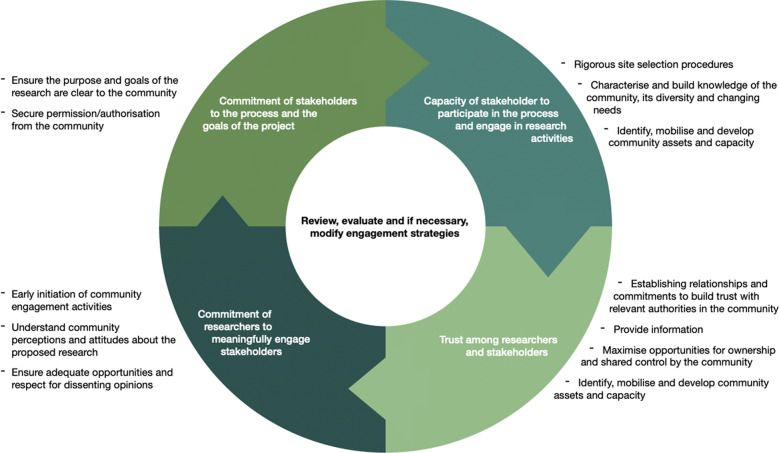
Using participatory action research principles, the research team will actively engage with local communities to ensure genuine user-led participatory systems modelling processes and enhance knowledge mobilisation within research sites. Ensuring that culturally diverse and Aboriginal and Torres Strait Islander community voices are included will support this process. A rigorous site selection process will be undertaken to ensure that the community is committed and has capacity to actively engage in the research activities. Stakeholder engagement commences from the site selection process with the aim to build trust between researchers and key stakeholders. The research team will establish a variety of engagement resources and make opportunities available to each site depending on their local context, needs and audiences they wish to target during the process.
This protocol describes the inclusive community engagement and knowledge mobilization process for the Right care, first time, where you live research Program. This Program will use an iterative and adaptive approach that considers the social, economic, and political context of each community and attempts to maximise research engagement. A theoretical framework for applying systems approaches to knowledge mobilization that is flexible will enable the implementation of a participatory action research approach. This protocol commits to a rigorous and genuine stakeholder engagement process that can be applied in mental health research implementation.
全球正在大力推动改变青少年心理健康不良和自杀的趋势。确保年轻人能够获得满足其个人需求且易于获取的服务是当务之急。利益相关者真正参与心理健康系统设计对于确保在这些复杂环境中加强系统建设取得成功至关重要。描述研究团队在心理健康项目实施和规划中所开展的参与过程的文献有限。本方案描述了将用于通过系统科学方法让当地社区参与进来,以调动知识和行动来加强青少年心理健康服务的方法。
研究团队将运用参与式行动研究原则,积极与当地社区互动,以确保真正由用户主导的参与式系统建模过程,并加强研究地点内的知识调动。确保纳入文化多元以及原住民和托雷斯海峡岛民社区的声音将有助于这一过程。将进行严格的选址过程,以确保社区有意愿且有能力积极参与研究活动。利益相关者参与从选址过程开始,目的是在研究人员和关键利益相关者之间建立信任。研究团队将根据每个地点的当地情况、需求以及他们在此过程中希望针对的受众,建立各种参与资源并提供机会。
本方案描述了“在你生活的地方,首次获得正确护理”研究项目的包容性社区参与和知识调动过程。该项目将采用迭代和适应性方法,考虑每个社区的社会、经济和政治背景,并试图最大限度地提高研究参与度。一个灵活的将系统方法应用于知识调动的理论框架将有助于实施参与式行动研究方法。本方案致力于一个可应用于心理健康研究实施的严格且真正的利益相关者参与过程。