Freebairn Louise, Occhipinti Jo-An, Song Yun Ju C, Skinner Adam, Lawson Kenny, Lee Grace Yeeun, Hockey Samuel J, Huntley Samantha, Hickie Ian B
Brain and Mind Centre, Faculty of Medicine and Health, University of Sydney, Camperdown, Australia.
Computer Simulation & Advanced Research Technologies (CSART), Sydney, Australia.
JMIR Res Protoc. 2022 Feb 7;11(2):e32988. doi: 10.2196/32988.
Despite significant investment, mental health issues remain a leading cause of death among young people globally. Sophisticated decision analysis methods are needed to better understand the dynamic and multisector drivers of youth mental health. System modeling can help explore complex issues such as youth mental health and inform strategies to effectively respond to local needs and achieve lasting improvements. The advantages of engaging stakeholders in model development processes have long been recognized; however, the methods for doing so are often not well-described.
This paper aims to describe the participatory procedures that will be used to support systems modeling for national multisite implementation. The Right Care, First Time, Where You Live research program will focus on regional youth mental health applications of systems modeling in 8 different sites across Australia.
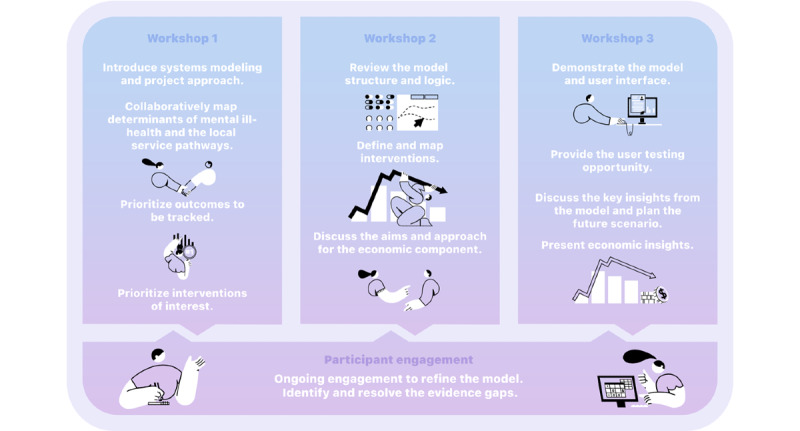
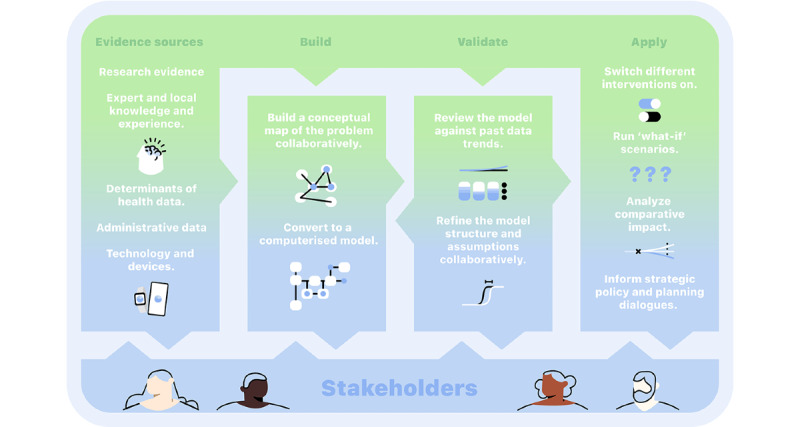
The participatory model development approach involves an iterative process of engaging with a range of participants, including people with lived experience of mental health issues. Their knowledge of the local systems, pathways, and drivers is combined with the academic literature and data to populate the models and validate their structure. The process centers around 3 workshops where participants interact and actively engage in group model-building activities to define, refine, and validate the systems models. This paper provides a detailed blueprint for the implementation of this process for mental health applications.
The participatory modeling methods described in this paper will be implemented at 2 sites per year from 2022 to 2025. The 8 selected sites have been chosen to capture variations in important factors, including determinants of mental health issues and access to services. Site engagement commenced in August 2021, and the first modeling workshops are scheduled to commence in February 2022.
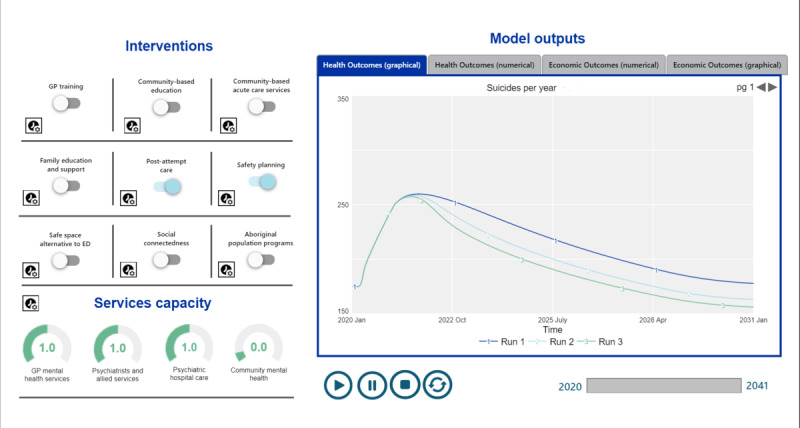
Mental health system decision makers require tools to help navigate complex environments and leverage interdisciplinary problem-solving. Systems modeling can mobilize data from diverse sources to explore a range of scenarios, including the impact of interventions in different combinations and contexts. Involving stakeholders in the model development process ensures that the model findings are context-relevant and fit-for-purpose to inform decision-making.
INTERNATIONAL REGISTERED REPORT IDENTIFIER (IRRID): PRR1-10.2196/32988.
尽管投入巨大,但心理健康问题仍是全球年轻人死亡的主要原因之一。需要先进的决策分析方法来更好地理解青少年心理健康的动态和多部门驱动因素。系统建模有助于探索诸如青少年心理健康等复杂问题,并为有效应对当地需求和实现持久改善的策略提供信息。让利益相关者参与模型开发过程的优势早已得到认可;然而,这样做的方法往往没有得到很好的描述。
本文旨在描述将用于支持全国多地点实施的系统建模的参与式程序。“正确护理,就在您居住的地方,首次尝试”研究计划将专注于澳大利亚8个不同地点的系统建模在区域青少年心理健康方面的应用。
参与式模型开发方法涉及与一系列参与者(包括有心理健康问题亲身经历的人)进行迭代过程。他们对当地系统、途径和驱动因素的了解与学术文献和数据相结合,以填充模型并验证其结构。该过程围绕3个研讨会展开,参与者在这些研讨会上进行互动并积极参与小组模型构建活动,以定义、完善和验证系统模型。本文为该过程在心理健康应用中的实施提供了详细蓝图。
本文所述的参与式建模方法将于2022年至2025年每年在2个地点实施。选择的8个地点旨在捕捉重要因素的差异,包括心理健康问题的决定因素和服务可及性。地点参与于2021年8月开始,首次建模研讨会计划于2022年2月开始。
心理健康系统决策者需要工具来帮助应对复杂环境并利用跨学科解决问题的方法。系统建模可以整合来自不同来源的数据,以探索一系列情景,包括不同组合和背景下干预措施的影响。让利益相关者参与模型开发过程可确保模型结果与背景相关且适用于决策。
国际注册报告识别号(IRRID):PRR1-10.2196/32988