Torrens-Burton Anna, Goss Silvia, Sutton Eileen, Barawi Kali, Longo Mirella, Seddon Kathy, Carduff Emma, Farnell Damian J J, Nelson Annmarie, Byrne Anthony, Phillips Rhiannon, Selman Lucy E, Harrop Emily
PRIME Centre Wales, Division of Population Medicine, School of Medicine, Cardiff University, Cardiff, UK.
Marie Curie Palliative Care Research Centre, Division of Population Medicine, School of Medicine, Cardiff University, Cardiff, UK.
Palliat Care Soc Pract. 2022 Apr 19;16:26323524221092456. doi: 10.1177/26323524221092456. eCollection 2022.
The COVID-19 pandemic has been a devastating, mass bereavement event characterised by high levels of disruption to end-of-life, grieving and coping processes. Quantitative evidence is emerging on the effects of the pandemic on grief outcomes, but rich qualitative evidence on the lived experiences of people bereaved during these times is lacking.
We analysed qualitative data from two independent UK-wide online surveys to describe the experiences of 881 people bereaved during the pandemic. We analysed the data in two phases, conducting an inductive thematic analysis and then applying Stroebe and Schut's Dual Process Model (DPM) and concepts of loss-oriented and restoration-oriented coping (1999; 2010) as an analytic lens to further contextualise and interpret the data.
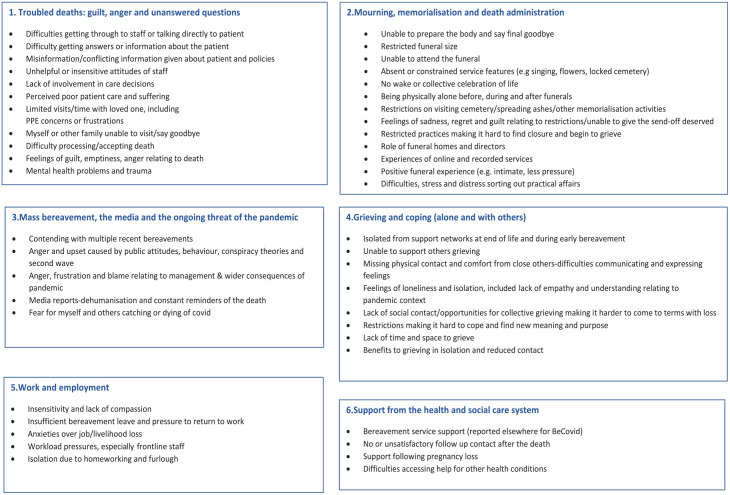
We identified six main themes: troubled deaths; mourning, memorialisation and death administration; mass bereavement, the media and the ongoing threat of the pandemic; grieving and coping; work and employment; and support from the health and social care system. Examples of loss-oriented stressors included being unable to visit and say goodbye at the end of life and restricted funeral and memorialisation practices. Associated reactions were feelings of guilt, anger, and problems accepting the death and beginning to grieve. Examples of restoration-oriented stressors and reactions were severely curtailed support-systems and social/recreational activities, which impacted people's ability to cope.
Study results demonstrate the exceptionally difficult sets of experiences associated with pandemic bereavement, and the utility of the DPM for conceptualising these additional challenges and their impacts on grieving. Our analysis builds and expands on previous use of the DPM in explicating the impact of the pandemic on bereavement. We make recommendations for statutory, private and third sector organisations for improving the experiences of people bereaved during and following this and future pandemics.
新冠疫情是一场毁灭性的大规模丧亲事件,其特点是临终、悲伤和应对过程受到高度干扰。关于疫情对悲伤结果影响的定量证据正在出现,但缺乏关于这段时期丧亲者生活经历的丰富定性证据。
我们分析了来自英国全国范围内两项独立在线调查的定性数据,以描述881名在疫情期间丧亲者的经历。我们分两个阶段分析数据,先进行归纳主题分析,然后应用斯特罗贝和舒特的双重过程模型(DPM)以及丧失导向和恢复导向应对的概念(1999年;2010年)作为分析视角,以进一步将数据置于背景中并进行解读。
我们确定了六个主要主题:麻烦的死亡;哀悼、纪念和死亡管理;大规模丧亲、媒体和疫情的持续威胁;悲伤和应对;工作与就业;以及来自健康和社会护理系统的支持。丧失导向压力源的例子包括临终时无法探视和道别,以及葬礼和纪念活动受到限制。相关反应包括内疚、愤怒的情绪,以及难以接受死亡和开始悲伤。恢复导向压力源和反应的例子包括支持系统和社交/娱乐活动大幅减少,这影响了人们的应对能力。
研究结果表明,与疫情丧亲相关的经历异常艰难,以及DPM在概念化这些额外挑战及其对悲伤的影响方面的效用。我们的分析在之前使用DPM解释疫情对丧亲影响的基础上进行了拓展。我们为法定、私营和第三部门组织提出建议,以改善在此及未来疫情期间和之后丧亲者的经历。