The State Key Laboratory Breeding Base of Basic Science of Stomatology (Hubei-MOST) & Key Laboratory of Oral Biomedicine Ministry of Education, School & Hospital of Stomatology, Wuhan University, Wuhan, China.
Department of Obstetrics and Gynecology, Hubei Provincial Hospital of Integrated Chinese and Western Medicine, Wuhan, China.
Biomed Res Int. 2022 Apr 14;2022:3918045. doi: 10.1155/2022/3918045. eCollection 2022.
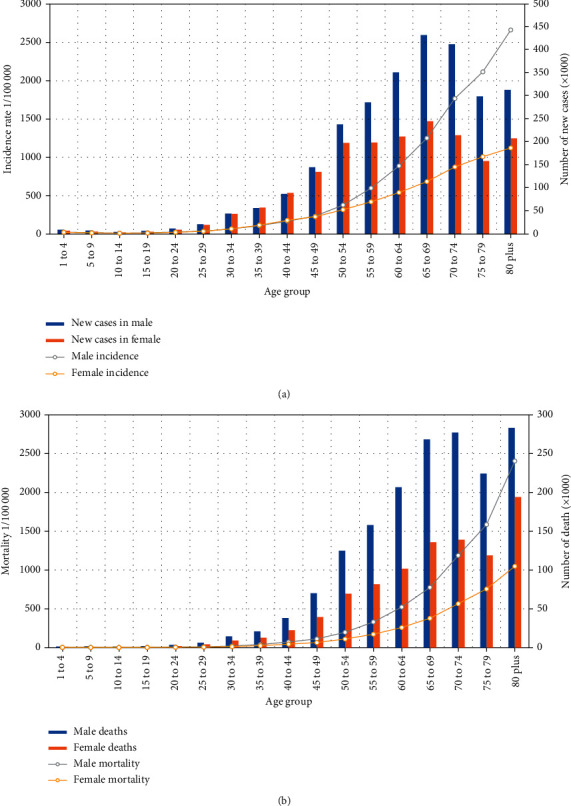
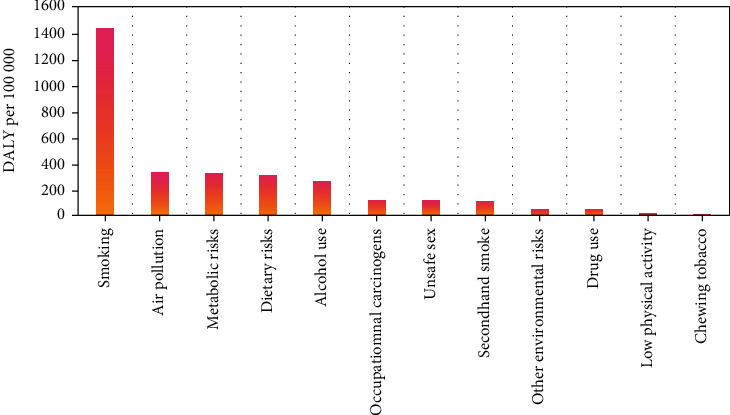
This study reports the risk factors, trends, and burden of cancer in China from 1990 to 2019 from the Global Burden of Diseases. The incidence, mortality, and DALY of all cancers in China for the past 30 years were analyzed. In 2019, the age-standardized rates (ASRs) of cancer incidence, mortality, and DALY in China were 232.42/100 000, 136.72/100 000, and 3288.22/100 000, respectively. The five cancers with the highest age-standardized incidence rates were lung, stomach, colorectal, breast, and prostate cancers. From 1990 to 2019, the number of new cancer cases, deaths, and DALY increased by 168.78%, 86.89%, and 51.20%, respectively. The ASR increased by 22.21% for incidence and decreased by 19.01% and 27.19% for mortality and DALY, respectively, and their corresponding average annual percent change values were 0.71, -0.80, and -1.26, respectively. The main risk factors for cancer in China were smoking, air pollution, dietary factors, and alcohol use. From 1990 to 2019, the cancer incidence rate was on the rise, and cancer mortality and DALY rates were declining; however, these characteristics vary by cancer site. Therefore, current prevention strategies should be reoriented, and specific strategies for cancers in different sites should be established to prevent the increase in cancer cases.
本研究报告了全球疾病负担研究中,1990 年至 2019 年中国癌症的风险因素、趋势和负担。分析了过去 30 年中国所有癌症的发病率、死亡率和伤残调整生命年。2019 年,中国癌症发病率、死亡率和伤残调整生命年的年龄标准化率(ASR)分别为 232.42/100000、136.72/100000 和 3288.22/100000。年龄标准化发病率最高的五种癌症是肺癌、胃癌、结直肠癌、乳腺癌和前列腺癌。1990 年至 2019 年,新癌症病例、死亡人数和伤残调整生命年分别增加了 168.78%、86.89%和 51.20%。发病率的 ASR 增加了 22.21%,死亡率和伤残调整生命年分别下降了 19.01%和 27.19%,相应的年均变化百分比值分别为 0.71、-0.80 和-1.26。中国癌症的主要危险因素是吸烟、空气污染、饮食因素和饮酒。1990 年至 2019 年,癌症发病率呈上升趋势,癌症死亡率和伤残调整生命年率呈下降趋势;然而,这些特征因癌症部位而异。因此,当前的预防策略应重新定位,并为不同部位的癌症制定具体的预防策略,以防止癌症病例的增加。