Lindhiem Oliver, Goel Mayank, Shaaban Sam, Mak Kristie J, Chikersal Prerna, Feldman Jamie, Harris Jordan L
Department of Psychiatry, School of Medicine, University of Pittsburgh, Pittsburgh, PA, United States.
Human-Computer Interaction Institute, School of Computer Science, Carnegie Mellon University, Pittsburgh, PA, United States.
JMIR Form Res. 2022 Apr 25;6(4):e35803. doi: 10.2196/35803.
Although hyperactivity is a core symptom of attention-deficit/hyperactivity disorder (ADHD), there are no objective measures that are widely used in clinical settings.
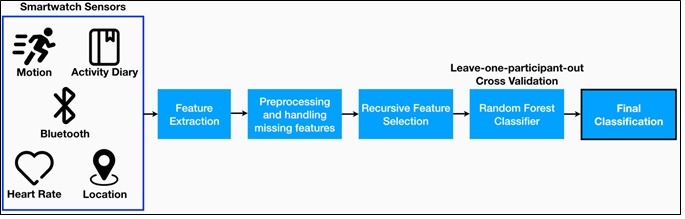
We describe the development of a smartwatch app to measure hyperactivity in school-age children. The LemurDx prototype is a software system for smartwatches that uses wearable sensor technology and machine learning to measure hyperactivity. The goal is to differentiate children with ADHD combined presentation (a combination of inattentive and hyperactive/impulsive presentations) or predominantly hyperactive/impulsive presentation from children with typical levels of activity.
In this pilot study, we recruited 30 children, aged 6 to 11 years, to wear a smartwatch with the LemurDx app for 2 days. Parents also provided activity labels for 30-minute intervals to help train the algorithm. Half of the participants had ADHD combined presentation or predominantly hyperactive/impulsive presentation (n=15), and half were in the healthy control group (n=15).
The results indicated high usability scores and an overall diagnostic accuracy of 0.89 (sensitivity=0.93; specificity=0.86) when the motion sensor output was paired with the activity labels.
State-of-the-art sensors and machine learning may provide a promising avenue for the objective measurement of hyperactivity.
尽管多动是注意缺陷多动障碍(ADHD)的核心症状,但在临床环境中并没有广泛使用的客观测量方法。
我们描述了一款用于测量学龄儿童多动情况的智能手表应用程序的开发。LemurDx原型是一个用于智能手表的软件系统,它利用可穿戴传感器技术和机器学习来测量多动情况。目标是将患有ADHD综合表现型(注意力不集中与多动/冲动表现相结合)或主要为多动/冲动表现型的儿童与活动水平正常的儿童区分开来。
在这项试点研究中,我们招募了30名6至11岁的儿童,让他们佩戴装有LemurDx应用程序的智能手表2天。家长们还按30分钟的间隔提供活动标签,以帮助训练算法。一半的参与者患有ADHD综合表现型或主要为多动/冲动表现型(n = 15),另一半为健康对照组(n = 15)。
结果显示,当运动传感器输出与活动标签配对时,可用性得分很高,总体诊断准确率为0.89(敏感性 = 0.93;特异性 = 0.86)。
先进的传感器和机器学习可能为多动的客观测量提供一条有前景的途径。