Brocki Barbara Cristina, Andreasen Jan Jesper, Aaroe Jens, Andreasen Jane, Thorup Charlotte Brun
Department of Physiotherapy and Occupational Therapy, Aalborg University Hospital, Aalborg, Denmark.
Department of Cardiothoracic Surgery, Aalborg University Hospital and Clinical Institute, Aalborg University, Aalborg, Denmark.
JMIR Rehabil Assist Technol. 2022 Apr 26;9(2):e34819. doi: 10.2196/34819.
The use of telehealth technology to improve functional recovery following transcatheter aortic valve implantation (TAVI) has not been investigated.
In this study, we aimed to examine the feasibility of exercise-based cardiac telerehabilitation after TAVI.
This was a single-center, prospective, nonrandomized study using a mixed methods approach. Data collection included testing, researchers' observations, logbooks, and individual patient interviews, which were analyzed using a content analysis approach. The intervention lasted 3 weeks and consisted of home-based web-based exercise training, an activity tracker, a TAVI information website, and 1 web-based session with a nurse.
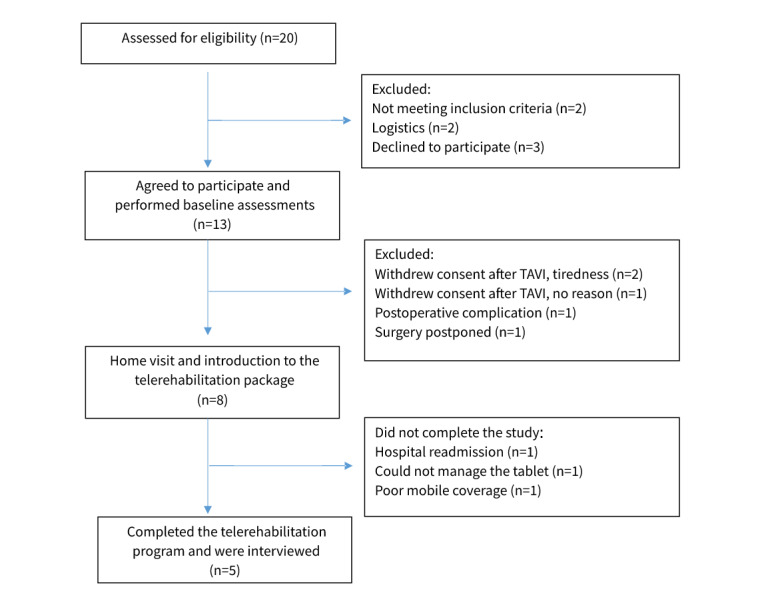
Of the initially included 13 patients, 5 (40%) completed the study and were interviewed; the median age was 82 (range 74-84) years, and the sample comprised 3 men and 2 women. Easy access to supervised exercise training at home with real-time feedback and use of the activity tracker to count daily steps were emphasized by the patients who completed the intervention. Reasons for patients not completing the program included poor data coverage, participants' limited information technology skills, and a lack of functionality in the systems used. No adverse events were reported.
Exercise-based telerehabilitation for older people after TAVI, in the population as included in this study, and delivered as a web-based intervention, does not seem feasible, as 60% (8/13) of patients did not complete the study. Those completing the intervention highly appreciated the real-time feedback during the web-based training sessions. Future studies should address aspects that support retention rates and enhance patients' information technology skills.
尚未对利用远程医疗技术改善经导管主动脉瓣植入术(TAVI)后的功能恢复情况进行研究。
在本研究中,我们旨在探讨TAVI术后基于运动的心脏远程康复的可行性。
这是一项采用混合方法的单中心、前瞻性、非随机研究。数据收集包括测试、研究人员的观察、日志以及个体患者访谈,并采用内容分析法进行分析。干预持续3周,包括居家基于网络的运动训练、一个活动追踪器、一个TAVI信息网站以及与一名护士进行的一次基于网络的交流。
最初纳入的13例患者中,5例(40%)完成了研究并接受了访谈;中位年龄为82岁(范围74 - 84岁),样本包括3名男性和2名女性。完成干预的患者强调了在家中易于获得有实时反馈的监督运动训练以及使用活动追踪器来计算每日步数。患者未完成该项目的原因包括数据覆盖差、参与者的信息技术技能有限以及所用系统功能不足。未报告不良事件。
对于本研究纳入人群中TAVI术后的老年人,以基于网络的干预方式进行基于运动的远程康复似乎不可行,因为60%(8/13)的患者未完成研究。完成干预的患者高度赞赏基于网络的训练课程中的实时反馈。未来的研究应解决有助于提高留存率和增强患者信息技术技能的方面。