Rensselaer Polytechnic Institute, Department of Biomedical Engineering, Troy, New York, United States.
J Biomed Opt. 2022 Apr;27(8). doi: 10.1117/1.JBO.27.8.083016.
Deep learning (DL) models are being increasingly developed to map sensor data to the image domain directly. However, DL methodologies are data-driven and require large and diverse data sets to provide robust and accurate image formation performances. For research modalities such as 2D/3D diffuse optical imaging, the lack of large publicly available data sets and the wide variety of instrumentation designs, data types, and applications leads to unique challenges in obtaining well-controlled data sets for training and validation. Meanwhile, great efforts over the last four decades have focused on developing accurate and computationally efficient light propagation models that are flexible enough to simulate a wide variety of experimental conditions.
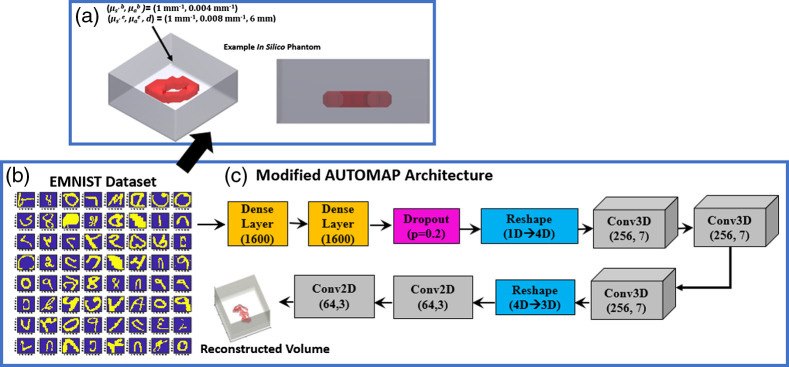
Recent developments in Monte Carlo (MC)-based modeling offer the unique advantage of simulating accurately light propagation spatially, temporally, and over an extensive range of optical parameters, including minimally to highly scattering tissue within a computationally efficient platform. Herein, we demonstrate how such MC platforms, namely "Monte Carlo eXtreme" and "Mesh-based Monte Carlo," can be leveraged to generate large and representative data sets for training the DL model efficiently.
We propose data generator pipeline strategies using these platforms and demonstrate their potential in fluorescence optical topography, fluorescence optical tomography, and single-pixel diffuse optical tomography. These applications represent a large variety in instrumentation design, sample properties, and contrast function.
DL models trained using the MC-based in silico datasets, validated further with experimental data not used during training, show accurate and promising results.
Overall, these MC-based data generation pipelines are expected to support the development of DL models for rapid, robust, and user-friendly image formation in a wide variety of applications.
深度学习(DL)模型正越来越多地被开发出来,以便直接将传感器数据映射到图像域。然而,DL 方法是数据驱动的,需要大型且多样化的数据集,以提供稳健且准确的图像形成性能。对于 2D/3D 漫射光学成像等研究模式,缺乏大型公共可用数据集以及仪器设计、数据类型和应用的广泛多样性,导致在获得用于训练和验证的良好控制数据集方面存在独特的挑战。与此同时,在过去的四十年中,人们付出了巨大的努力来开发准确且计算效率高的光传播模型,这些模型具有足够的灵活性,可以模拟各种实验条件。
基于蒙特卡罗(MC)的建模的最新进展提供了一个独特的优势,即可以准确地模拟光在空间、时间和广泛的光学参数范围内的传播,包括在计算效率高的平台中对最小到高度散射的组织进行模拟。在此,我们展示了如何利用这些 MC 平台,即“Monte Carlo eXtreme”和“基于网格的蒙特卡罗”,来有效地生成大型且具有代表性的数据集,以训练 DL 模型。
我们提出了使用这些平台的数据集生成器管道策略,并在荧光光学层析成像、荧光光学层析成像和单像素漫射光学层析成像中展示了它们的潜力。这些应用代表了仪器设计、样品性质和对比度函数的多样性。
使用基于 MC 的计算机模拟数据集训练的 DL 模型,进一步用未在训练中使用的实验数据进行验证,显示出准确且有前途的结果。
总的来说,这些基于 MC 的数据生成管道有望支持 DL 模型的开发,以便在各种应用中快速、稳健且用户友好地进行图像形成。