Northeastern Univ., United States.
Analogic Corp., United States.
J Biomed Opt. 2022 May;27(8). doi: 10.1117/1.JBO.27.8.083019.
The Monte Carlo (MC) method is widely used as the gold-standard for modeling light propagation inside turbid media, such as human tissues, but combating its inherent stochastic noise requires one to simulate a large number photons, resulting in high computational burdens.
We aim to develop an effective image denoising technique using deep learning (DL) to dramatically improve the low-photon MC simulation result quality, equivalently bringing further acceleration to the MC method.
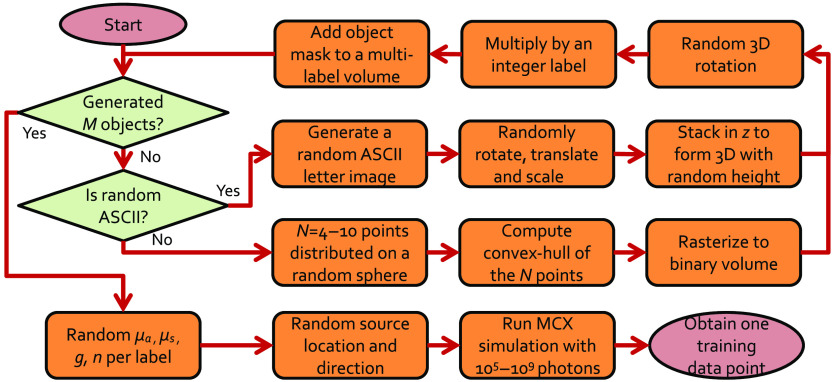
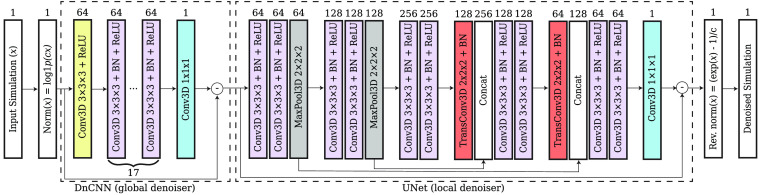
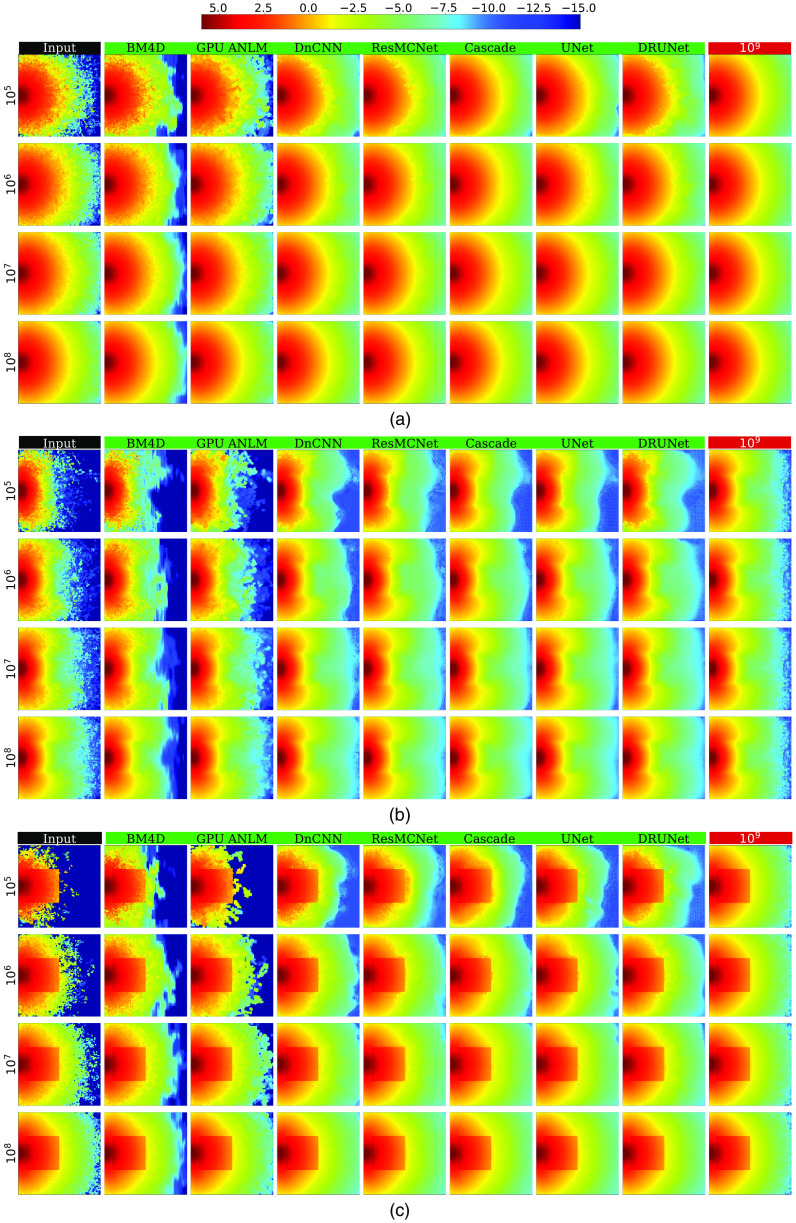
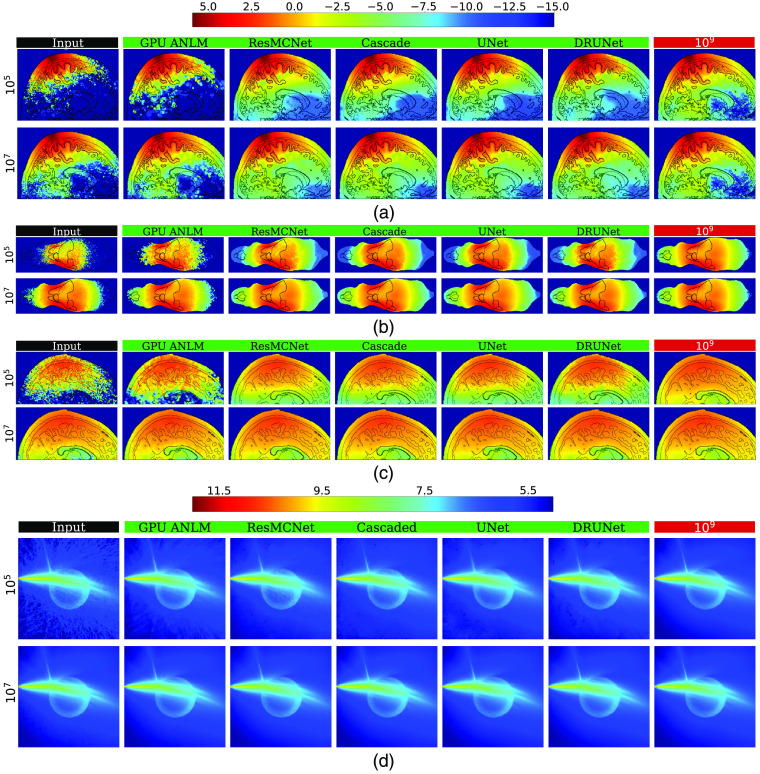
We developed a cascade-network combining DnCNN with UNet, while extending a range of established image denoising neural-network architectures, including DnCNN, UNet, DRUNet, and deep residual-learning for denoising MC renderings (ResMCNet), in handling three-dimensional MC data and compared their performances against model-based denoising algorithms. We also developed a simple yet effective approach to creating synthetic datasets that can be used to train DL-based MC denoisers.
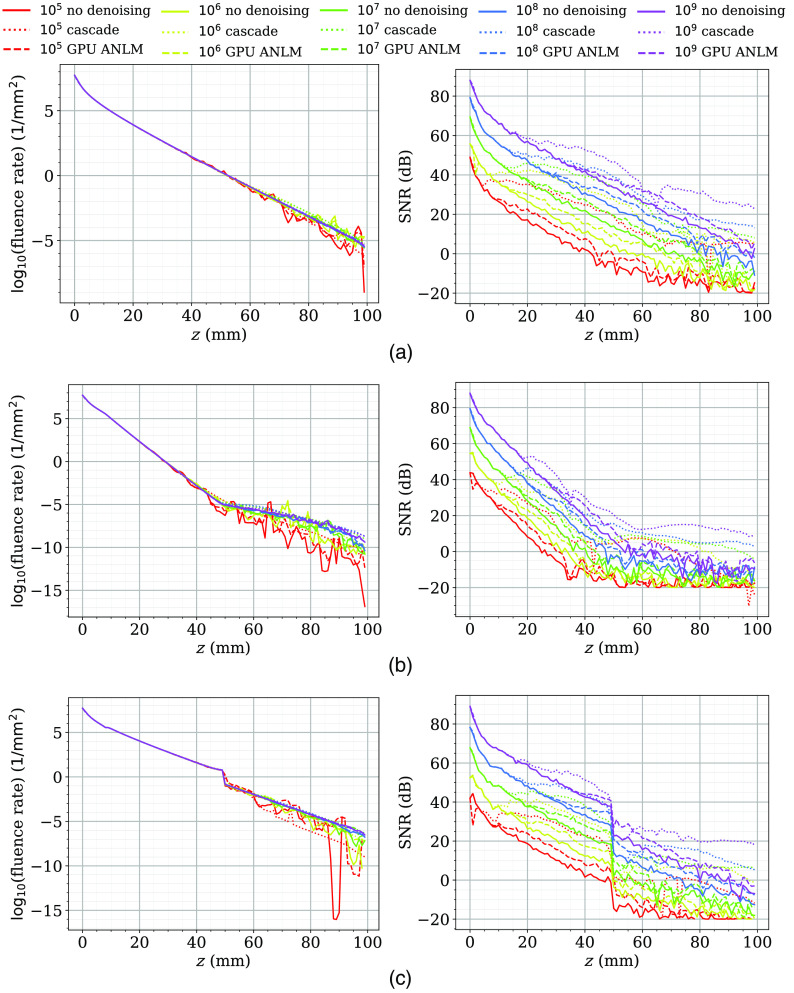
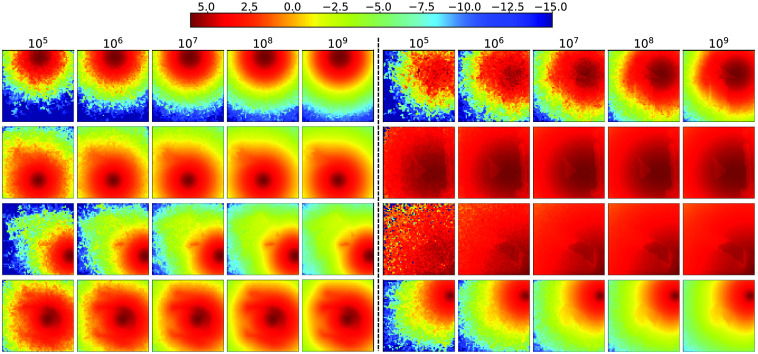
Overall, DL-based image denoising algorithms exhibit significantly higher image quality improvements over traditional model-based denoising algorithms. Among the tested DL denoisers, our cascade network yields a 14 to 19 dB improvement in signal-to-noise ratio, which is equivalent to simulating 25 × to 78 × more photons. Other DL-based methods yielded similar results, with our method performing noticeably better with low-photon inputs and ResMCNet along with DRUNet performing better with high-photon inputs. Our cascade network achieved the highest quality when denoising complex domains, including brain and mouse atlases.
Incorporating state-of-the-art DL denoising techniques can equivalently reduce the computation time of MC simulations by one to two orders of magnitude. Our open-source MC denoising codes and data can be freely accessed at http://mcx.space/.
蒙特卡罗(MC)方法被广泛用作模拟混浊介质(如人体组织)内光传播的金标准,但要克服其固有的随机噪声,需要模拟大量光子,从而导致计算负担很高。
我们旨在开发一种有效的基于深度学习(DL)的图像去噪技术,以显著提高低光子 MC 模拟结果的质量,从而为 MC 方法带来进一步的加速。
我们开发了一个级联网络,结合了 DnCNN 和 UNet,同时扩展了一系列成熟的图像去噪神经网络架构,包括 DnCNN、UNet、DRUNet 和用于去噪 MC 渲染的深度残差学习(ResMCNet),以处理三维 MC 数据,并将它们的性能与基于模型的去噪算法进行比较。我们还开发了一种简单而有效的方法来创建可用于训练基于 DL 的 MC 去噪器的合成数据集。
总体而言,基于 DL 的图像去噪算法在图像质量改善方面明显优于传统的基于模型的去噪算法。在所测试的 DL 去噪器中,我们的级联网络在信噪比方面提高了 14 到 19 分贝,相当于模拟了 25 到 78 倍更多的光子。其他基于 DL 的方法也得到了类似的结果,我们的方法在低光子输入时表现明显更好,ResMCNet 和 DRUNet 在高光子输入时表现更好。当去噪复杂域(包括大脑和小鼠图谱)时,我们的级联网络达到了最高的质量。
采用最先进的 DL 去噪技术可以将 MC 模拟的计算时间减少一到两个数量级。我们的开源 MC 去噪代码和数据可在 http://mcx.space/ 免费访问。