Faculty of Chemistry, Department of Advanced Material Technologies, Wroclaw University of Science and Technology, Wroclaw, Poland.
Poultry Department, Faculty of Agriculture, Zagazig University, Zagazig, Egypt.
Vet Q. 2022 Dec;42(1):68-94. doi: 10.1080/01652176.2022.2073399.
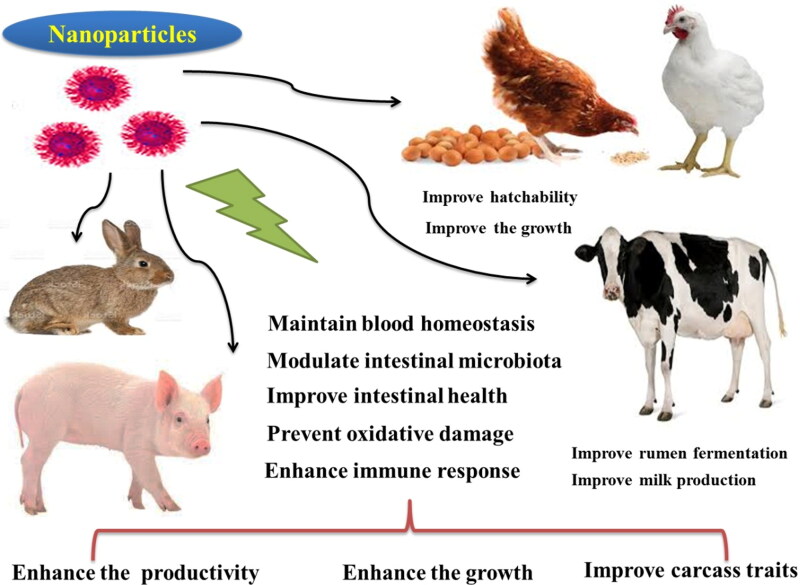
The application of high doses of mineral feed additives in the form of inorganic salts increases the growth performance of animals, but at the same, due to their low bioavailability, can contaminate the environment. Therefore, there is a need to find a replacement of administering high doses of minerals with an equally effective alternative. The application of lower doses of metal-containing nanoparticles with the same effect on animal production could be a potential solution. In the present review, zinc, silver, copper, gold, selenium, and calcium nanoparticles are discussed as potential feed additives for animals. Production of nanoparticles under laboratory conditions using traditional chemical and physical methods as well as green and sustainable methods - biosynthesis has been described. Special attention has been paid to the biological properties of nanoparticles, as well as their effect on animal health and performance. Nano-minerals supplemented to animal feed (poultry, pigs, ruminants, rabbits) acting as growth-promoting, immune-stimulating and antimicrobial agents have been highlighted. Metal nanoparticles are known to exert a positive effect on animal performance, productivity, carcass traits through blood homeostasis maintenance, intestinal microflora, oxidative damage prevention, enhancement of immune responses, etc. Metal-containing nanoparticles can also be a solution for nutrient deficiencies in animals (higher bioavailability and absorption) and can enrich animal products with microelements like meat, milk, or eggs. Metal-containing nanoparticles are proposed to partially replace inorganic salts as feed additives. However, issues related to their potential toxicity and safety to livestock animals, poultry, humans, and the environment should be carefully investigated.
高剂量的矿物饲料添加剂以无机盐的形式应用于动物,可提高动物的生长性能,但同时由于其生物利用度低,会污染环境。因此,需要寻找一种替代方法,即用同样有效的方法来替代高剂量的矿物质。使用同样对动物生产有效果的低剂量含金属纳米粒子可能是一种潜在的解决方案。在本综述中,讨论了锌、银、铜、金、硒和钙纳米粒子作为动物潜在饲料添加剂的应用。描述了在实验室条件下使用传统化学和物理方法以及绿色和可持续方法-生物合成生产纳米粒子。特别关注了纳米粒子的生物特性及其对动物健康和性能的影响。强调了补充到动物饲料中的纳米矿物质(家禽、猪、反刍动物、兔子)作为促生长、免疫刺激和抗菌剂的作用。已知金属纳米粒子通过维持血液内环境平衡、肠道微生物群、预防氧化损伤、增强免疫反应等,对动物的生产性能、生产力、胴体特征产生积极影响。含金属的纳米粒子还可以解决动物营养缺乏的问题(提高生物利用度和吸收度),并可以使肉类、牛奶或鸡蛋等动物产品富含微量元素。含金属的纳米粒子被提议部分替代无机盐作为饲料添加剂。但是,应仔细研究其对牲畜、家禽、人类和环境的潜在毒性和安全性问题。