Liu Elizabeth E, Suthahar Navin, Paniagua Samantha M, Wang Dongyu, Lau Emily S, Li Shawn X, Jovani Manol, Takvorian Katherine S, Kreger Bernard E, Benjamin Emelia J, Meijers Wouter C, Bakker Stephan J L, Kieneker Lyanne M, Gruppen Eke G, van der Vegt Bert, de Bock Geertruida H, Gansevoort Ron T, Hussain Shehnaz K, Hoffmann Udo, Splansky Greta Lee, Vasan Ramachandran S, Larson Martin G, Levy Daniel, Cheng Susan, de Boer Rudolf A, Ho Jennifer E
Cardiovascular Institute and Division of Cardiology, Department of Medicine, Beth Israel Deaconess Medical Center, Boston, Massachusetts, USA.
Department of Cardiology, University Medical Center Groningen, University of Groningen, Groningen, the Netherlands.
JACC CardioOncol. 2022 Mar 15;4(1):69-81. doi: 10.1016/j.jaccao.2022.01.095. eCollection 2022 Mar.
Obesity and cardiometabolic dysfunction have been associated with cancer risk and severity. Underlying mechanisms remain unclear.
The aim of this study was to examine associations of obesity and related cardiometabolic traits with incident cancer.
FHS (Framingham Heart Study) and PREVEND (Prevention of Renal and Vascular End-Stage Disease) study participants without prevalent cancer were studied, examining associations of obesity, body mass index (BMI), waist circumference, visceral adipose tissue (VAT) and subcutaneous adipose tissue depots, and C-reactive protein (CRP) with future cancer in Cox models.
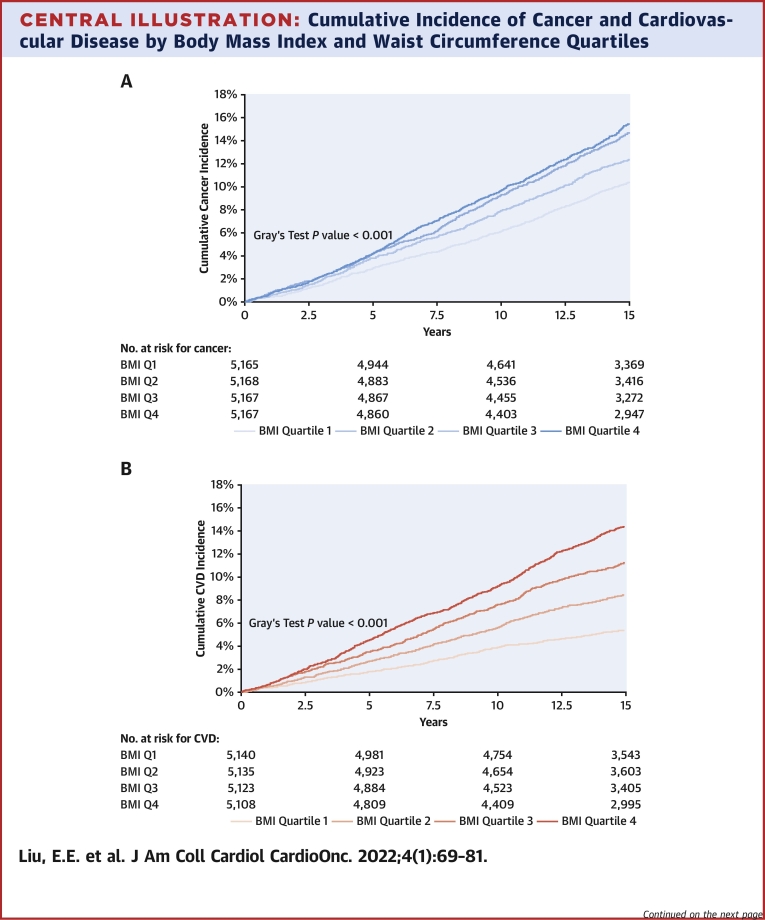
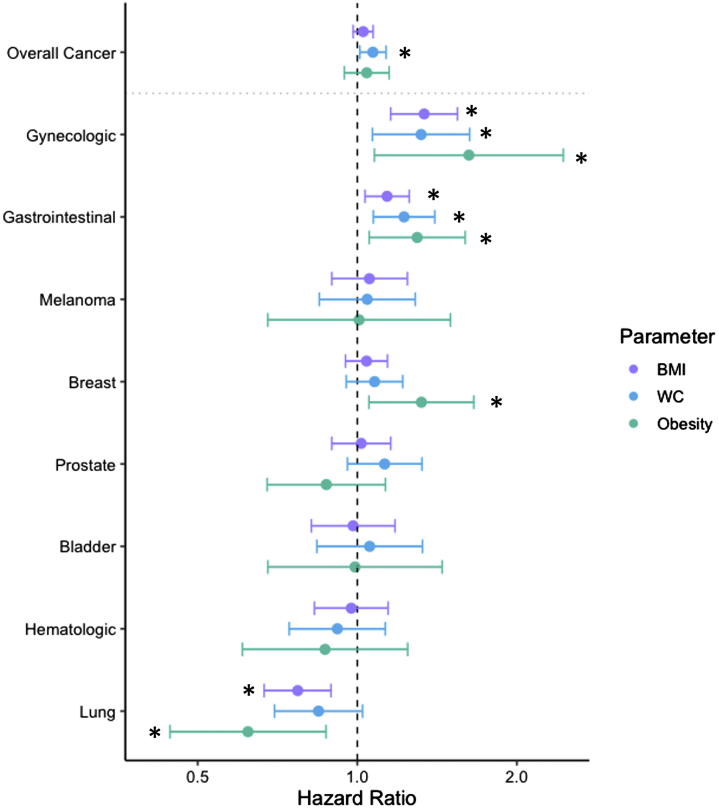
Among 20,667 participants (mean age 50 years, 53% women), 2,619 cancer events were observed over a median follow-up duration of 15 years. Obesity was associated with increased risk for future gastrointestinal (HR: 1.30; 95% CI: 1.05-1.60), gynecologic (HR: 1.62; 95% CI: 1.08-2.45), and breast (HR: 1.32; 95% CI: 1.05-1.66) cancer and lower risk for lung cancer (HR: 0.62; 95% CI: 0.44-0.87). Similarly, waist circumference was associated with increased risk for overall, gastrointestinal, and gynecologic but not lung cancer. VAT but not subcutaneous adipose tissue was associated with risk for overall cancer (HR: 1.22; 95% CI: 1.05-1.43), lung cancer (HR: 1.92; 95% CI: 1.01-3.66), and melanoma (HR: 1.56; 95% CI: 1.02-2.38) independent of BMI. Last, higher CRP levels were associated with higher risk for overall, colorectal, and lung cancer ( < 0.05 for all).
Obesity and abdominal adiposity are associated with future risk for specific cancers (eg, gastrointestinal, gynecologic). Although obesity was associated with lower risk for lung cancer, greater VAT and CRP were associated with higher lung cancer risk after adjusting for BMI.
肥胖和心脏代谢功能障碍与癌症风险及严重程度相关。潜在机制尚不清楚。
本研究旨在探讨肥胖及相关心脏代谢特征与新发癌症之间的关联。
对弗明汉心脏研究(FHS)和预防肾与血管终末期疾病研究(PREVEND)中无癌症病史的参与者进行研究,在Cox模型中检验肥胖、体重指数(BMI)、腰围、内脏脂肪组织(VAT)、皮下脂肪组织储存以及C反应蛋白(CRP)与未来患癌风险的关联。
在20667名参与者(平均年龄50岁,53%为女性)中,中位随访期15年期间共观察到2619例癌症事件。肥胖与未来患胃肠道癌(风险比:1.30;95%置信区间:1.05 - 1.60)、妇科癌(风险比:1.62;95%置信区间:1.08 - 2.45)和乳腺癌(风险比:1.32;95%置信区间:1.05 - 1.66)的风险增加相关,而与肺癌风险降低相关(风险比:0.62;95%置信区间:0.44 - 0.87)。同样,腰围与总体、胃肠道和妇科癌症风险增加相关,但与肺癌无关。VAT而非皮下脂肪组织与总体癌症风险(风险比:1.22;95%置信区间:1.05 - 1.43)、肺癌风险(风险比:1.92;95%置信区间:1.01 - 3.66)和黑色素瘤风险(风险比:1.56;95%置信区间:1.02 - 2.38)相关,且独立于BMI。最后,较高的CRP水平与总体、结直肠癌和肺癌风险增加相关(所有P值均<0.05)。
肥胖和腹部肥胖与未来特定癌症(如胃肠道癌、妇科癌)风险相关。尽管肥胖与肺癌风险降低相关,但在调整BMI后,较高的VAT和CRP与较高的肺癌风险相关。