Centre for Global Health Research, Unity Health Toronto and Dalla Lana School of Public Health, University of Toronto, Toronto, Ontario, Canada.
Institute of Health Policy, Management and Evaluation, University of Toronto, Toronto, Ontario, Canada.
BMJ Open. 2022 May 2;12(5):e058324. doi: 10.1136/bmjopen-2021-058324.
We sought to quantify the impact of vaping introduction on cigarette smoking across settings with varied regulatory approaches to vaping.
Interrupted time series analysis, adjusted for cigarette tax levels.
Four Canadian provinces, UK and Australia.
Entire population of smokers in each country.
The year that vaping was widely introduced in each country.
The primary outcome is cigarette consumption per adult, and the secondary outcome is smoking prevalence among young adults.
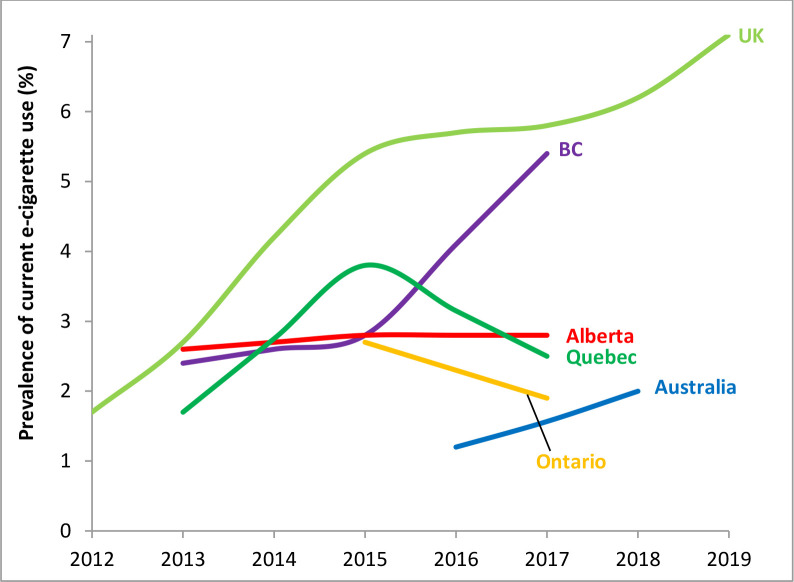
Based on allowable nicotine levels, restrictions on e-cigarette advertising, sales and access, and taxation, the least to most restrictive jurisdictions were, in order, Alberta, Ontario, Quebec and British Columbia (all in Canada), UK and Australia. In most, but not all, settings where higher nicotine content was permitted in vaping products (66 mg/mL), vaping introduction led to a reduction in cigarette consumption per capita (Ontario: p=0.037, Quebec: p=0.007) or in smoking prevalence among young adults (Alberta men, p=0.027; Quebec men, p=0.008; Quebec women, p=0.008). In the UK, where the maximum permitted nicotine content in vaping products was 20 mg/mL, vaping introduction slowed the declining trend in cigarette smoking among men aged 16-24 years (p=0.031) and 25-34 years (p=0.002) but not in cigarette consumption per adult. In Australia, where nicotine was not permitted in e-cigarettes, e-cigarette introduction slowed the declining trend in cigarette consumption per capita and in smoking prevalence among men aged 18-24 years (cigarette consumption: p=0.015, prevalence: p=0.044).
In environments that enable substitution of cigarettes with e-cigarettes, e-cigarette introduction reduces overall cigarette consumption. Thus, to reduce cigarette smoking, policies that encourage adults to substitute cigarette smoking with vaping should be considered.
我们旨在量化在采用不同电子烟监管方法的不同环境中,引入电子烟对吸烟的影响。
调整香烟税收水平的中断时间序列分析。
加拿大四个省、英国和澳大利亚。
每个国家的所有吸烟者。
每个国家广泛引入电子烟的年份。
主要结果是每个成年人的香烟消费,次要结果是年轻人的吸烟率。
根据允许的尼古丁水平、电子烟广告、销售和获取限制以及税收,限制最宽松到最严格的司法管辖区依次为艾伯塔省、安大略省、魁北克省和不列颠哥伦比亚省(均在加拿大)、英国和澳大利亚。在大多数但并非所有允许电子烟产品中尼古丁含量更高的环境中(66mg/ml),引入电子烟会导致人均香烟消费量减少(安大略省:p=0.037,魁北克省:p=0.007)或年轻人吸烟率下降(艾伯塔省男性,p=0.027;魁北克省男性,p=0.008;魁北克省女性,p=0.008)。在英国,电子烟产品允许的最大尼古丁含量为 20mg/ml,电子烟的引入减缓了 16-24 岁和 25-34 岁男性吸烟量的下降趋势(p=0.031 和 p=0.002),但并未减缓成年人的人均香烟消费量。在澳大利亚,电子烟中不允许含有尼古丁,电子烟的引入减缓了人均香烟消费量和 18-24 岁男性吸烟率的下降趋势(香烟消费:p=0.015,吸烟率:p=0.044)。
在能够用电子烟替代香烟的环境中,电子烟的引入会减少整体香烟消费。因此,为了减少吸烟,应该考虑鼓励成年人用电子烟替代香烟的政策。