Gene Expression and Therapy Group, King's College London, Faculty of Life Sciences & Medicine, Department of Medical and Molecular Genetics, Guy's Hospital, London, SE1 9RT, UK.
Department of Twin Research and Genetic Epidemiology, King's College London, London, UK.
Environ Health. 2022 May 3;21(1):46. doi: 10.1186/s12940-022-00860-0.
Dietary habits have a profound influence on the metabolic activity of gut microorganisms and their influence on health. Concerns have been raised as to whether the consumption of foodstuffs contaminated with pesticides can contribute to the development of chronic disease by affecting the gut microbiome. We performed the first pesticide biomonitoring survey of the British population, and subsequently used the results to perform the first pesticide association study on gut microbiome composition and function from the TwinsUK registry.
Dietary exposure of 186 common insecticide, herbicide, or fungicide residues and the faecal microbiome in 65 twin pairs in the UK was investigated. We evaluated if dietary habits, geographic location, or the rural/urban environment, are associated with the excretion of pesticide residues. The composition and metabolic activity of faecal microbiota was evaluated using shotgun metagenomics and metabolomics respectively. We performed a targeted urine metabolomics analysis in order to evaluate whether pesticide urinary excretion was also associated with physiological changes.
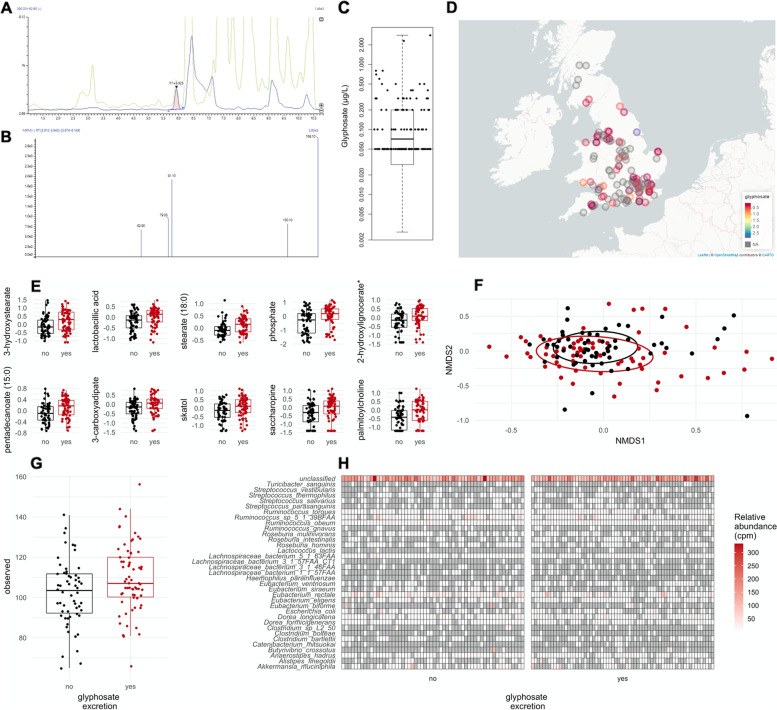
Pyrethroid and/or organophosphorus insecticide residues were found in all urine samples, while the herbicide glyphosate was found in 53% of individuals. Food frequency questionnaires showed that residues from organophosphates were higher with increased consumption of fruit and vegetables. A total of 34 associations between pesticide residue concentrations and faecal metabolite concentrations were detected. Glyphosate excretion was positively associated with an overall increased bacterial species richness, as well as to fatty acid metabolites and phosphate levels. The insecticide metabolite Br2CA, reflecting deltamethrin exposure, was positively associated with the phytoestrogens enterodiol and enterolactone, and negatively associated with some N-methyl amino acids. Urine metabolomics performed on a subset of samples did not reveal associations with the excretion of pesticide residues.
The consumption of conventionally grown fruit and vegetables leads to higher ingestion of pesticides with unknown long-term health consequences. Our results highlight the need for future dietary intervention studies to understand effects of pesticide exposure on the gut microbiome and possible health consequences.
饮食习惯对肠道微生物的代谢活动及其对健康的影响有深远的影响。人们担心,食用受农药污染的食物是否会通过影响肠道微生物群而导致慢性病的发生。我们对英国人群进行了首次农药生物监测调查,随后利用调查结果,从 TwinsUK 登记处首次开展了关于肠道微生物组组成和功能与农药关联的研究。
我们研究了英国 65 对双胞胎中的 186 种常见杀虫剂、除草剂或杀菌剂残留以及粪便微生物组的饮食暴露情况。我们评估了饮食习惯、地理位置或城乡环境是否与农药残留的排泄有关。分别使用宏基因组学和代谢组学评估粪便微生物群落的组成和代谢活性。我们进行了靶向尿液代谢组学分析,以评估农药尿液排泄是否也与生理变化有关。
所有尿液样本中均发现了拟除虫菊酯和/或有机磷杀虫剂残留,而 53%的个体中发现了除草剂草甘膦残留。食物频率调查问卷显示,随着水果和蔬菜摄入量的增加,有机磷农药残留量增加。检测到 34 种农药残留浓度与粪便代谢物浓度之间的关联。草甘膦排泄与细菌物种丰富度的整体增加呈正相关,与脂肪酸代谢物和磷酸盐水平也呈正相关。代谢物 Br2CA 反映了溴氰菊酯的暴露,与植物雌激素肠二醇和肠内酯呈正相关,与一些 N-甲基氨基酸呈负相关。在部分样本中进行的尿液代谢组学分析未发现与农药残留排泄有关的关联。
食用常规种植的水果和蔬菜会导致摄入更多未知长期健康后果的农药。我们的研究结果强调了需要进行未来的饮食干预研究,以了解农药暴露对肠道微生物群的影响及其可能产生的健康后果。