Department of Neurosurgery, The Royal Melbourne Hospital, Parkville, VIC, Australia.
Department of Medicine, University of Melbourne, Parkville, VIC, Australia.
PLoS One. 2022 May 4;17(5):e0267931. doi: 10.1371/journal.pone.0267931. eCollection 2022.
Predicting reduced health-related quality of life (HRQoL) after resection of a benign or low-grade brain tumour provides the opportunity for early intervention, and targeted expenditure of scarce supportive care resources. We aimed to develop, and evaluate the performance of, machine learning (ML) algorithms to predict HRQoL outcomes in this patient group.
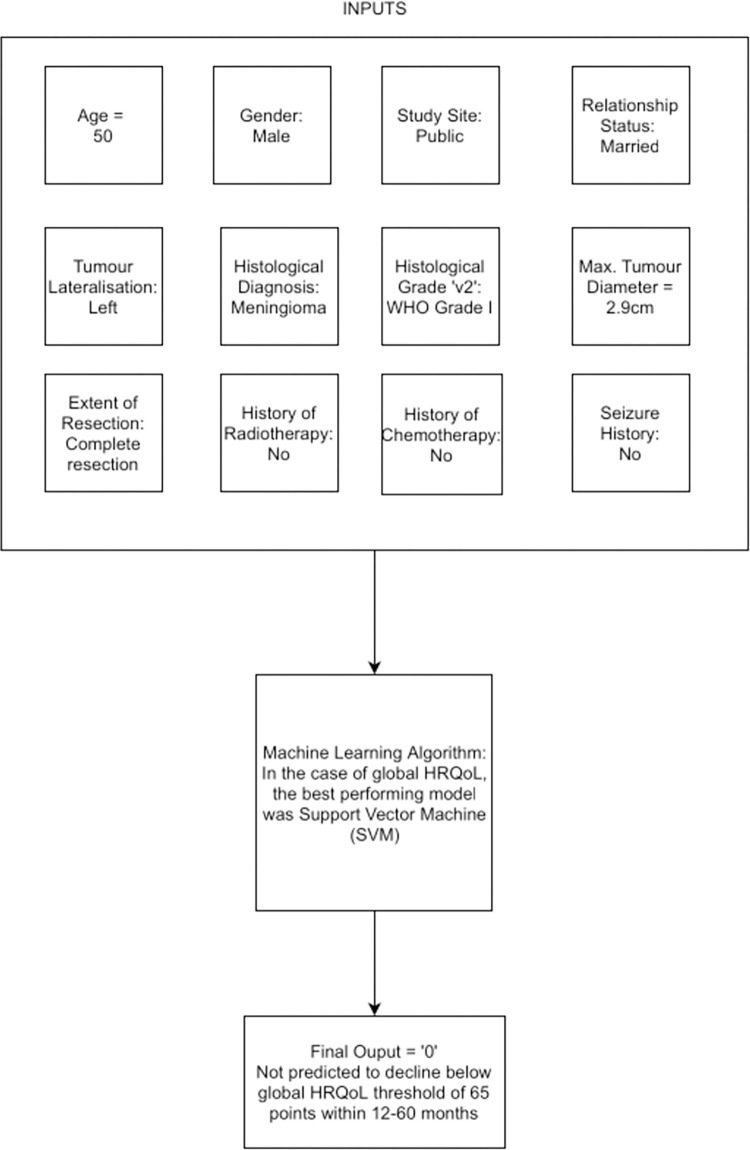
Using a large prospective dataset of HRQoL outcomes in patients surgically treated for low grade glioma, acoustic neuroma and meningioma, we investigated the capability of ML to predict a) HRQoL-impacting symptoms persisting between 12 and 60 months from tumour resection and b) a decline in global HRQoL by more than the minimum clinically important difference below a normative population mean within 12 and 60 months after resection. Ten-fold cross-validation was used to measure the area under the receiver operating characteristic curve (AUC), area under the precision-recall curve (PR-AUC), sensitivity, and specificity of models. Six ML algorithms were explored per outcome: Random Forest Classifier, Decision Tree Classifier, Logistic Regression, K Neighbours Classifier, Support Vector Machine, and Gradient Boosting Machine.
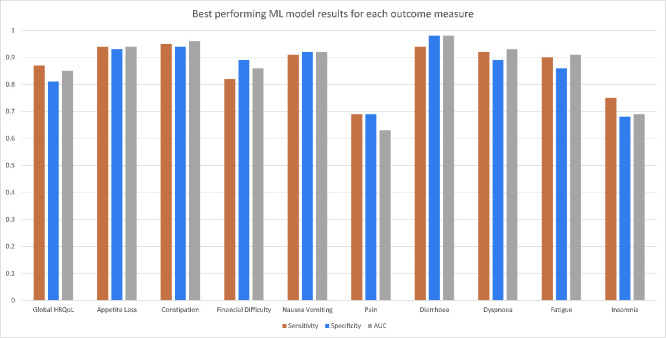
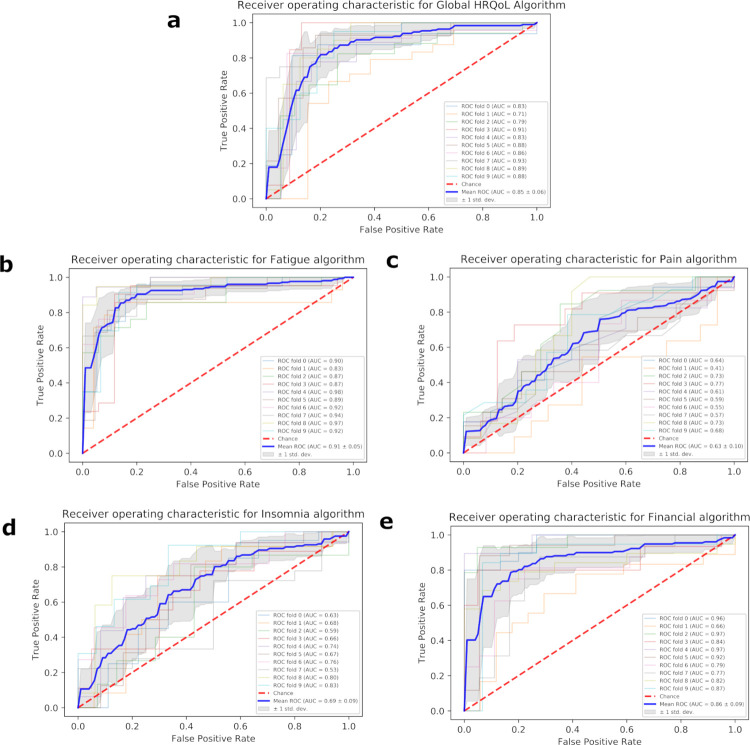
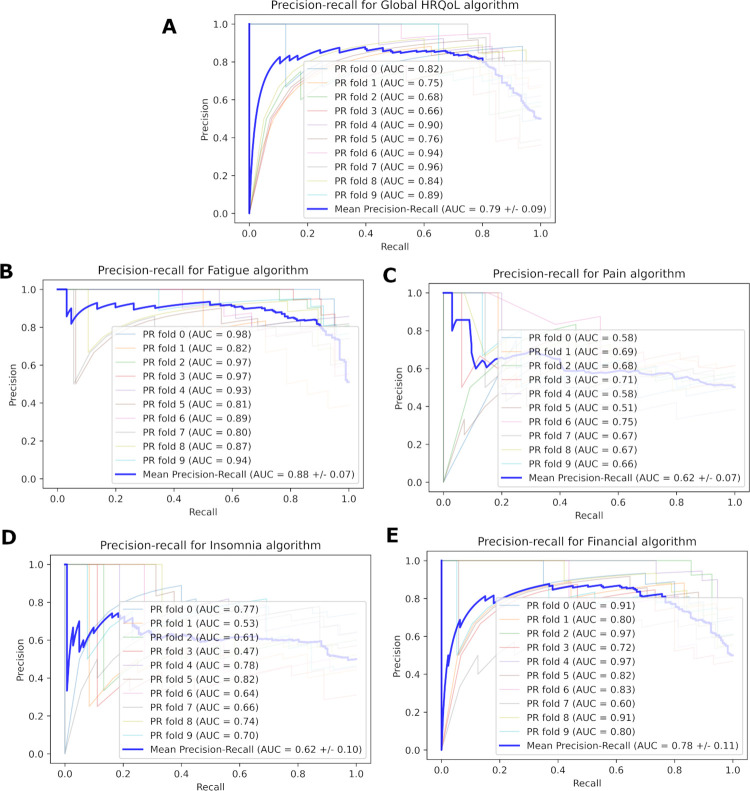
The final cohort included 262 patients. Outcome measures for which AUC>0.9 were Appetite loss, Constipation, Nausea and vomiting, Diarrhoea, Dyspnoea and Fatigue. AUC was between 0.8 and 0.9 for global HRQoL and Financial difficulty. Pain and Insomnia achieved AUCs below 0.8. PR-AUCs were similar overall to the AUC of each respective classifier.
ML algorithms based on routine demographic and perioperative data show promise in their ability to predict HRQoL outcomes in patients with low grade and benign brain tumours between 12 and 60 months after surgery.
预测良性或低级别脑肿瘤切除术后健康相关生活质量(HRQoL)下降,为早期干预和靶向投入稀缺的支持性护理资源提供了机会。我们旨在开发并评估机器学习(ML)算法在该患者群体中预测 HRQoL 结局的性能。
使用大量接受手术治疗的低级别胶质瘤、听神经瘤和脑膜瘤患者的 HRQoL 结局的前瞻性数据集,我们研究了 ML 预测以下内容的能力:a)肿瘤切除后 12 至 60 个月内持续存在的 HRQoL 影响症状;b)在切除后 12 至 60 个月内,全球 HRQoL 下降超过正常人群平均值的最低临床重要差异。十折交叉验证用于衡量受试者工作特征曲线下的面积(AUC)、精度-召回曲线下的面积(PR-AUC)、敏感性和特异性。对于每个结果,探索了六种 ML 算法:随机森林分类器、决策树分类器、逻辑回归、K 近邻分类器、支持向量机和梯度提升机。
最终队列包括 262 名患者。AUC>0.9 的结果测量指标包括食欲减退、便秘、恶心和呕吐、腹泻、呼吸困难和疲劳。全球 HRQoL 和经济困难的 AUC 在 0.8 到 0.9 之间。疼痛和失眠的 AUC 低于 0.8。PR-AUC 总体上与每个分类器的 AUC 相似。
基于常规人口统计学和围手术期数据的 ML 算法在预测低级别和良性脑肿瘤患者手术后 12 至 60 个月的 HRQoL 结局方面具有潜力。