. Clínica de Pneumologia, Hospital Otávio de Freitas, Recife (PE) Brasil.
. Laboratório do Sono e Coração, Pronto-Socorro Cardiológico Universitário de Pernambuco - PROCAPE - Universidade de Pernambuco, Recife (PE) Brasil.
J Bras Pneumol. 2022 Apr 29;48(3):e20210340. doi: 10.36416/1806-3756/e20210340. eCollection 2022.
To evaluate clinical predictors of poor sleep quality in COPD patients with and without obstructive sleep apnea (OSA).
Consecutive stable patients with COPD were evaluated for OSA by means of overnight polysomnography; for sleep quality by means of the Pittsburgh Sleep Quality Index (PSQI); and for disease impact by means of the COPD Assessment Test. COPD severity was graded in accordance with the 2020 GOLD guidelines. Predictors of poor sleep quality were evaluated by multivariate logistic regression analysis.
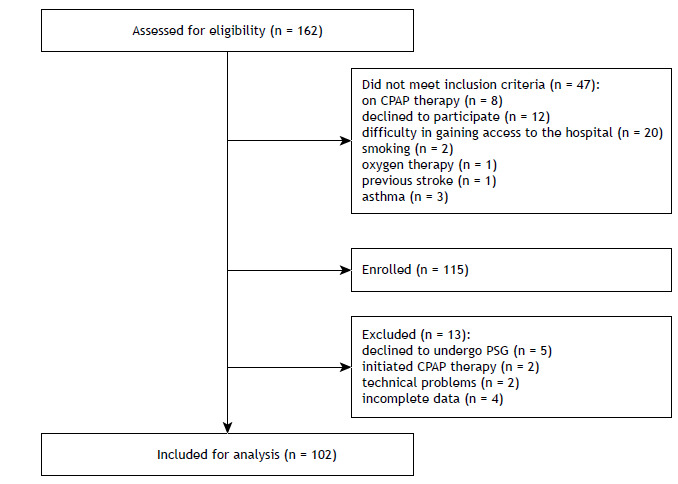
We studied 51 patients with COPD alone and 51 patients with COPD and OSA. Both groups had similar age (66.2 ± 9.2 years vs. 69.6 ± 10.7, p = 0.09) and airflow limitation (p = 0.37). Poor sleep quality was present in 74.8% of the study participants, with no significant difference between COPD patients with and without OSA regarding PSQI scores (p = 0.73). Polysomnography showed increased stage 1 non-rapid eye movement sleep and arousal index, as well as reduced sleep efficiency and stage 3 non-rapid eye movement sleep, in the group of patients with COPD and OSA (p < 0.05). Independent predictors of poor sleep quality were GOLD grade C/D COPD (OR = 6.4; 95% CI, 1.79-23.3; p < 0.01), a COPD Assessment Test score ≥ 10 (OR = 12.3; 95% CI, 4.1-36.5; p < 0.01), and lowest SaO2 < 80% (p < 0.0001).
Poor sleep quality is quite common in patients with COPD and is associated with severe COPD and poor health status, having a negative impact on overall quality of life. Despite changes in polysomnography, OSA appears to have no impact on subjective sleep quality in COPD patients.
评估合并和不合并阻塞性睡眠呼吸暂停(OSA)的 COPD 患者睡眠质量差的临床预测因素。
通过整夜多导睡眠图评估连续稳定的 COPD 患者的 OSA;通过匹兹堡睡眠质量指数(PSQI)评估睡眠质量;通过 COPD 评估测试评估疾病影响。根据 2020 年 GOLD 指南对 COPD 严重程度进行分级。通过多变量逻辑回归分析评估睡眠质量差的预测因素。
我们研究了 51 例单纯 COPD 患者和 51 例 COPD 合并 OSA 患者。两组患者年龄(66.2±9.2 岁比 69.6±10.7 岁,p=0.09)和气流受限(p=0.37)相似。研究参与者中睡眠质量差的比例为 74.8%,COPD 合并和不合并 OSA 的患者 PSQI 评分无显著差异(p=0.73)。多导睡眠图显示,合并 OSA 的 COPD 患者 stage 1 非快速眼动睡眠和觉醒指数增加,睡眠效率和 stage 3 非快速眼动睡眠减少(p<0.05)。睡眠质量差的独立预测因素为 GOLD 分级 C/D COPD(OR=6.4;95%CI,1.79-23.3;p<0.01)、COPD 评估测试评分≥10(OR=12.3;95%CI,4.1-36.5;p<0.01)和最低 SaO2<80%(p<0.0001)。
睡眠质量差在 COPD 患者中较为常见,与严重 COPD 和健康状况不佳相关,对整体生活质量产生负面影响。尽管多导睡眠图发生变化,但 OSA 似乎对 COPD 患者的主观睡眠质量没有影响。