Center for Genomics and Systems Biology, New York University, NY, USA.
Department of Infectious Diseases, College of Veterinary Medicine, University of Georgia, Athens, GA, USA.
Mol Syst Biol. 2022 May;18(5):e10724. doi: 10.15252/msb.202110724.
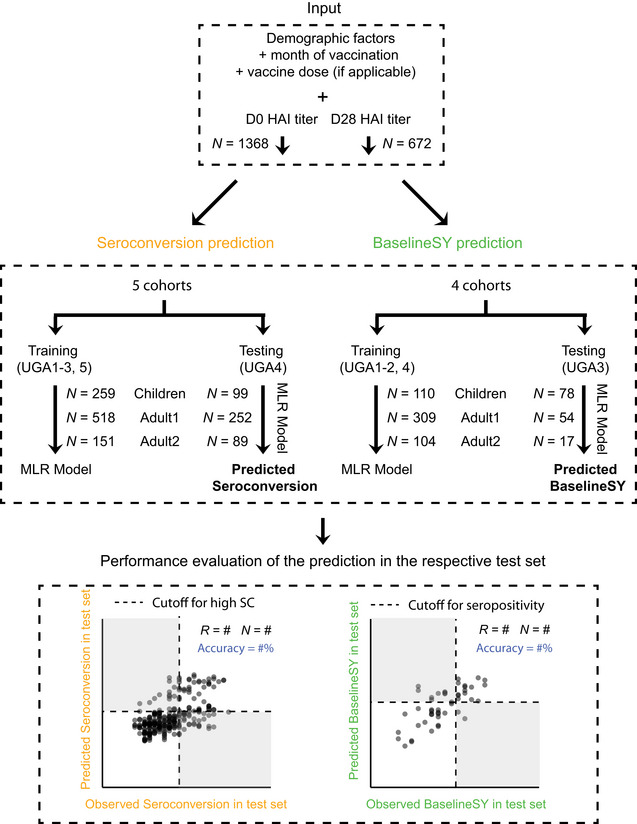
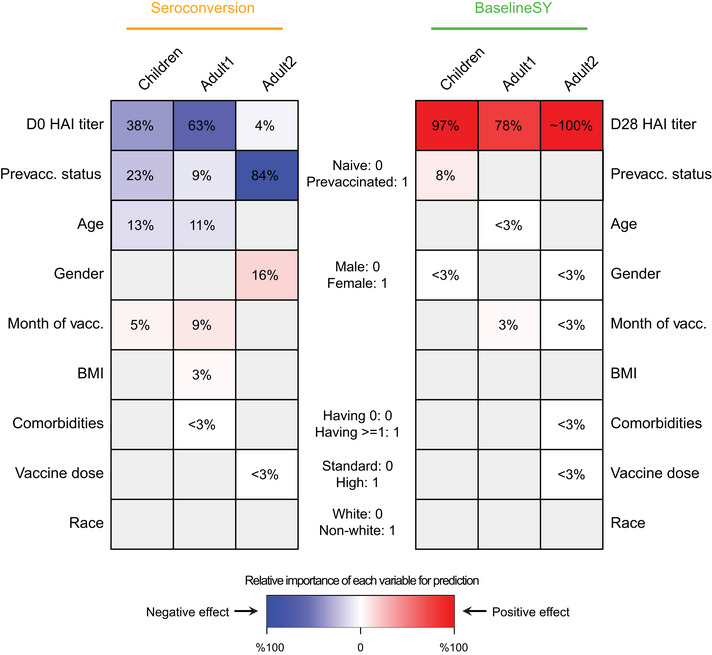
The seasonal influenza vaccine is only effective in half of the vaccinated population. To identify determinants of vaccine efficacy, we used data from > 1,300 vaccination events to predict the response to vaccination measured as seroconversion as well as hemagglutination inhibition (HAI) titer levels one year after. We evaluated the predictive capabilities of age, body mass index (BMI), sex, race, comorbidities, vaccination history, and baseline HAI titers, as well as vaccination month and vaccine dose in multiple linear regression models. The models predicted the categorical response for > 75% of the cases in all subsets with one exception. Prior vaccination, baseline titer level, and age were the major determinants of seroconversion, all of which had negative effects. Further, we identified a gender effect in older participants and an effect of vaccination month. BMI had a surprisingly small effect, likely due to its correlation with age. Comorbidities, vaccine dose, and race had negligible effects. Our models can generate a new seroconversion score that is corrected for the impact of these factors which can facilitate future biomarker identification.
季节性流感疫苗在接种人群中的有效率仅为一半。为了确定疫苗效力的决定因素,我们使用了超过 1300 次接种事件的数据来预测接种后一年的血清转化率和血凝抑制(HAI)滴度水平。我们评估了年龄、体重指数(BMI)、性别、种族、合并症、接种史和基线 HAI 滴度以及接种月份和疫苗剂量在多个线性回归模型中的预测能力。除了一个例外,这些模型可以预测所有亚组中超过 75%的病例的分类反应。既往接种、基线滴度水平和年龄是血清转化率的主要决定因素,均有负面效应。此外,我们还发现了年龄较大参与者中的性别效应和接种月份的效应。BMI 的影响出人意料地小,可能是因为它与年龄相关。合并症、疫苗剂量和种族的影响可以忽略不计。我们的模型可以生成一个新的血清转化率评分,该评分可纠正这些因素的影响,从而有助于未来的生物标志物识别。