Molinari Leonardo, Zaltieri Martina, Massaroni Carlo, Filippi Simonetta, Gizzi Alessio, Schena Emiliano
Department of Mathematics and Computer Science, Emory University, Atlanta, GA, United States.
Laboratory of Measurement and Biomedical Instrumentation, Department of Engineering, University of Rome Campus Bio-Medico, Rome, Italy.
Front Physiol. 2022 Apr 19;13:845896. doi: 10.3389/fphys.2022.845896. eCollection 2022.
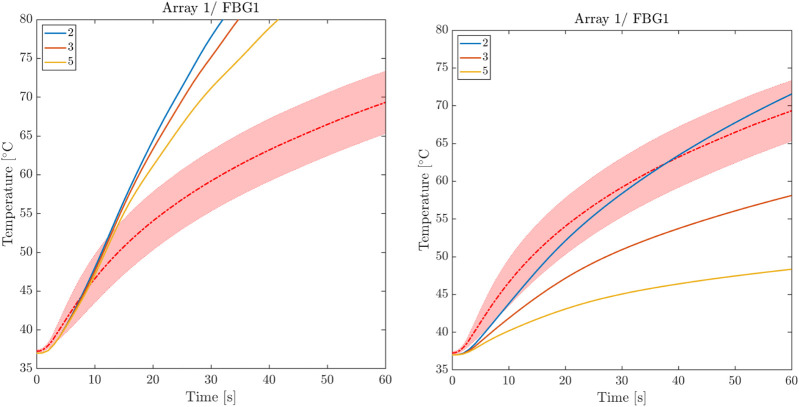
Radiofrequency catheter ablation (RFCA) is the mainstream treatment for drug-refractory cardiac fibrillation. Multiple studies demonstrated that incorrect dosage of radiofrequency energy to the myocardium could lead to uncontrolled tissue damage or treatment failure, with the consequent need for unplanned reoperations. Monitoring tissue temperature during thermal therapy and predicting the extent of lesions may improve treatment efficacy. Cardiac computational modeling represents a viable tool for identifying optimal RFCA settings, though predictability issues still limit a widespread usage of such a technology in clinical scenarios. We aim to fill this gap by assessing the influence of the intrinsic myocardial microstructure on the thermo-electric behavior at the tissue level. By performing multi-point temperature measurements on swine cardiac tissue samples, the experimental characterization of myocardial thermal anisotropy allowed us to assemble a fine-tuned thermo-electric material model of the cardiac tissue. We implemented a multiphysics and multiscale computational framework, encompassing thermo-electric anisotropic conduction, phase-lagging for heat transfer, and a three-state dynamical system for cellular death and lesion estimation. Our analysis resulted in a remarkable agreement between measurements and numerical results. Accordingly, we identified myocardium anisotropy as the driving effect on the outcomes of hyperthermic treatments. Furthermore, we characterized the complex nonlinear couplings regulating tissue behavior during RFCA, discussing model calibration, limitations, and perspectives.
射频导管消融术(RFCA)是药物难治性房颤的主流治疗方法。多项研究表明,向心肌输送的射频能量剂量不当可能导致无法控制的组织损伤或治疗失败,进而需要进行计划外的再次手术。在热疗过程中监测组织温度并预测损伤范围可能会提高治疗效果。心脏计算模型是确定最佳RFCA设置的可行工具,不过可预测性问题仍然限制了该技术在临床场景中的广泛应用。我们旨在通过评估心肌固有微观结构对组织水平热电行为的影响来填补这一空白。通过对猪心脏组织样本进行多点温度测量,心肌热各向异性的实验表征使我们能够构建一个经过微调的心脏组织热电材料模型。我们实施了一个多物理场和多尺度计算框架,包括热电各向异性传导、热传递的相位滞后以及用于细胞死亡和损伤估计的三态动力学系统。我们的分析结果显示测量值与数值结果之间具有显著的一致性。因此,我们确定心肌各向异性是热疗结果的驱动因素。此外,我们对调节RFCA期间组织行为的复杂非线性耦合进行了表征,讨论了模型校准、局限性和前景。