Aronis Konstantinos N, Prakosa Adityo, Bergamaschi Teya, Berger Ronald D, Boyle Patrick M, Chrispin Jonathan, Ju Suyeon, Marine Joseph E, Sinha Sunil, Tandri Harikrishna, Ashikaga Hiroshi, Trayanova Natalia A
Section of Electrophysiology, Division of Cardiology, Johns Hopkins Hospital, Baltimore, MD, United States.
Department of Biomedical Engineering, The Institute for Computational Medicine, Johns Hopkins University, Baltimore, MD, United States.
Front Physiol. 2021 Jul 14;12:684149. doi: 10.3389/fphys.2021.684149. eCollection 2021.
Patients with ischemic cardiomyopathy (ICMP) are at high risk for malignant arrhythmias, largely due to electrophysiological remodeling of the non-infarcted myocardium. The electrophysiological properties of the non-infarcted myocardium of patients with ICMP remain largely unknown.
To assess the pro-arrhythmic behavior of non-infarcted myocardium in ICMP patients and couple computational simulations with machine learning to establish a methodology for the development of disease-specific action potential models based on clinically measured action potential duration restitution (APDR) data.
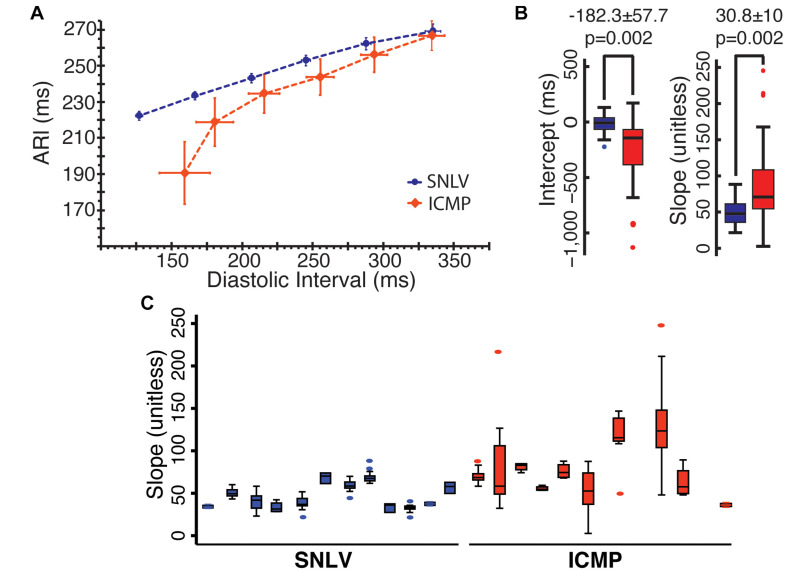
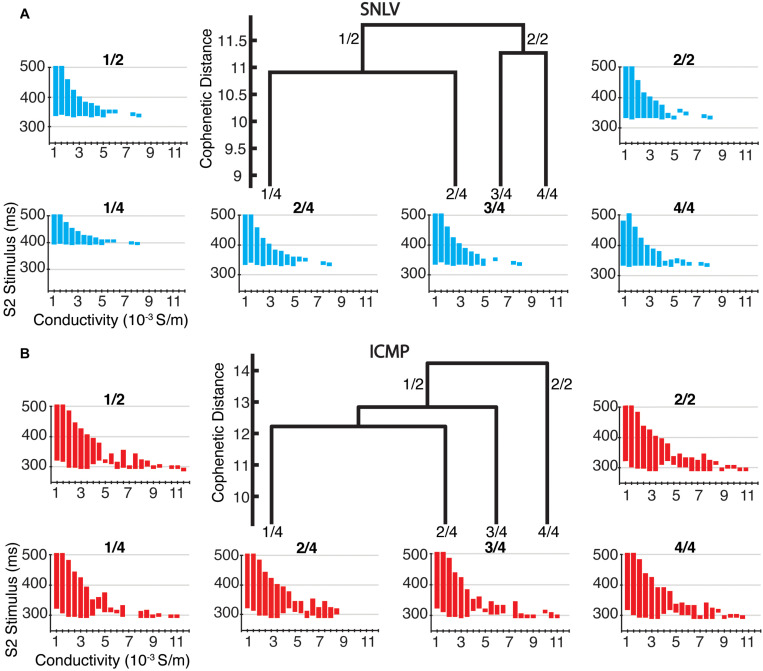
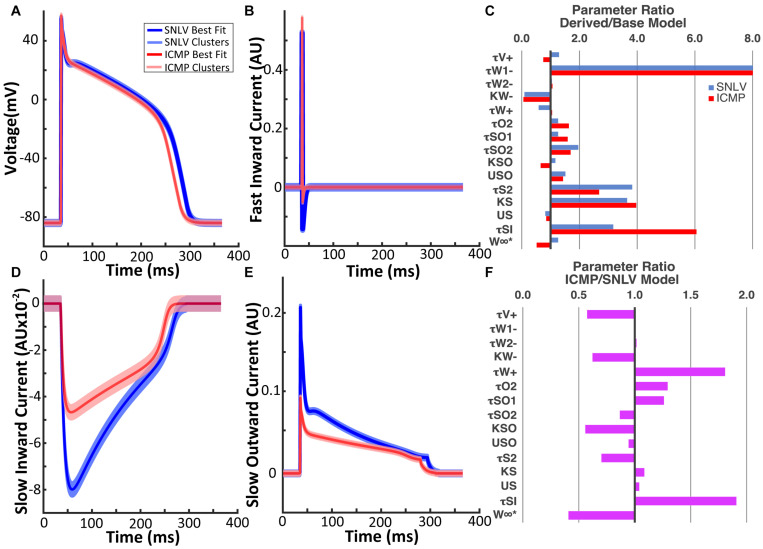
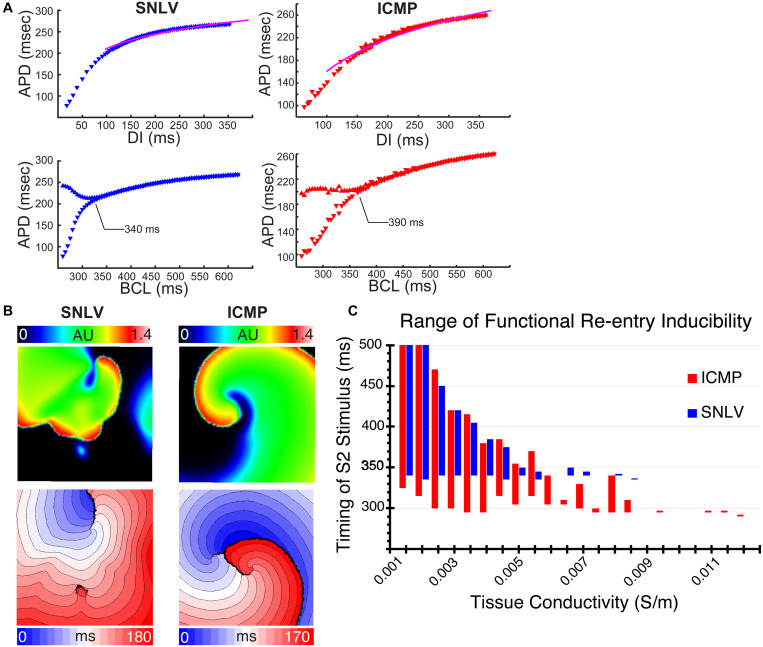
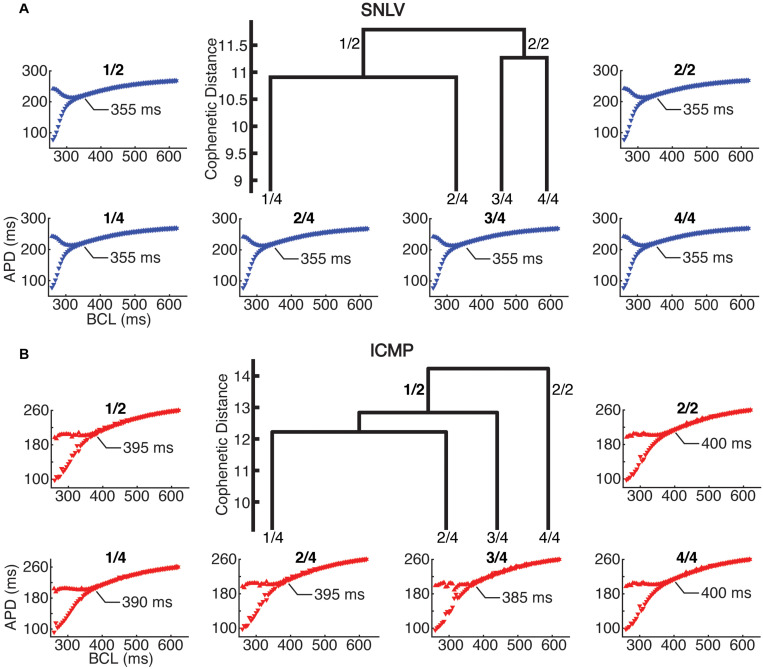
We enrolled 22 patients undergoing left-sided ablation (10 ICMP) and compared APDRs between ICMP and structurally normal left ventricles (SNLVs). APDRs were clinically assessed with a decremental pacing protocol. Using genetic algorithms (GAs), we constructed populations of action potential models that incorporate the cohort-specific APDRs. The variability in the populations of ICMP and SNLV models was captured by clustering models based on their similarity using unsupervised machine learning. The pro-arrhythmic potential of ICMP and SNLV models was assessed in cell- and tissue-level simulations. Clinical measurements established that ICMP patients have a steeper APDR slope compared to SNLV (by 38%, < 0.01). In cell-level simulations, APD alternans were induced in ICMP models at a longer cycle length compared to SNLV models (385-400 vs 355 ms). In tissue-level simulations, ICMP models were more susceptible for sustained functional re-entry compared to SNLV models.
Myocardial remodeling in ICMP patients is manifested as a steeper APDR compared to SNLV, which underlies the greater arrhythmogenic propensity in these patients, as demonstrated by cell- and tissue-level simulations using action potential models developed by GAs from clinical measurements. The methodology presented here captures the uncertainty inherent to GAs model development and provides a blueprint for use in future studies aimed at evaluating electrophysiological remodeling resulting from other cardiac diseases.
缺血性心肌病(ICMP)患者发生恶性心律失常的风险很高,这主要归因于非梗死心肌的电生理重塑。ICMP患者非梗死心肌的电生理特性在很大程度上仍不清楚。
评估ICMP患者非梗死心肌的促心律失常行为,并将计算模拟与机器学习相结合,以建立一种基于临床测量的动作电位时程恢复(APDR)数据开发疾病特异性动作电位模型的方法。
我们纳入了22例接受左侧消融术的患者(10例ICMP患者),并比较了ICMP患者与结构正常的左心室(SNLVs)之间的APDR。采用递减起搏方案对APDR进行临床评估。使用遗传算法(GAs),我们构建了包含队列特异性APDR的动作电位模型群体。基于ICMP和SNLV模型群体的相似性,通过无监督机器学习对模型进行聚类,从而捕捉其变异性。在细胞和组织水平模拟中评估ICMP和SNLV模型的促心律失常潜力。临床测量表明,与SNLV相比,ICMP患者的APDR斜率更陡(高38%,P<0.01)。在细胞水平模拟中,与SNLV模型相比,ICMP模型在更长的周期长度下诱导出动作电位交替(385 - 400 vs 355 ms)。在组织水平模拟中,与SNLV模型相比,ICMP模型更容易发生持续的功能性折返。
与SNLV相比,ICMP患者的心肌重塑表现为更陡的APDR,这是这些患者更大的致心律失常倾向的基础,这一点通过使用基于临床测量由GAs开发的动作电位模型进行的细胞和组织水平模拟得到了证明。本文提出的方法捕捉了GAs模型开发中固有的不确定性,并为未来旨在评估其他心脏疾病引起的电生理重塑的研究提供了蓝图。