Yang Weitao, Yang Suhong, Jiang Liping, Zhou Yujuan, Yang Cuiling, Deng Cuijun
Department of Medical Ultrasound, Shanghai Tenth People's Hospital, Ultrasound Research and Education Institute, Tongji University Cancer Center, Shanghai Engineering Research Center of Ultrasound Diagnosis and Treatment, Tongji University School of Medicine Shanghai 200072 China
Department of Respiratory and Intensive Care Unit, Anqiu People's Hospital Weifang 262100 China
RSC Adv. 2020 Jul 16;10(45):26742-26751. doi: 10.1039/d0ra04651e. eCollection 2020 Jul 15.
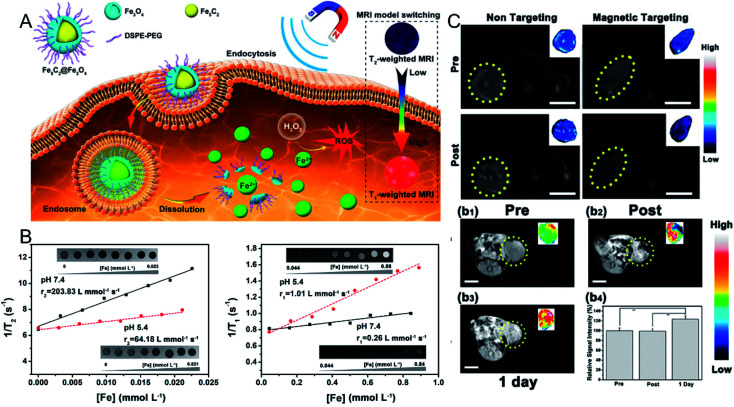
Inorganic nanoparticles (NPs)-mediated tumor theranostics have attracted widespread attention due to their unique physicochemical properties, such as optical, electrical, magnetic, and thermal properties. In the past decade, great advancements have been made in inorganic NPs-associated drug delivery, multimodal tumor imaging, and tumor therapy. However, the potential toxicity of inorganic NPs due to their low biodegradability, background signals interference and treatment side effects limit their clinical application. Therefore, developing biodegradable and intelligent NPs is beneficial to avoid excessive metal ions deposition, specific tumor imaging and treatment. In this review, we summarize the recent advances in tumor microenvironment (TME)-triggered biodegradation of inorganic NPs accompanied by imaging signal amplification and the released ions-mediated tumor therapy. First, the feature characteristics of the TME are introduced, including mild acidity, hypoxia, overexpressed reactive oxygen species (ROS), glutathione (GSH), and enzymes ; then, the biodegradation of NPs in a TME-induced activation of imaging signals, such as magnetic resonance (MR) imaging and fluorescence imaging is described; furthermore, tumor therapies through "Fenton", "Fenton-like" reactions, and interference of biological effects in cells is presented. Finally, the challenges and outlook for improving the degradation efficiency, imaging, specificity and efficiency of tumor imaging and treatment are discussed.
无机纳米粒子(NPs)介导的肿瘤诊疗因其独特的物理化学性质,如光学、电学、磁学和热学性质,而受到广泛关注。在过去十年中,无机NPs相关的药物递送、多模态肿瘤成像和肿瘤治疗取得了巨大进展。然而,无机NPs由于其低生物降解性、背景信号干扰和治疗副作用而具有的潜在毒性限制了它们的临床应用。因此,开发可生物降解的智能NPs有利于避免过量金属离子沉积、实现特异性肿瘤成像和治疗。在这篇综述中,我们总结了肿瘤微环境(TME)触发的无机NPs生物降解的最新进展,同时伴有成像信号放大以及释放的离子介导的肿瘤治疗。首先,介绍了TME的特征,包括轻度酸性、缺氧、活性氧(ROS)、谷胱甘肽(GSH)和酶的过表达;然后,描述了NPs在TME诱导的成像信号激活中的生物降解,如磁共振(MR)成像和荧光成像;此外,还介绍了通过“芬顿”、“类芬顿”反应以及对细胞生物学效应的干扰进行的肿瘤治疗。最后,讨论了提高肿瘤成像和治疗的降解效率、成像、特异性和效率方面的挑战与展望。