Du Yan, Zhong Yuanyuan, Dong Jingjing, Qian Chuntong, Sun Shian, Gao Liping, Yang Dongzhi
Jiangsu Key Laboratory of New Drug Research and Clinical Pharmacy, Xuzhou Medical University Xuzhou Jiangsu 221004 China
Xuzhou Air Force College Xuzhou Jiangsu 221000 China.
RSC Adv. 2019 Apr 17;9(22):12218-12225. doi: 10.1039/c9ra00022d.
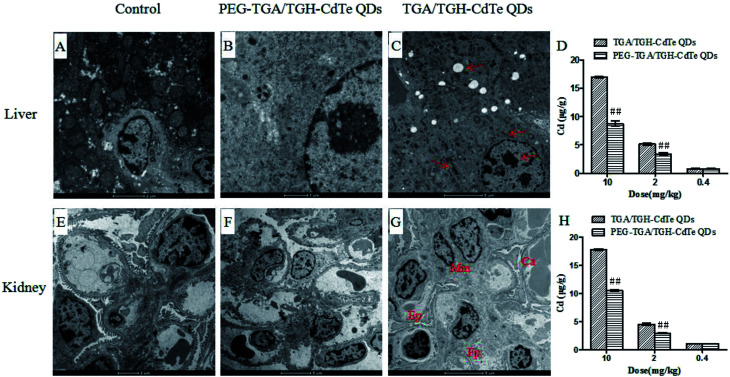
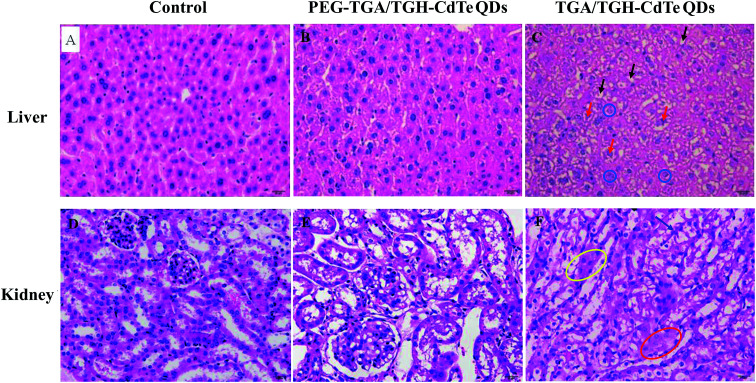
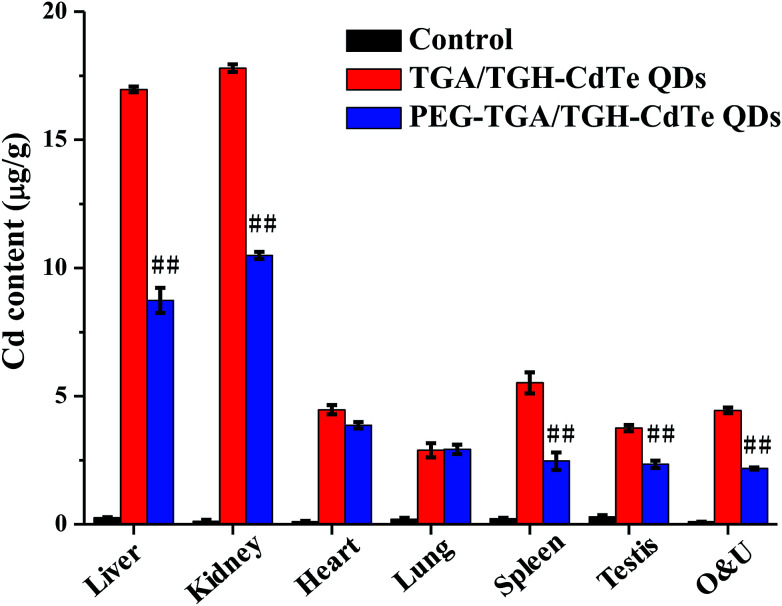
CdTe quantum dots (QDs) are considered a potential toxic substance because they contain metal ions. However, most toxicology data are derived from studies or limited analysis and may not reflect responses and biodistribution. Proper modification is one of the most widely used routes to reduce the toxicity of QDs. Herein, we demonstrated the role of polyethylene glycol (PEG) in decreasing the toxicity of QDs by studying the animal survival, clinical biochemistry, organ histology, biodistribution and oxidative stress in thioglycolic acid (TGA)- and mercapto-acetohydrazide (TGH)-stabilized CdTe QD (TGA/TGH-CdTe QD)-treated groups. the histology, transmission electron microscopy (TEM) and biodistribution results, it was found that the QDs mainly accumulated in the liver and kidney at 7 days post-injection, and obvious tissue damage was also observed in the bare TGA/TGH-CdTe QD group. Based on the evaluation of oxidative stress in the liver and kidney, the indicators exhibited an obvious variation with a high dose of TGA/TGH-CdTe QDs. In contrast, the QD aggregation decreased in the liver and kidney with no clear physiological index variation after PEG functionalization. Thus, PEG plays an important role in decreasing the toxicity of the CdTe QDs, and both the accumulation of cadmium and oxidative stress variation instead of an isolation factor are responsible for the toxicity of these QDs.
碲化镉量子点(QDs)因其含有金属离子而被视为一种潜在的有毒物质。然而,大多数毒理学数据来自研究或有限的分析,可能无法反映其反应和生物分布情况。适当的修饰是降低量子点毒性最广泛使用的途径之一。在此,我们通过研究巯基乙酸(TGA)和巯基乙酰肼(TGH)稳定的碲化镉量子点(TGA/TGH-CdTe QD)处理组的动物存活率、临床生物化学、器官组织学、生物分布和氧化应激,证明了聚乙二醇(PEG)在降低量子点毒性方面的作用。通过组织学、透射电子显微镜(TEM)和生物分布结果发现,量子点在注射后7天主要积聚在肝脏和肾脏中,并且在未修饰的TGA/TGH-CdTe QD组中也观察到明显的组织损伤。基于对肝脏和肾脏氧化应激的评估,高剂量的TGA/TGH-CdTe量子点处理后,各项指标呈现出明显变化。相比之下,PEG功能化后,肝脏和肾脏中的量子点聚集减少,且生理指标无明显变化。因此,PEG在降低碲化镉量子点的毒性方面发挥着重要作用,镉的积累和氧化应激变化而非隔离因素是这些量子点毒性的原因。