Wang Yan, Guo Liangmei, Xiong Xinjuan
Emergency Department, General Hospital of Xinjiang Military Region of People's Liberation Army, Ürümqi, China.
Neurology Department, The Second Medical Center & National Clinical Research Center for Geriatric Diseases, Chinese People's Liberation Army (PLA) General Hospital, Beijing, China.
Front Psychol. 2022 Apr 19;13:842847. doi: 10.3389/fpsyg.2022.842847. eCollection 2022.
Needle-related pain, fear, and anxiety can be a deterrent to treatments in children and adolescents. Virtual reality (VR) can be used to manage the poor experience of needle procedures.
This meta-analysis aimed to examine the effects of VR on pain, fear, and anxiety related to needle procedures in children and adolescents.
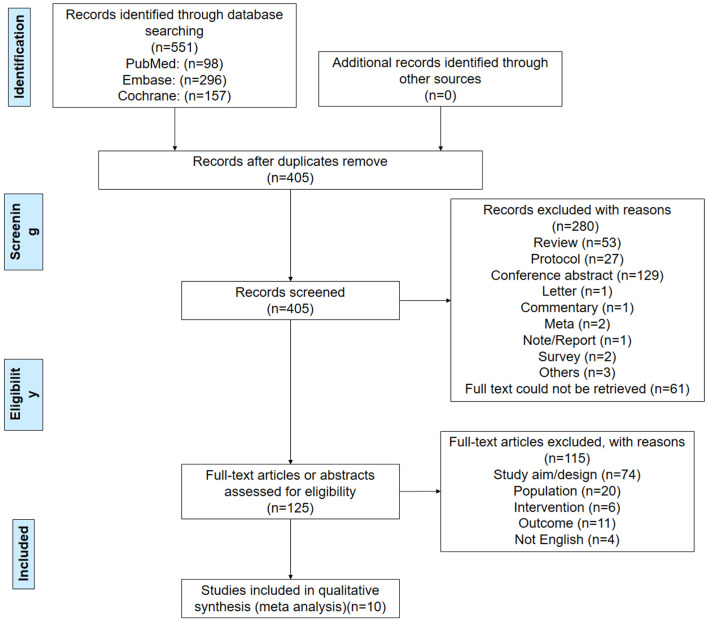
PubMed, EMBASE, and the Cochrane Library were searched for potentially eligible studies published up to June 2021. The outcomes were pain assessed by the Wong-Baker Faces Pain Scale (WBS) or Faces Pain Scale-Revised (FPS-R), and Visual Analog Scale (VAS), fear assessed by Children's Fear Scale (CFS), and anxiety assessed by Children's Anxiety Meter (CAM), VAS, or CFS. Because of expected heterogeneity among studies, all analyses were conducted using the random-effects model.
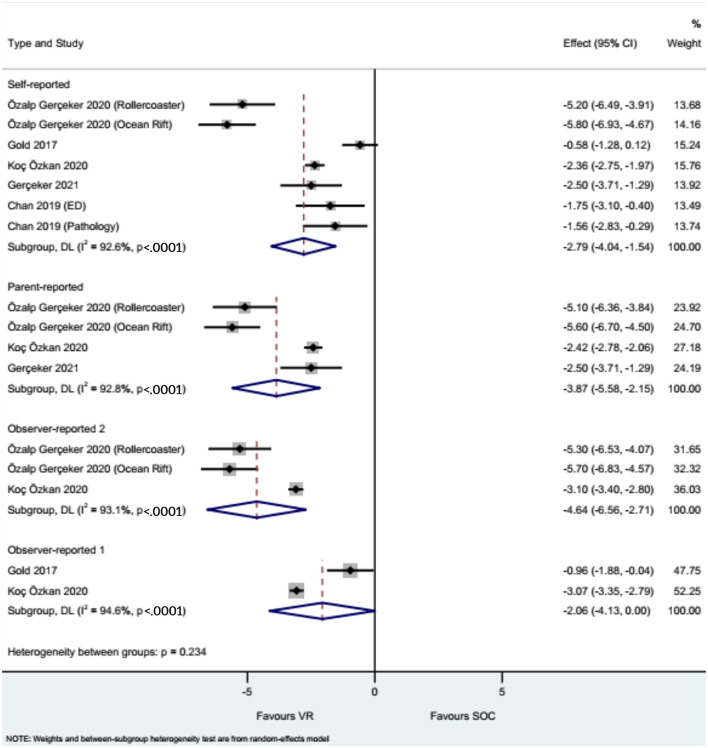
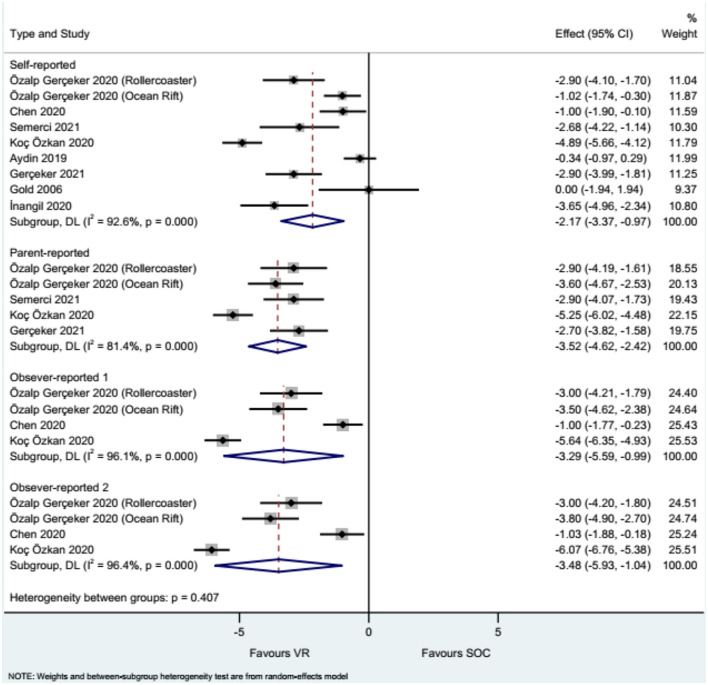
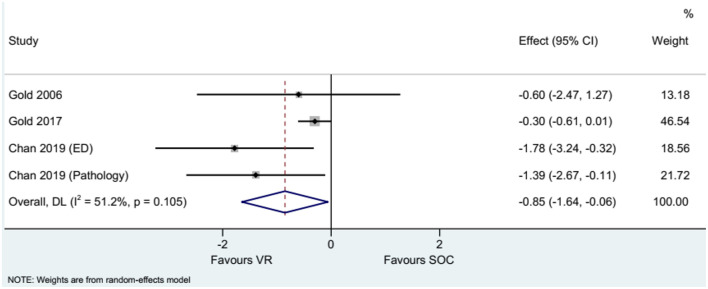
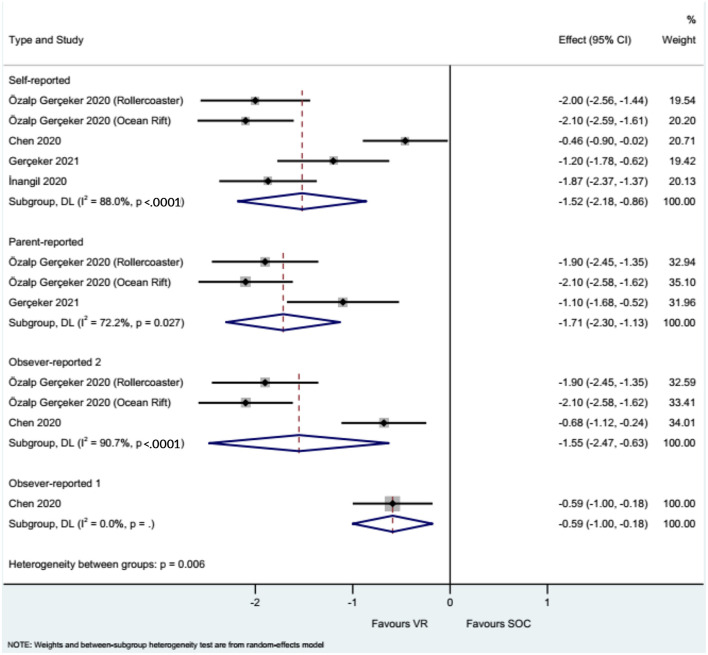
Ten studies were included (571 children in the VR group and 575 in the control group). Based on the WBS, VR reduced pain, either self-reported (WMD = -2.17, 95%CI: -3.37, -0.97), parent-reported (WMD = -3.52, 95%CI: -4.62, -2.42), nurse-reported (WMD = -3.29, 95%CI: -5.59, -0.99), and physician/investigator-reported (WMD = -3.48, 95%CI: -5.93, -1.04). Using the FPS-R, VR reduced needle-related pain compared with controls (WMD = -0.85, 95%CI: -1.64, -0.06). Similar results were observed for fear (children/adolescents: WMD = -1.52, 95%CI: -2.18, -0.86; parents: WMD = -1.71, 95%CI: -2.30, -1.13; nurses: WMD = -1.55, 95%CI: -2.47, -0.63; physicians/investigators: WMD = -0.59, 95%CI: -1.00, -0.18) and anxiety (self-reported: WMD = -2.79, 95%CI: -4.07, -1.54; parent-reported: WMD = -3.87, 95%CI: -5.58, -2.15; nurse-reported: WMD = -4.64, 95%CI: -6.56, -2.71; physician/investigator-reported: WMD = -2.06, 95%CI: -4.13, -0.00).
A VR-based intervention could reduce needle-related pain, fear, and anxiety in children and adolescents.
与针头相关的疼痛、恐惧和焦虑可能会阻碍儿童和青少年接受治疗。虚拟现实(VR)可用于改善针头操作带来的不良体验。
本荟萃分析旨在研究VR对儿童和青少年与针头操作相关的疼痛、恐惧和焦虑的影响。
检索了截至2021年6月发表的潜在合格研究的PubMed、EMBASE和Cochrane图书馆。结局指标包括通过面部表情疼痛量表(WBS)或修订的面部表情疼痛量表(FPS-R)以及视觉模拟量表(VAS)评估的疼痛,通过儿童恐惧量表(CFS)评估的恐惧,以及通过儿童焦虑量表(CAM)、VAS或CFS评估的焦虑。由于预期研究之间存在异质性,所有分析均使用随机效应模型进行。
纳入了10项研究(VR组571名儿童,对照组575名)。基于WBS量表,VR减轻了疼痛,无论是自我报告的(加权均数差[WMD]=-2.17,95%置信区间[CI]:-3.37,-0.97)、家长报告的(WMD=-3.52,95%CI:-4.62,-2.42)、护士报告的(WMD=-3.29,95%CI:-5.59,-�.99)以及医生/研究者报告的(WMD=-3.48,95%CI:-5.93,-1.04)。使用FPS-R量表时,与对照组相比,VR减轻了与针头相关的疼痛(WMD=-0.85,95%CI:-1.64,-0.06)。在恐惧(儿童/青少年:WMD=-1.52,95%CI:-2.18,-0.86;家长:WMD=-1.71,95%CI:-2.30,-1.13;护士:WMD=-1.55,95%CI:-2.47,-0.63;医生/研究者:WMD=-0.59,95%CI:-1.00,-0.18)和焦虑(自我报告:WMD=-2.79,95%CI:-4.07,-1.54;家长报告:WMD=-3.87,95%CI:-5.58,-2.15;护士报告:WMD=-4.64,95%CI:-6.56,-2.71;医生/研究者报告:WMD=-2.06,95%CI:-4.13,-0.00)方面也观察到了类似结果。
基于VR的干预措施可减轻儿童和青少年与针头相关的疼痛、恐惧和焦虑。