Institute for Health Sciences, Kunming Medical University, Kunming 650500, China; Collaborative Innovation Center for West Ecological Safety (CIWES), Lanzhou University, Lanzhou 730000, China.
Institute for Health Sciences, Kunming Medical University, Kunming 650500, China.
Poult Sci. 2022 Jun;101(6):101892. doi: 10.1016/j.psj.2022.101892. Epub 2022 Mar 31.
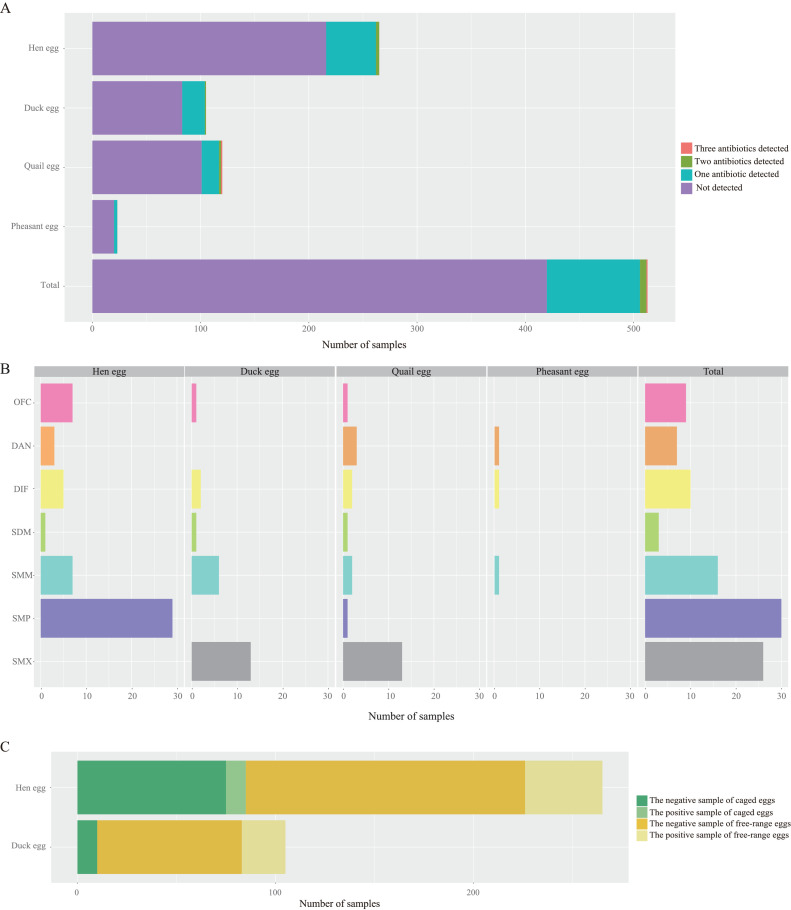
Antibiotic residues contained in poultry eggs pose threat to human health. However, the classes and concentrations of antibiotics in poultry egg in southwestern China is unknown due to insufficient monitoring and research. A total of 513 egg samples were collected from supermarkets and farm markets in Kunming city in 2020 and the levels of 7 antibiotics were analyzed using ultra high performance liquid chromatography-tandem mass spectrometry (UHPLC-MS/MS) method. The linear correlation coefficients were above 0.990 for all antibiotics tested. The limits of detection and limits of quantification in poultry eggs were 0.002 to 0.010 μg/g and 0.007 to 0.033 μg/g, respectively. The average recoveries of the 7 analytes from poultry egg samples were 80.00 to 128.01%, with relative standard deviations of less than 13.97%. A total of 93 (18.13%) samples tested positive for antibiotics, with the highest concentration being 2.48 μg/g. The concentration range of ofloxacin, danofloxacin, difloxacin, sulfadimethoxine, sulfamonomethoxine, sulfamethoxypyridazine, and sulfamethoxazole in poultry eggs was 0.01 to 0.37 μg/g, 0.06 to 0.48 μg/g, 0.05 to 0.29 μg/g, 0.03 to 0.16 μg/g, 0.06 to 1.00 μg/g, 0.05 to 0.37, and 0.07 to 2.48 μg/g, respectively. Sulfamonomethoxine was detected from hen eggs with the highest concentration level at 1.00 μg/g. Sulfamethoxazole was detected with the highest concentration level from both duck and quail eggs, at 1.87 and 2.48 μg/g, respectively. The antibiotic with the highest residue level in pheasant eggs was danofloxacin, which was 0.37 μg/g. Sulfamethoxypyridazine was identified in 30 samples with the highest positive rate of 5.85%, sulfadimethoxine was identified in 3 samples with the lowest positive rate of 0.58%. We observed that 7 targeted antibiotic residues in quail eggs and 3 targeted antibiotic residues in pheasant eggs. We also found that there were antibiotic residues in free-range hen eggs and the concentration was not low. The antibiotic with the highest residue level in free-range eggs was sulfamonomethoxine, which was 1.00 μg/g. These findings suggest that continual antibiotic residue monitoring of poultry eggs is essential in China.
禽蛋中的抗生素残留对人类健康构成威胁。然而,由于监测和研究不足,中国西南地区禽蛋中的抗生素种类和浓度尚不清楚。2020 年,从昆明市超市和农贸市场共采集 513 个鸡蛋样品,采用超高效液相色谱-串联质谱法(UHPLC-MS/MS)检测 7 种抗生素的残留水平。所有抗生素的线性相关系数均大于 0.990。禽蛋中抗生素的检测限和定量限分别为 0.002-0.010μg/g 和 0.007-0.033μg/g。7 种分析物在禽蛋样品中的平均回收率为 80.00%-128.01%,相对标准偏差小于 13.97%。93(18.13%)个样品中检测到抗生素残留,最高浓度为 2.48μg/g。氧氟沙星、丹氟沙星、二氟沙星、磺胺二甲氧嘧啶、磺胺甲噁唑、磺胺间甲氧嘧啶和磺胺甲噁唑在禽蛋中的浓度范围分别为 0.01-0.37μg/g、0.06-0.48μg/g、0.05-0.29μg/g、0.03-0.16μg/g、0.06-1.00μg/g、0.05-0.37μg/g 和 0.07-2.48μg/g。磺胺甲噁唑在鸡蛋中检出浓度最高,为 1.00μg/g。磺胺甲噁唑在鸭蛋和鹌鹑蛋中检出率最高,浓度分别为 1.87μg/g 和 2.48μg/g。野鸡蛋中检出的抗生素残留水平最高的是丹氟沙星,浓度为 0.37μg/g。30 个样品中检出磺胺间甲氧嘧啶,阳性率最高,为 5.85%,3 个样品中检出磺胺二甲氧嘧啶,阳性率最低,为 0.58%。在鹌鹑蛋中检出 7 种目标抗生素残留,在野鸡蛋中检出 3 种目标抗生素残留。此外,还发现散养鸡蛋中存在抗生素残留,且浓度不低。散养鸡蛋中磺胺甲噁唑残留水平最高,为 1.00μg/g。这些结果表明,中国有必要持续监测禽蛋中的抗生素残留。