Department of Fundamental Veterinary Medicine, College of Animal Science and Veterinary Medicine, Shandong Agricultural University, 61 Daizong Street, Tai'an 271018, China.
Shandong Provincial Key Laboratory of Animal Biotechnology and Disease Control and Prevention, Shandong Agricultural University, Tai'an 271018, China.
Biomed Res Int. 2022 Apr 28;2022:5833769. doi: 10.1155/2022/5833769. eCollection 2022.
Swine influenza A virus (IAV-S) is a common cause of respiratory disease in pigs and poses a major public health threat. However, little attention and funding have been given to such studies. The aim of this study was to assess the prevalence of the Eurasian avian-like H1N1 (EA H1N1), 2009 pandemic H1N1 (pdm/09 H1N1), and H3N2 subtype antibodies in unvaccinated swine populations through serological investigations. Such data are helpful in understanding the prevalence of the IAV-S.
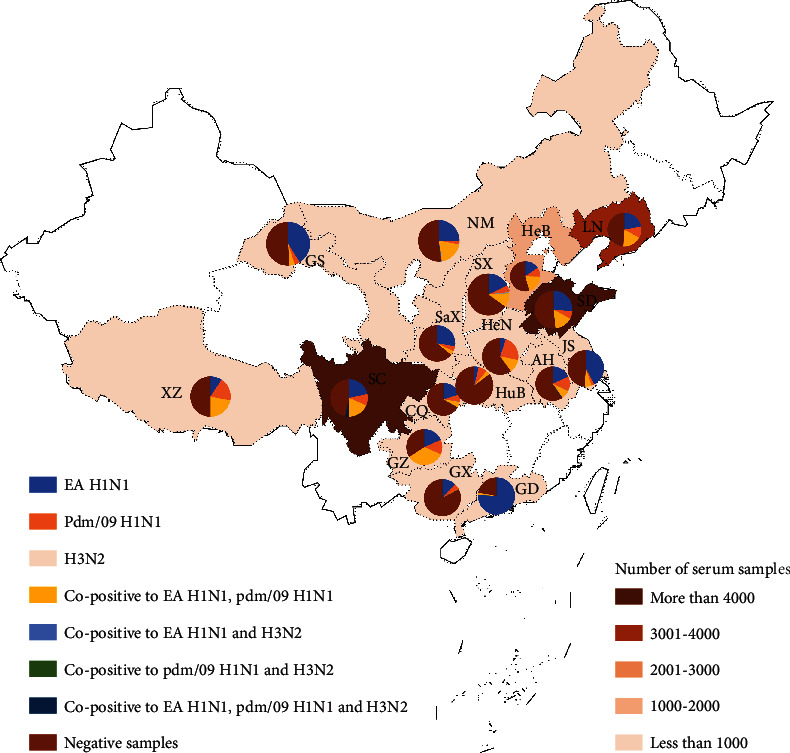
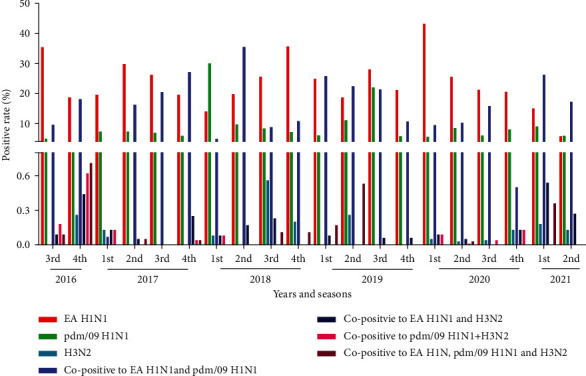
A total of 40,343 serum samples from 17 regions in China were examined using hemagglutination inhibition (HI) tests against EA H1N1, pdm/09 H1N1, and H3N2 IAV-S from 2016 to 2021. The results were analyzed based on a reginal distribution, seasonal distribution, and in different breeding stages.
A total of 19,682 serum samples out of the 40,343 were positive for IAV-S (48.79%). The positivity rates to the EA H1N1 subtype, pdm/09 H1N1 subtype, and H3N2 subtype were 24.75% (9,986/40,343), 7.94% (3,205/40,343), and 0.06% (24/40,343), respectively. The occurrences of coinfections from two or more subtypes were also detected. In general, the positivity rates of serum samples were related to the regional distribution and feeding stages.
The results of this study showed that the anti-EA H1N1 subtype and pdm/09 H1N1 subtype antibodies were readily detected in swine serum samples. The EA H1N1 subtype has become dominant in the pig population. The occurrences of coinfections from two or more subtypes afforded opportunities for their reassortment to produce new viruses. Our findings emphasized the need for continuous surveillance of influenza viruses.
猪流感 A 病毒(IAV-S)是引起猪呼吸道疾病的常见原因,对公共卫生构成重大威胁。然而,人们对这类研究的关注和资金投入都很少。本研究旨在通过血清学调查评估未接种疫苗的猪群中欧亚类禽流感 H1N1(EA H1N1)、2009 年大流行 H1N1(pdm/09 H1N1)和 H3N2 亚型抗体的流行率。这些数据有助于了解 IAV-S 的流行率。
我们用血凝抑制(HI)试验检测了 2016 年至 2021 年来自中国 17 个地区的 40343 份血清样本,针对 EA H1N1、pdm/09 H1N1 和 H3N2 IAV-S。结果根据地域分布、季节分布和不同养殖阶段进行了分析。
在 40343 份血清样本中,共有 19682 份(48.79%)对 IAV-S 呈阳性。EA H1N1 亚型、pdm/09 H1N1 亚型和 H3N2 亚型的阳性率分别为 24.75%(9986/40343)、7.94%(3205/40343)和 0.06%(24/40343)。还检测到两种或更多亚型的合并感染。一般来说,血清样本的阳性率与地域分布和养殖阶段有关。
本研究结果表明,猪血清样本中很容易检测到抗 EA H1N1 亚型和 pdm/09 H1N1 亚型抗体。EA H1N1 亚型已成为猪群中的优势亚型。两种或更多亚型的合并感染为它们的重组产生新病毒提供了机会。我们的研究结果强调了对流感病毒进行持续监测的必要性。