Department of Basic Veterinary Medicine, College of Animal Science and Veterinary Medicine, Shandong Agricultural University, 61 Daizong Street, Tai'an 271018, China.
Shandong Provincial Key Laboratory of Animal Biotechnology and Disease Control and Prevention, Shandong Agricultural University, Tai'an 271018, China.
Viruses. 2020 Mar 9;12(3):298. doi: 10.3390/v12030298.
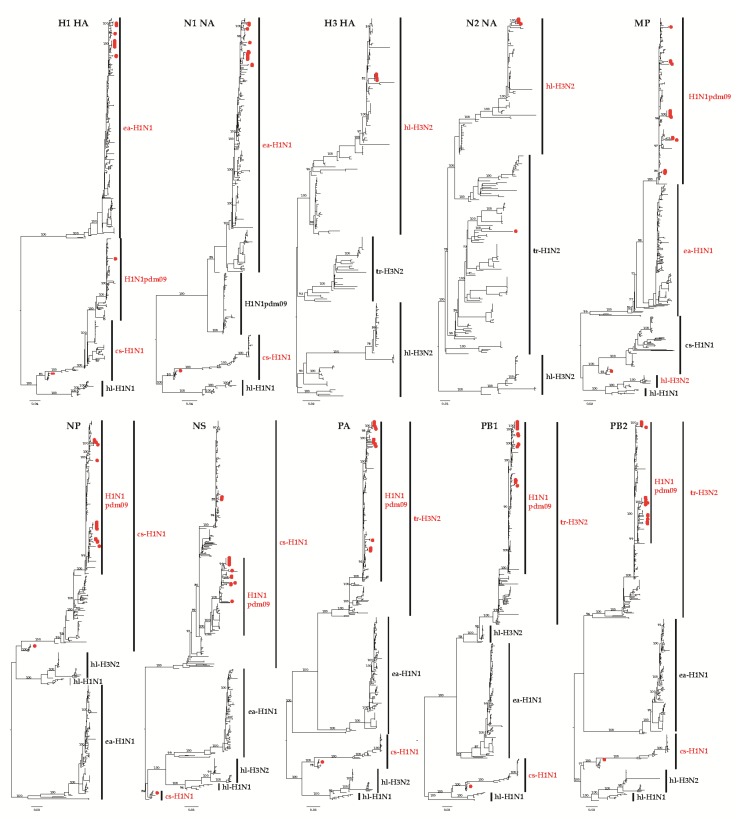
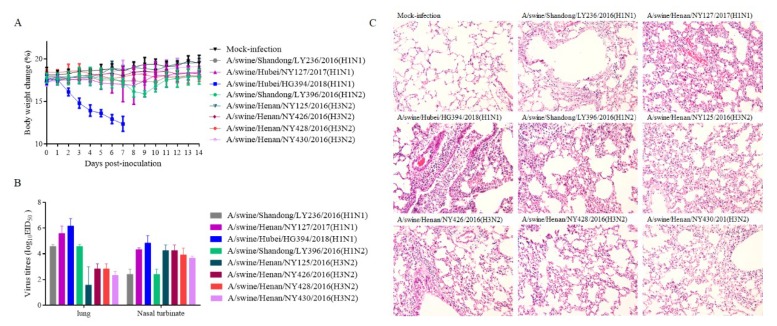
Pigs are considered a "mixing vessel" that can produce new influenza strains through genetic reassortments, which pose a threat to public health and cause economic losses worldwide. The timely surveillance of the epidemiology of the swine influenza virus is of importance for prophylactic action. In this study, 15 H1N1, one H1N2, and four H3N2 strains were isolated from a total of 4080 nasal swabs which were collected from 20 pig farms in three provinces in China between 2016 and 2019. All the isolates were clustered into four genotypes. A new genotype represented by the H1N2 strain was found, whose fragments came from the triple reassortant H1N2 lineage, classical swine influenza virus (cs-H1N1) lineage, and 2009 H1N1 pandemic virus lineage. A/Sw/HB/HG394/2018(H1N1), which was clustered into the cs-H1N1 lineage, showed a close relationship with the 1918 pandemic virus. Mutations determining the host range specificity were found in the hemagglutinin of all isolates, which indicated that all the isolates had the potential for interspecies transmission. To examine pathogenicity, eight isolates were inoculated into 6-week-old female BALB/c mice. The isolates replicated differently, producing different viral loadings in the mice; A/Swine/HB/HG394/2018(H1N1) replicated the most efficiently. This suggested that the cs-H1N1 reappeared, and more attention should be given to the new pandemic to pigs. These results indicated that new reassortments between the different strains occurred, which may increase potential risks to human health. Continuing surveillance is imperative to monitor swine influenza A virus evolution.
猪被认为是一种“混合容器”,可以通过基因重配产生新的流感毒株,这对公共卫生构成威胁,并在全球范围内造成经济损失。及时监测猪流感病毒的流行病学情况对于预防措施非常重要。在这项研究中,从 2016 年至 2019 年,从中国三个省的 20 个养猪场采集的 4080 个鼻拭子中分离出了 15 株 H1N1、1 株 H1N2 和 4 株 H3N2 株。所有分离株分为四个基因型。发现了一种新的基因型,代表株为 H1N2 株,其片段来自三重重配 H1N2 谱系、经典猪流感病毒(cs-H1N1)谱系和 2009 年 H1N1 大流行病毒谱系。聚类到 cs-H1N1 谱系的 A/Sw/HB/HG394/2018(H1N1)株与 1918 年大流行病毒株关系密切。所有分离株的血凝素中都发现了决定宿主范围特异性的突变,表明所有分离株都具有种间传播的潜力。为了检验致病性,将 8 株分离株接种到 6 周龄雌性 BALB/c 小鼠中。分离株的复制能力不同,在小鼠中产生的病毒载量不同;A/Swine/HB/HG394/2018(H1N1)株的复制效率最高。这表明 cs-H1N1 再次出现,应更加关注对猪的新大流行。这些结果表明,不同株之间发生了新的重配,这可能增加了对人类健康的潜在风险。继续监测对于监测猪流感 A 病毒的进化至关重要。