Le Sage Valerie, Souza Carine K, Rockey Nicole C, Shephard Meredith, Zanella Giovana C, Arruda Bailey, Wang Shengyang, Drapeau Elizabeth M, Doyle Joshua D, Xu Lingqing, Barbeau Dominique J, Paulson James C, McElroy Anita K, Hensley Scott E, Anderson Tavis K, Vincent Baker Amy L, Lakdawala Seema S
Department of Microbiology and Molecular Genetics, University of Pittsburgh School of Medicine, Pittsburgh, Pennsylvania, USA.
Center for Vaccine Research, University of Pittsburgh School of Medicine, Pittsburgh, PA, USA.
Emerg Microbes Infect. 2025 Dec;14(1):2492210. doi: 10.1080/22221751.2025.2492210. Epub 2025 May 7.
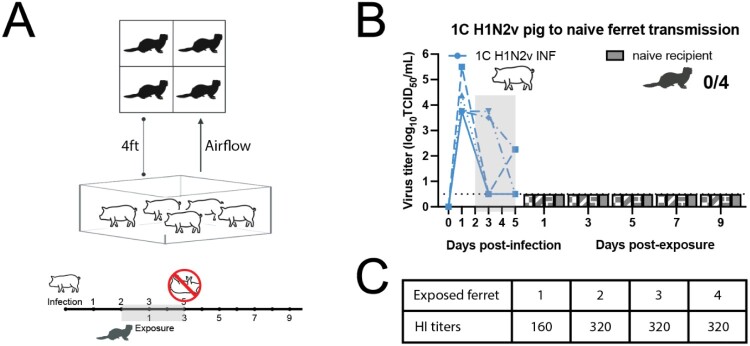
Recent surveillance has identified an expansion of swine H1 1C influenza viruses in Eurasian swine. Since 2010, at least 21 spillover events of 1C virus into humans have been detected and three of these occurred from July to December of 2023. Pandemic risk assessment of H1 1C influenza virus revealed that individuals born after 1950 had limited cross-reactive antibodies, confirming that they are antigenically novel viruses. The 1C virus exhibited phenotypic signatures similar to the 2009 pandemic H1N1 virus, including human receptor preference, productive replication in human airway cells, and robust environmental stability. Efficient inter- and intraspecies airborne transmission using the swine and ferret models was observed, including efficient airborne transmission to ferrets with pre-existing human seasonal H1N1 immunity. Together our data suggest H1 1C influenza virus poses a relatively high pandemic risk.
近期监测发现,欧亚猪群中H1 1C型猪流感病毒有所扩散。自2010年以来,已检测到至少21起1C型病毒跨物种传播至人类的事件,其中3起发生在2023年7月至12月期间。对H1 1C型流感病毒的大流行风险评估显示,1950年以后出生的个体具有的交叉反应抗体有限,证实它们是抗原性新型病毒。1C型病毒表现出与2009年大流行H1N1病毒相似的表型特征,包括对人类受体的偏好、在人类气道细胞中的有效复制以及强大的环境稳定性。利用猪和雪貂模型观察到了高效的种间和种内空气传播,包括向具有预先存在的人类季节性H1N1免疫力的雪貂进行高效空气传播。我们的数据共同表明,H1 1C型流感病毒构成相对较高的大流行风险。