Serafim Patricia, Borges Camila Aparecida, Cabral-Miranda William, Jaime Patricia Constante
Post-Graduate Program in Nutrition and Public Health, School of Public Health, University of São Paulo, São Paulo, Brazil.
Center for Epidemiological Research in Nutrition and Health (NUPENS), University of São Paulo, São Paulo, Brazil.
Front Nutr. 2022 Apr 20;9:858089. doi: 10.3389/fnut.2022.858089. eCollection 2022.
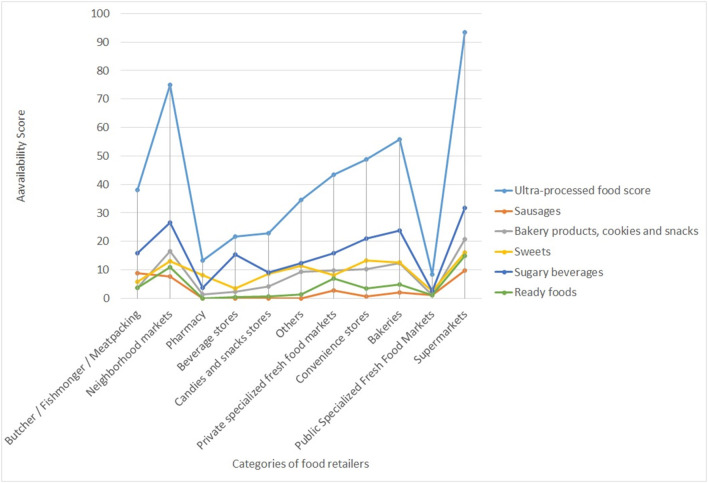
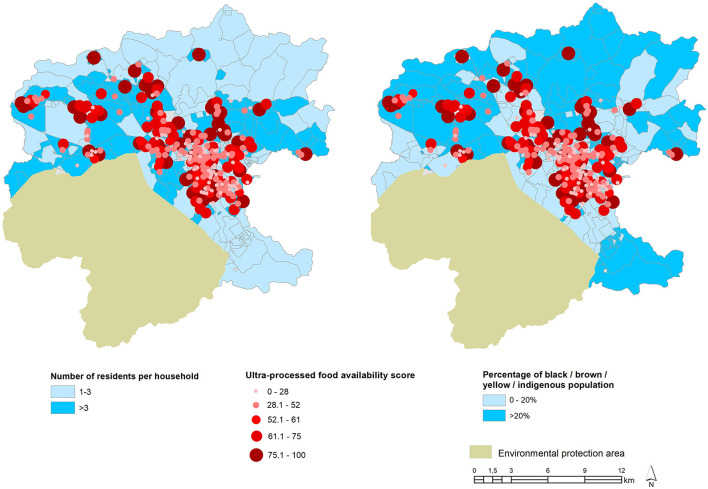
The availability of ultra-processed foods in a municipality tends to be related to different types of food retailers and their location in the territory, besides social, economic, and demographic factors. The aim of this study was to evaluate the availability of ultra-processed foods according to different types of food retailers and sociodemographic factors. This is a cross-sectional observational study carried out with audit data from food retailers in the municipality of Jundiaí, SP. Using a validated instrument, data on the availability of 18 types of ultra-processed foods were used to create a score of ultra-processed foods, ranging from 0 to 100 points, and five subscores referring to the ultra-processed food subgroups. Descriptive statistics and means comparison tests were performed to verify differences in the ultra-processed food availability score, according to the food retail type, household income, number of household members, and percentage of people of the color population in the census tract in which food retailers were located. Geo-referenced maps were used to characterize the score of ultra-processed in the territory, according to sociodemographic variables. A total of 649 food retailers were analyzed, most of which were classified as neighborhood markets (25.4%). The supermarkets were the category with the highest ultra-processed food availability score. Among the subgroups of ultra-processed foods analyzed, candies, soft drinks, and snacks were available in 60% of the food retailers. Higher ultra-processed food availability score was observed in regions with lower income, higher percentage of people of color population, and higher number of members per household. The findings show that the greater availability of ultra-processed foods is related to supermarkets and markets and regions of greater social vulnerability, which can put this population at nutritional risk.
除了社会、经济和人口因素外,一个城市中超加工食品的可获得性往往与不同类型的食品零售商及其在该地区的位置有关。本研究的目的是根据不同类型的食品零售商和社会人口因素评估超加工食品的可获得性。这是一项横断面观察性研究,使用了来自巴西圣保罗州容迪亚伊市食品零售商的审计数据。使用经过验证的工具,利用18种超加工食品的可获得性数据创建了一个超加工食品得分,范围从0到100分,以及五个涉及超加工食品亚组的子得分。进行了描述性统计和均值比较测试,以验证根据食品零售类型、家庭收入、家庭成员数量以及食品零售商所在普查区有色人种人口百分比划分的超加工食品可获得性得分的差异。根据社会人口变量,使用地理参考地图来描述该地区超加工食品的得分情况。共分析了649家食品零售商,其中大多数被归类为社区市场(25.4%)。超市是超加工食品可获得性得分最高的类别。在分析的超加工食品亚组中,60%的食品零售商有糖果、软饮料和零食出售。在收入较低、有色人种人口百分比较高以及每户家庭成员数量较多的地区,观察到超加工食品的可获得性得分较高。研究结果表明,超加工食品的更高可获得性与超市、市场以及社会脆弱性较高的地区有关,这可能使这些人群面临营养风险。