Immunology and Immunotherapy Program, University of Navarra, IdiSNA, Pamplona, Spain.
Department of Clinical Biochemistry, Clínica Universidad de Navarra, University of Navarra, IdiSNA, CIBERONC, Pamplona, Spain.
Oncoimmunology. 2022 May 1;11(1):2070337. doi: 10.1080/2162402X.2022.2070337. eCollection 2022.
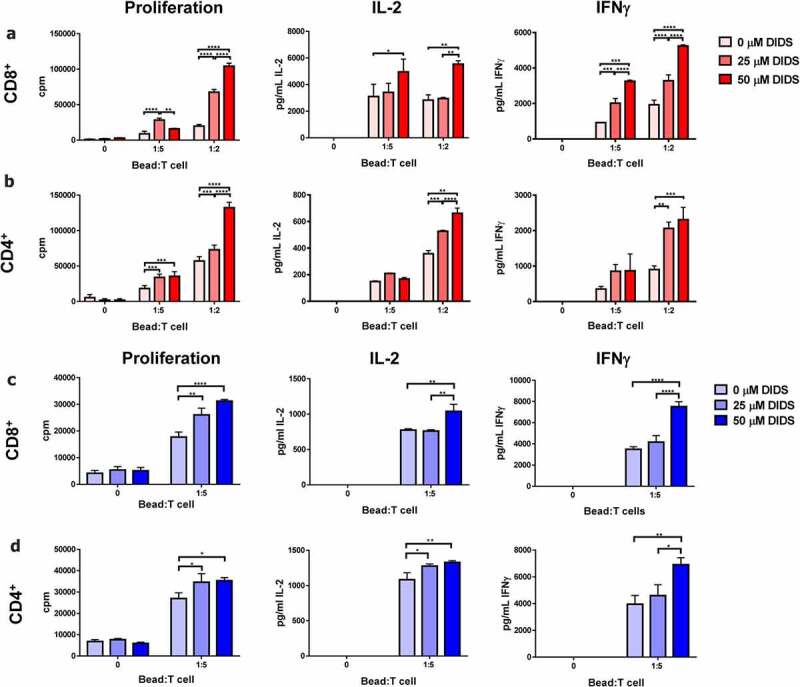
The high metabolic activity and insufficient perfusion of tumors leads to the acidification of the tumor microenvironment (TME) that may inhibit the antitumor T cell activity. We found that pharmacological inhibition of the acid loader chloride/bicarbonate anion exchanger 2 (Ae2), with 4,4'-diisothiocyanatostilbene-2,2'-disulfonicacid (DIDS) enhancedCD4 andCD8 T cell function upon TCR activation , especially under low pH conditions. , DIDS administration delayed B16OVA tumor growth in immunocompetent mice as monotherapy or when combined with adoptive T cell transfer of OVA-specificT cells. Notably, genetic Ae2 silencing in OVA-specificT cells improvedCD4/CD8 T cell function as well as their antitumor activity . Similarly, genetic modification of OVA-specificT cells to overexpress Hvcn1, a selectiveH outward current mediator that prevents cell acidification, significantly improved T cell function , even at low pH conditions. The adoptive transfer of OVA-specificT cells overexpressing Hvcn1 exerted a better antitumor activity in B16OVA tumor-bearingmice. Hvcn1 overexpression also improved the antitumor activity of CAR T cells specific for Glypican 3 (GPC3) in mice bearing PM299L-GPC3tumors. Our results suggest that preventing intracellular acidification by regulating the expression of acidifier ion channels such as Ae2 or alkalinizer channels like Hvcn1 in tumor-specificlymphocytes enhances their antitumor response by making them more resistant to the acidic TME.
肿瘤的高代谢活性和灌注不足导致肿瘤微环境(TME)酸化,可能抑制抗肿瘤 T 细胞活性。我们发现,通过药理学抑制酸加载器氯离子/碳酸氢根阴离子交换器 2(Ae2),用 4,4'-二异硫氰酸基二苯乙烯-2,2'-二磺酸(DIDS),在 TCR 激活时增强 CD4 和 CD8 T 细胞的功能,尤其是在低 pH 条件下。, DIDS 给药可延迟 B16OVA 肿瘤在免疫活性小鼠中的生长,无论是作为单一疗法还是与 OVA 特异性 T 细胞过继转移联合使用。值得注意的是,OVA 特异性 T 细胞中的 Ae2 基因沉默可改善 CD4/CD8 T 细胞功能以及其抗肿瘤活性。同样,将 OVA 特异性 T 细胞遗传修饰为过表达 Hvcn1(一种选择性的 H 外向电流调节剂,可防止细胞酸化),可显著改善 T 细胞功能,即使在低 pH 条件下也是如此。过表达 Hvcn1 的 OVA 特异性 T 细胞的过继转移在 B16OVA 荷瘤小鼠中发挥了更好的抗肿瘤活性。Hvcn1 过表达还改善了 GPC3 特异性 CAR T 细胞在 PM299L-GPC3 肿瘤荷瘤小鼠中的抗肿瘤活性。我们的研究结果表明,通过调节肿瘤特异性淋巴细胞中酸加载离子通道(如 Ae2)或碱化剂通道(如 Hvcn1)的表达来防止细胞内酸化,可以通过使它们更耐受酸性 TME 来增强其抗肿瘤反应。