Sun Kun-Lai, Gao Min, Wang Yue-Zhen, Li Xue-Rong, Wang Peng, Wang Bin
Zhejiang Provincial Engineering Technology Research Center of Marine Biomedical Products, School of Food and Pharmacy, Zhejiang Ocean University, Zhoushan, China.
College of Food Science and Engineering, Ocean University of China, Qingdao, China.
Front Microbiol. 2022 Apr 21;13:791248. doi: 10.3389/fmicb.2022.791248. eCollection 2022.
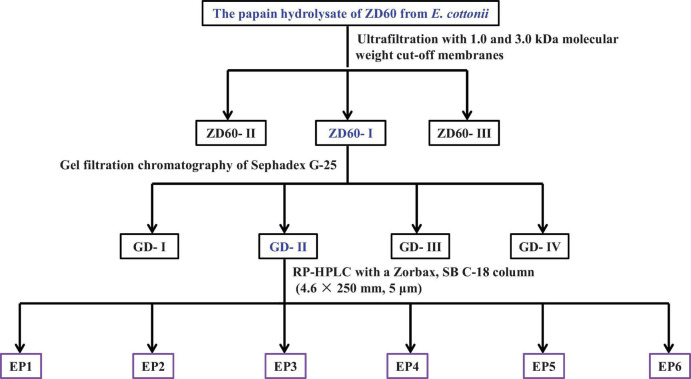
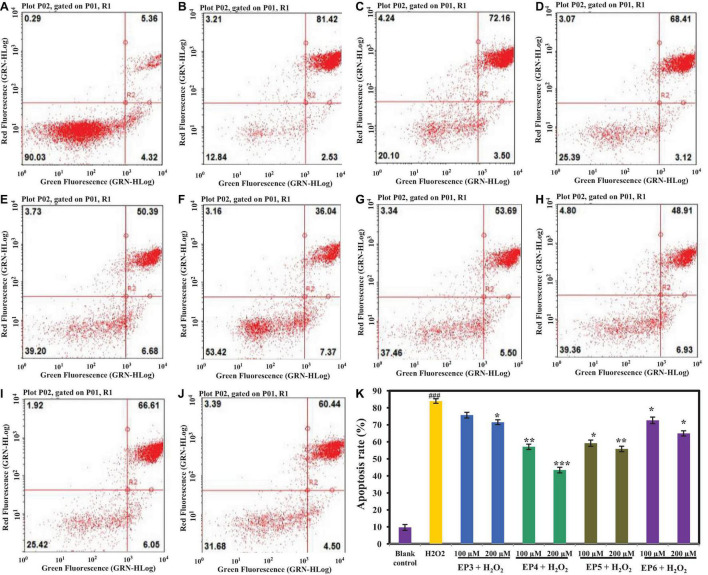
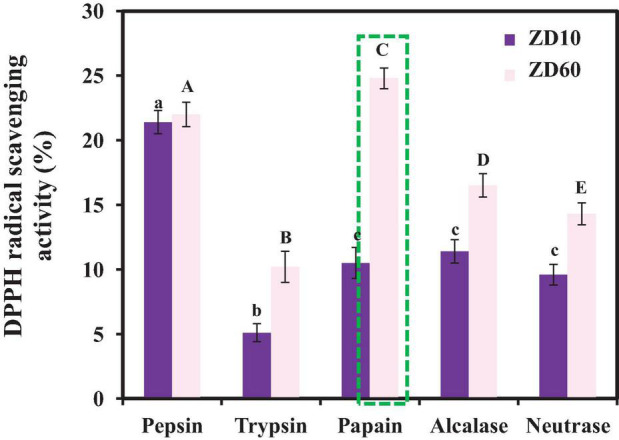
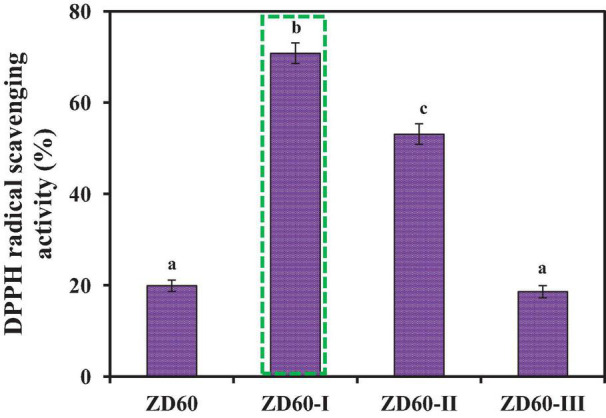
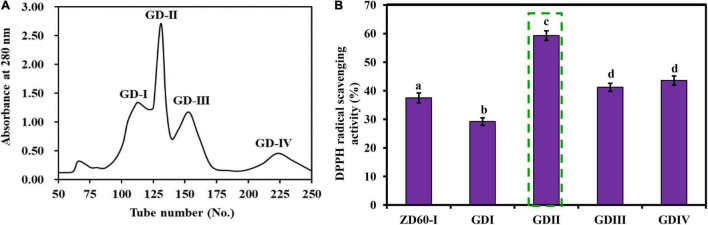
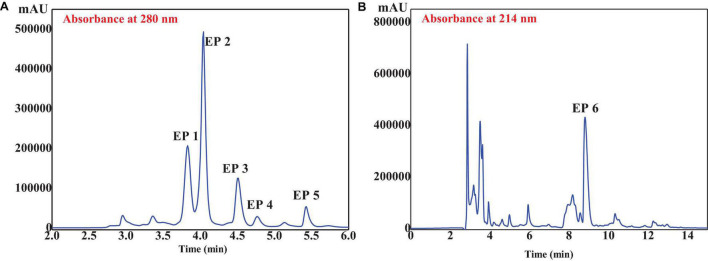
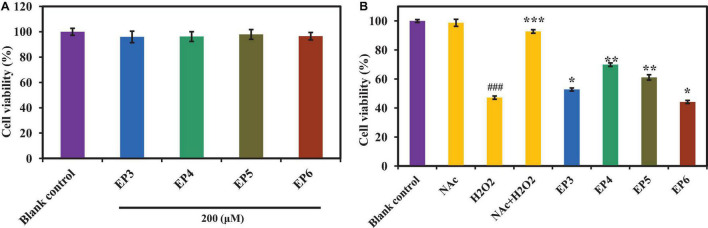
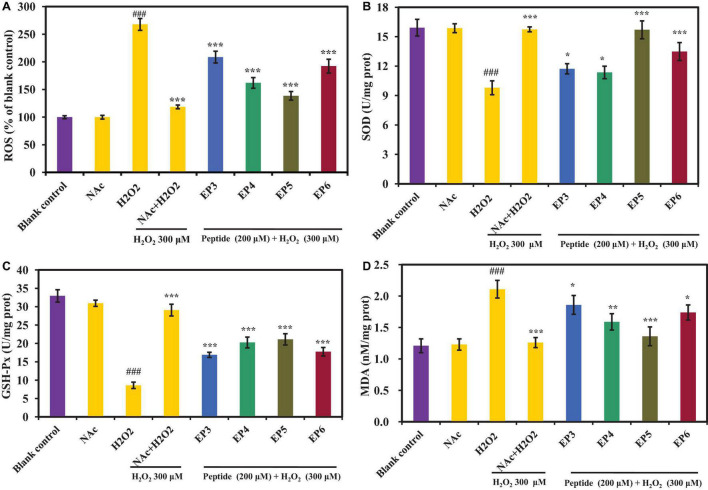
To screen, prepare, identify, and evaluate the activities of natural antioxidants for treating chronic diseases caused by oxidative stress. Two algal proteins, namely ZD10 and ZD60, precipitated with 10 and 60% (NH)SO were extracted from red algae () and hydrolyzed using five proteolytic enzymes. The results showed that ZD60 played the most significant role in the enhancement of 2,2-diphenyl-1-picrylhydrazyl radical (DPPH⋅) scavenging activity (25.91 ± 0.24%) among all protein hydrolysates. Subsequently, six antioxidant peptides (EP1-EP6) were isolated from the papain hydrolysate of ZD60 by ultrafiltration and chromatography methods. Their amino acid sequences were identified as Thr-Ala (EP1), Met-Asn (EP2), Tyr-Ser-Lys-Thr (EP3), Tyr-Ala-Val-Thr (EP4), Tyr-Leu-Leu (EP5), and Phe-Tyr-Lys-Ala (EP6) with molecular weights of 190.21, 263.33, 497.55, 452.51, 407.51, and 527.62 Da, respectively. Of which, EP3, EP4, EP5, and EP6 showed strong scavenging activities on DPPH⋅, hydroxyl radical (HO⋅), and superoxide anion radical (O- 2⋅). Moreover, EP4 and EP5 could significantly protect human umbilical vein endothelial cells (HUVECs) from HO-induced oxidative damage by increasing the levels of antioxidant enzyme systems including superoxide dismutase (SOD) and glutathione peroxidase (GSH-Px) to reduce the levels of reactive oxygen species (ROS) (60.51 and 51.74% of model group) and malondialdehyde (MDA) (75.36 and 64.45% of model group). In addition, EP4 and EP5 could effectively inhibit HO-induced apoptosis by preventing HUVECs from early apoptosis to late apoptosis. These results indicated that the antioxidant peptides derived from , especially EP4 and EP5, could serve as the natural antioxidants applied in pharmaceutical products to treat chronic cardiovascular diseases caused by oxidative damage, such as coronary heart disease, atherosclerosis, etc.
筛选、制备、鉴定和评估天然抗氧化剂治疗氧化应激引起的慢性疾病的活性。从红藻中提取两种分别用10%和60%硫酸铵沉淀的藻类蛋白,即ZD10和ZD60,并使用五种蛋白水解酶进行水解。结果表明,在所有蛋白水解物中,ZD60在增强2,2-二苯基-1-苦基肼自由基(DPPH·)清除活性方面发挥了最显著的作用(25.91±0.24%)。随后,通过超滤和色谱法从ZD60的木瓜蛋白酶水解物中分离出六种抗氧化肽(EP1-EP6)。它们的氨基酸序列被鉴定为苏氨酸-丙氨酸(EP1)、甲硫氨酸-天冬酰胺(EP2)、酪氨酸-丝氨酸-赖氨酸-苏氨酸(EP3)、酪氨酸-丙氨酸-缬氨酸-苏氨酸(EP4)、酪氨酸-亮氨酸-亮氨酸(EP5)和苯丙氨酸-酪氨酸-赖氨酸-丙氨酸(EP6),分子量分别为190.21、263.33、497.55、452.51、407.51和527.62 Da。其中,EP3、EP4、EP5和EP6对DPPH·、羟基自由基(HO·)和超氧阴离子自由基(O₂·)表现出较强的清除活性。此外,EP4和EP5可以通过提高包括超氧化物歧化酶(SOD)和谷胱甘肽过氧化物酶(GSH-Px)在内的抗氧化酶系统水平,显著保护人脐静脉内皮细胞(HUVECs)免受HO诱导的氧化损伤,以降低活性氧(ROS)水平(模型组的60.51%和51.74%)和丙二醛(MDA)水平(模型组的75.36%和64.45%)。此外,EP4和EP5可以通过防止HUVECs从早期凋亡发展到晚期凋亡,有效抑制HO诱导的细胞凋亡。这些结果表明,源自红藻的抗氧化肽,尤其是EP4和EP5,可作为天然抗氧化剂应用于医药产品中,以治疗由氧化损伤引起的慢性心血管疾病,如冠心病、动脉粥样硬化等。