Institute of Information Science, Academia Sinica, Taipei, 115, Taiwan.
Bioinformatics Program, International Graduate Program, Academia Sinica, Taipei, 115, Taiwan.
BMC Genomics. 2022 May 9;22(Suppl 5):919. doi: 10.1186/s12864-022-08537-1.
Alternative splicing (AS) increases the diversity of transcriptome and could fine-tune the function of genes, so that understanding the regulation of AS is vital. AS could be regulated by many different cis-regulatory elements, such as enhancer. Enhancer has been experimentally proved to regulate AS in some genes. However, there is a lack of genome-wide studies on the association between enhancer and AS (enhancer-AS association). To bridge the gap, here we developed an integrative analysis on a genome-wide scale to identify enhancer-AS associations in human and mouse.
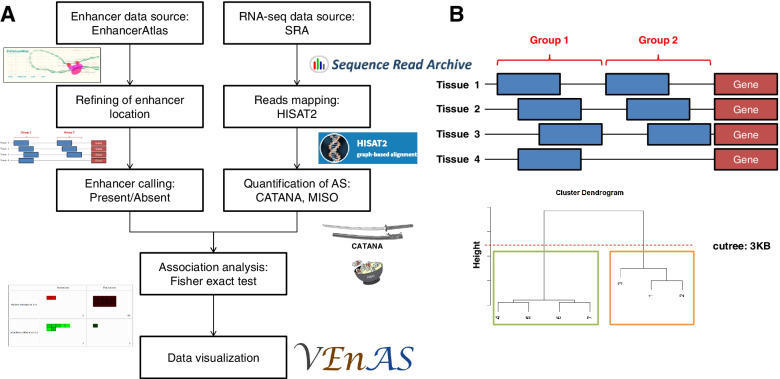
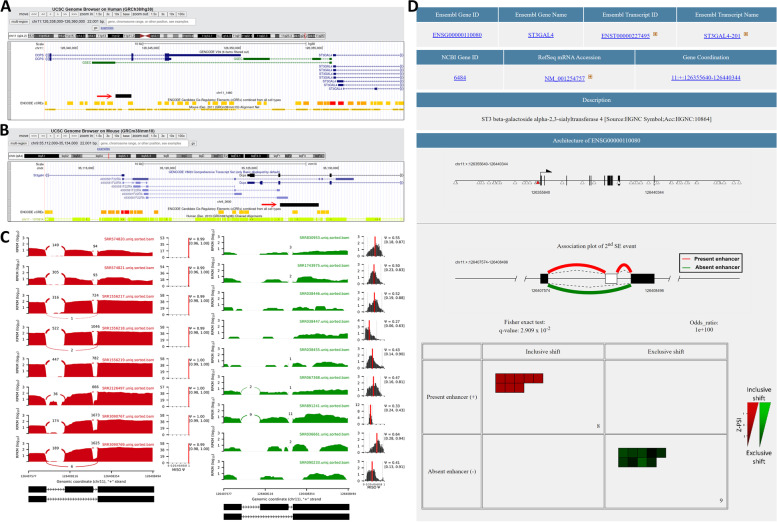
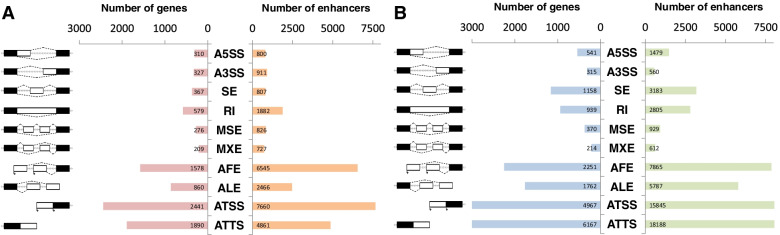
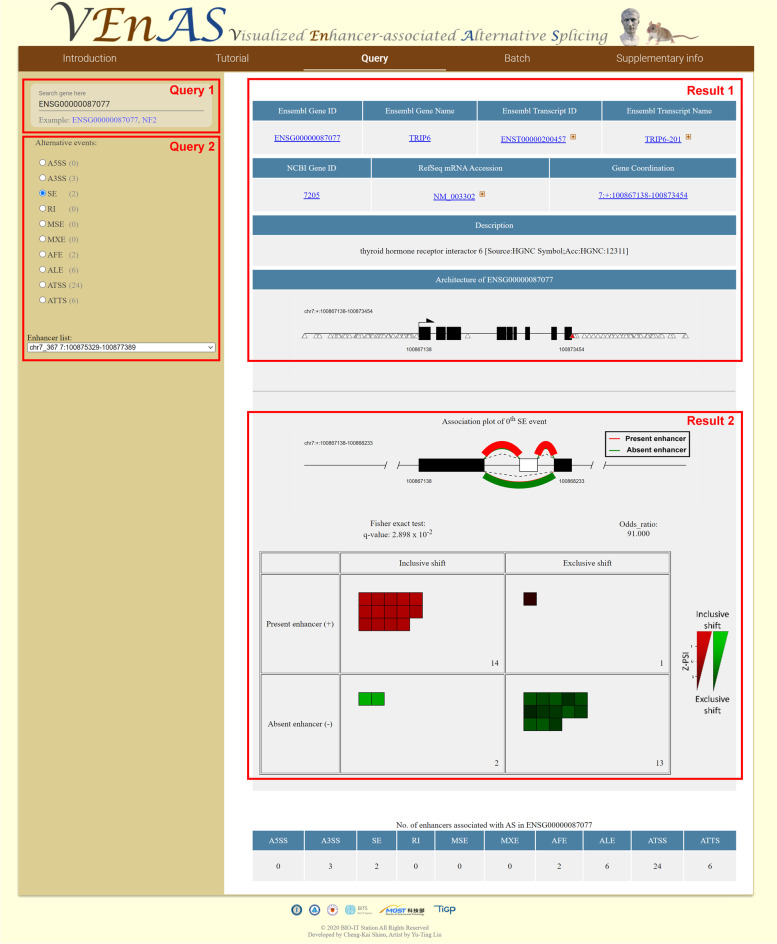
We collected enhancer datasets which include 28 human and 24 mouse tissues and cell lines, and RNA-seq datasets which are paired with the selected tissues. Combining with data integration and statistical analysis, we identified 3,242 human and 7,716 mouse genes which have significant enhancer-AS associations in at least one tissue. On average, for each gene, about 6% of enhancers in human (5% in mouse) are associated to AS change and for each enhancer, approximately one gene is identified to have enhancer-AS association in both human and mouse. We found that 52% of the human significant (34% in mouse) enhancer-AS associations are the co-existence of homologous genes and homologous enhancers. We further constructed a user-friendly platform, named Visualization of Enhancer-associated Alternative Splicing (VEnAS, http://venas.iis.sinica.edu.tw/ ), to provide genomic architecture, intuitive association plot, and contingency table of the significant enhancer-AS associations.
This study provides the first genome-wide identification of enhancer-AS associations in human and mouse. The results suggest that a notable portion of enhancers are playing roles in AS regulations. The analyzed results and the proposed platform VEnAS would provide a further understanding of enhancers on regulating alternative splicing.
可变剪接(AS)增加了转录组的多样性,并可以微调基因的功能,因此了解 AS 的调控至关重要。AS 可以受到许多不同的顺式调控元件的调控,例如增强子。增强子已被实验证明可以在某些基因中调节 AS。然而,关于增强子和 AS 之间的关联(增强子-AS 关联),缺乏全基因组研究。为了弥补这一空白,我们在这里开发了一种基于全基因组范围的综合分析方法,以鉴定人类和小鼠中的增强子-AS 关联。
我们收集了增强子数据集,其中包括 28 个人类和 24 个小鼠组织和细胞系,以及与所选组织配对的 RNA-seq 数据集。通过数据整合和统计分析,我们鉴定了至少在一种组织中具有显著增强子-AS 关联的 3242 个人类和 7716 个小鼠基因。平均而言,对于每个基因,人类中约有 6%(小鼠中约有 5%)的增强子与 AS 变化相关,对于每个增强子,大约有一个基因被鉴定为在人类和小鼠中都具有增强子-AS 关联。我们发现,52%的人类显著(34%在小鼠中)增强子-AS 关联是同源基因和同源增强子的共存。我们进一步构建了一个用户友好的平台,名为可视化增强子相关的可变剪接(VEnAS,http://venas.iis.sinica.edu.tw/),提供显著增强子-AS 关联的基因组结构、直观的关联图和列联表。
本研究首次在人类和小鼠中全基因组鉴定了增强子-AS 关联。结果表明,相当一部分增强子在 AS 调节中发挥作用。分析结果和提出的 VEnAS 平台将为增强子在调节可变剪接方面提供进一步的理解。