Ajucarmelprecilla Arulprakasam, Pandi Jhansi, Dhandapani Ranjithkumar, Ramanathan Saikishore, Chinnappan Jayaprakash, Paramasivam Ragul, Thangavelu Sathiamoorthi, Mohammed Ghilan Abdul-Kareem, Aljohani Saad Ali S, Oyouni Atif Abdulwahab A, Farasani Abdullah, Altayar Malik A, Althagafi Hussam Awwadh E, Alzahrani Othman R, Durairaj Kaliannan, Shrestha Anupama
Medical Microbiology Unit, Department of Microbiology, Alagappa University, Karaikudi, Tamil Nadu, India.
Chimertech Private Limited, Chennai, India.
Evid Based Complement Alternat Med. 2022 Apr 30;2022:6316158. doi: 10.1155/2022/6316158. eCollection 2022.
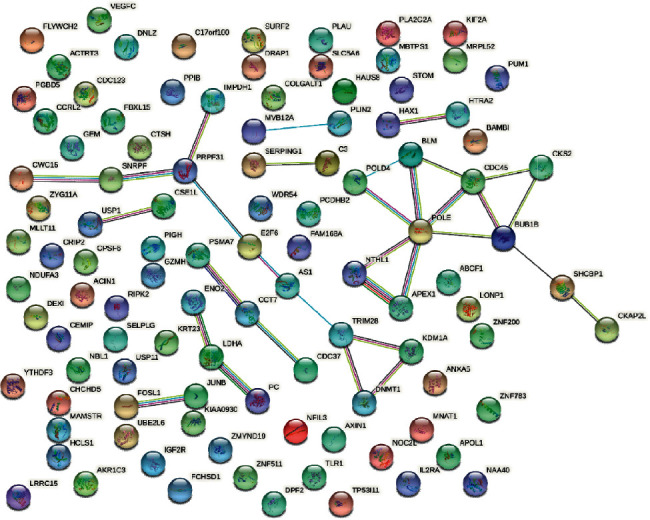
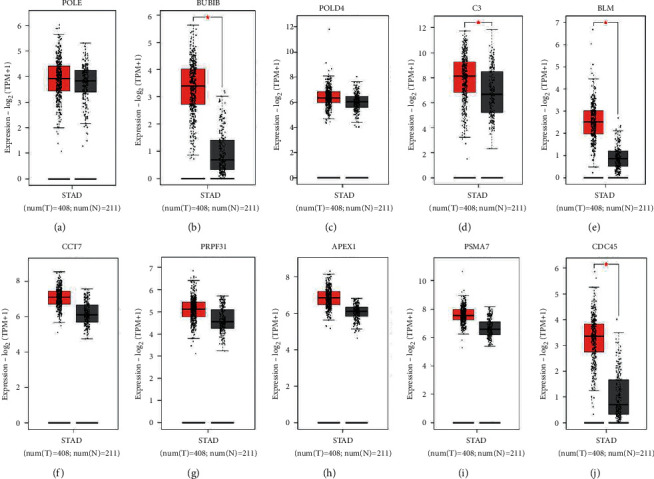
Perception of hub genes engaged in metastatic gastric cancer (mGC) promotes novel ways to diagnose and treat the illness. The goal of this investigation is to recognize the hub genes and reveal its molecular mechanism. In order to explore the potential facts for gastric cancer, the expression profiles of two different datasets were used (GSE161533 and GSE54129). The genes were confirmed to be part of the PPI network for gastric cancer pathogenesis and prognosis. In Cytoscape, the CytoHubba module was used to discover the hub genes. Responsible hub genes were identified. Data from Kaplan-Meier plotter confirmed the predictive value of these distinct genes in various stages of gastric malignancy. Upregulated and downregulated genes were identified to utilize for further analysis. Positive regulation by a host of viral process, positive regulation of granulocyte differentiation, negative regulation of histone H-K methylation were found in DEGs analysis. In addition, five KEGG pathways were identified as an essential enhancer that include nucleotide excision repair; base excision repair; DNA replication; homologous recombination; and complement and coagulation cascades. POLE, BUB1B, POLD4, C3, BLM, CCT7, PRPF31, APEX1, PSMA7, and CDC45 were chosen as hub genes after combining the PPI results. Our study recommends that BUB1B, CCT7, APEX1, PSMA7, and CDC45 might be potential biomarkers for gastric cancer. These biomarkers are upregulated genes. Therefore, suppression of these genes will increase the survival rate in gastric cancer patients.
对参与转移性胃癌(mGC)的枢纽基因的认识促进了诊断和治疗该疾病的新方法。本研究的目的是识别枢纽基因并揭示其分子机制。为了探索胃癌的潜在因素,使用了两个不同数据集的表达谱(GSE161533和GSE54129)。这些基因被证实是胃癌发病机制和预后的蛋白质-蛋白质相互作用(PPI)网络的一部分。在Cytoscape中,使用CytoHubba模块发现枢纽基因。确定了相关的枢纽基因。来自Kaplan-Meier绘图仪的数据证实了这些不同基因在胃癌各个阶段的预测价值。确定上调和下调基因以用于进一步分析。在差异表达基因(DEG)分析中发现了许多病毒过程的正调控、粒细胞分化的正调控、组蛋白H-K甲基化的负调控。此外,五条京都基因与基因组百科全书(KEGG)通路被确定为重要增强子,包括核苷酸切除修复;碱基切除修复;DNA复制;同源重组;以及补体和凝血级联反应。结合PPI结果后,选择POLE、BUB1B、POLD4、C3、BLM、CCT7、PRPF31、APEX1、PSMA7和CDC45作为枢纽基因。我们的研究表明,BUB1B、CCT7、APEX1、PSMA7和CDC45可能是胃癌的潜在生物标志物。这些生物标志物是上调基因。因此,抑制这些基因将提高胃癌患者的生存率。