Seafood, Nutrition and Environmental State, Institute of Marine Research (IMR), Bergen, Norway.
Centre for International Health, Department of Global Public Health and Primary Care, University of Bergen, Norway.
Br J Nutr. 2023 Mar 14;129(5):854-863. doi: 10.1017/S0007114522001465. Epub 2022 May 10.
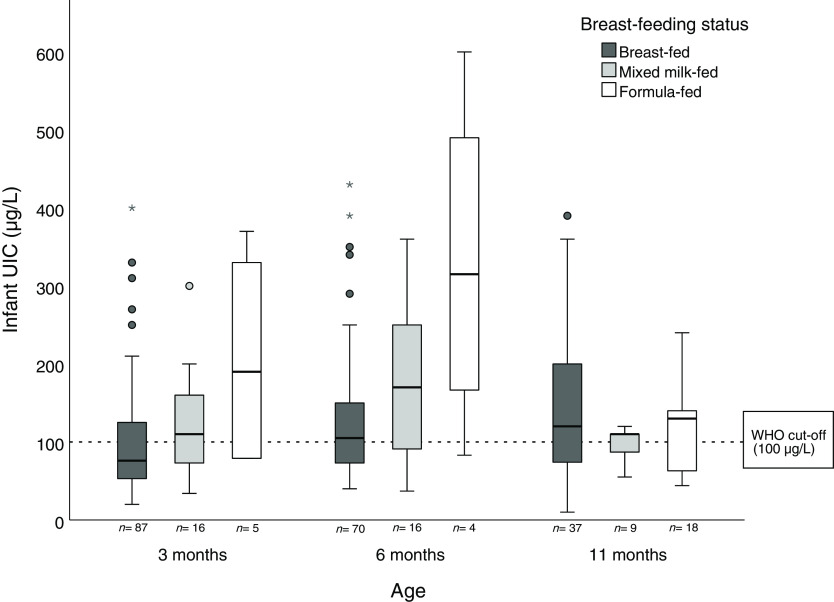
Adequate iodine nutrition during infancy is required for normal thyroid function and, subsequently, brain development. However, data on infant iodine status in the first year of life are scarce. This study aimed to describe infant iodine status and further explore its associations with maternal iodine nutrition, breast-feeding status and thyroid function. In this cohort study, 113 infants were followed up at ages 3, 6 and 11 months in Norway. Infant and maternal urinary iodine concentration (UIC), maternal iodine intake, breast milk iodine concentration (BMIC), breast-feeding status and infant thyroid function tests were measured. The median infant UIC was 82 µg/l at the age of 3 months and below the WHO cut-off of 100 µg/l. Infant UIC was adequate later in infancy (median 110 µg/l at ages 6 and 11 months). Infant UIC was associated positively with maternal UIC ( = 0·33, 95 % CI (0·12, 0·54)), maternal iodine intake ( = 0·30, 95 % CI (0·18, 0·42)) and BMIC ( = 0·46, 95 % CI (0·13, 0·79)). Breastfed infants had lower median UIC compared with formula-fed infants at ages 3 months (76 . 190 µg/l) and 6 months (105 . 315 µg/l). Neither infant UIC nor BMIC were associated with infant thyroid function tests. In conclusion, breastfed infants in Norway are at risk of insufficient iodine intake during the first months of life. Maternal iodine nutrition is important for providing sufficient iodine intake in infants, and awareness of promoting adequate iodine nutrition for lactating women should be prioritised.
婴儿时期摄入足够的碘对于甲状腺功能正常以及随后的大脑发育至关重要。然而,关于婴儿在生命第一年的碘状况的数据却很少。本研究旨在描述婴儿的碘状况,并进一步探讨其与母体碘营养、母乳喂养状况和甲状腺功能的关系。在这项队列研究中,113 名婴儿在挪威分别于 3、6 和 11 个月龄时进行随访。测量了婴儿和母亲的尿碘浓度(UIC)、母亲的碘摄入量、母乳碘浓度(BMIC)、母乳喂养状况和婴儿甲状腺功能检查。婴儿在 3 个月龄时的 UIC 中位数为 82μg/l,低于世界卫生组织 100μg/l 的切点。婴儿的 UIC 在婴儿期后期是充足的(6 和 11 个月龄时的中位数分别为 110μg/l)。婴儿的 UIC 与母亲的 UIC 呈正相关( = 0·33,95 % CI(0·12,0·54))、母亲的碘摄入量( = 0·30,95 % CI(0·18,0·42))和 BMIC( = 0·46,95 % CI(0·13,0·79))。与配方奶喂养的婴儿相比,母乳喂养的婴儿在 3 个月龄(76. 190μg/l)和 6 个月龄(105. 315μg/l)时的 UIC 中位数较低。婴儿的 UIC 和 BMIC 均与婴儿的甲状腺功能检查无关。综上所述,挪威母乳喂养的婴儿在生命的头几个月有摄入碘不足的风险。母体的碘营养对为婴儿提供充足的碘摄入很重要,应该优先考虑提高哺乳期妇女的碘营养意识。