Seafood, Nutrition and Environmental State, Institute of Marine Research, Bergen, Norway.
Regional Centre for Child and Youth Mental Health and Child Welfare, NORCE Norwegian Research Centre, Bergen, Norway.
Thyroid. 2021 Feb;31(2):288-298. doi: 10.1089/thy.2020.0115. Epub 2020 Sep 8.
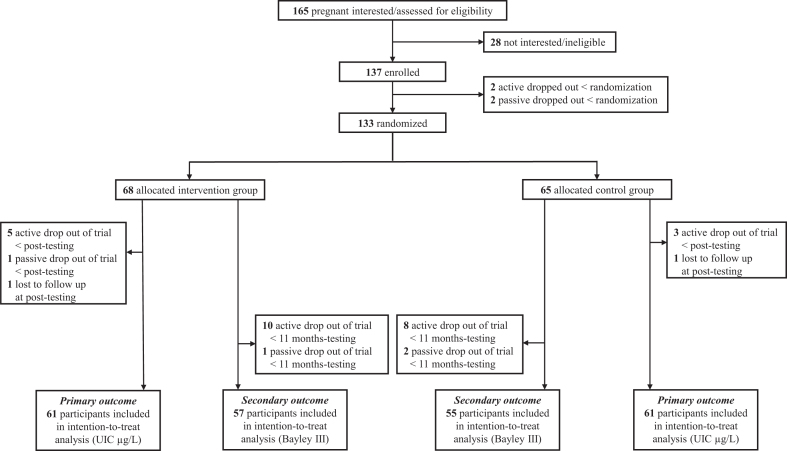
Mild-to-moderate iodine deficiency is still present in many countries, particularly in pregnant women. Observational studies suggest that mild-to-moderate iodine deficiency during pregnancy may be associated with impaired thyroid function and child neurodevelopment. Randomized-controlled food trials to increase iodine status are scarce. We assessed the impact of an increased intake of cod during pregnancy on maternal iodine status and infant neurodevelopment. In this randomized-controlled trial, pregnant women in Bergen, Norway, recruited through Haukeland University Hospital, were randomly assigned (1:1) to an intervention of 200 g of cod twice a week for 16 weeks (gestational week 20-36) or to continue with their standard diet (control group). Randomization was done by lottery. Primary outcome was urinary iodine concentration (UIC) (spot samples from six consecutive days) measured postintervention. Secondary outcome was infant neurodevelopment assessed by the cognitive, language, and motor scales of the third edition (Bayley-III) at 11 months of age. In addition, maternal thyroid function was measured (thyrotropin [TSH], free triiodothyronine [fT3], free thyroxine [fT4]) at baseline and postintervention. Between January 2016 until February 2017, 137 women were recruited. Postintervention UIC was higher in the intervention group ( = 61) [median (interquartile range, IQR) 98 (64-145) μg/L], compared with control ( = 61) [median (IQR) 73 (52-120) μg/L] ( = 0.028), also after adjusting for baseline UIC ( = 0.048). Infants of mothers in the intervention group had a lower cognitive composite score on the Bayley-III compared with the control group ( = 0.045). There were no group differences in the Bayley III language- or motor composite scores. Maternal thyroid hormones (TSH, fT3, fT4) did not differ between the groups postintervention. Increased cod intake during pregnancy improved the iodine status in women with mild-to-moderate iodine deficiency, however, did not affect thyroid function. The negative effect on cognition should be followed up to assess whether this is a stable effect over time. More studies are warranted to enable good health advice on iodine nutrition in pregnancy. ClinicalTrials.gov NCT02610959. Registered November 20, 2015.
许多国家仍存在轻至中度碘缺乏,尤其是孕妇。观察性研究表明,妊娠期间的轻至中度碘缺乏可能与甲状腺功能受损和儿童神经发育不良有关。增加碘状态的随机对照食物试验很少。我们评估了怀孕期间增加鳕鱼摄入量对孕妇碘状况和婴儿神经发育的影响。 在这项随机对照试验中,挪威卑尔根的 Haukeland 大学医院通过招募孕妇,将她们(1:1)随机分配到干预组(妊娠 20 周到 36 周期间每周两次食用 200 克鳕鱼)或继续食用标准饮食(对照组)。随机分配采用抽签方式。主要结局是尿碘浓度(UIC)(连续六天的点样),在干预后进行测量。次要结局是 11 个月时婴儿的神经发育,通过第三版(Bayley-III)的认知、语言和运动量表进行评估。此外,在基线和干预后测量了产妇的甲状腺功能(促甲状腺激素 [TSH]、游离三碘甲状腺原氨酸 [fT3]、游离甲状腺素 [fT4])。 2016 年 1 月至 2017 年 2 月期间,共招募了 137 名女性。与对照组(61 名)相比,干预组(61 名)的 UIC 更高(中位数 [四分位数范围,IQR] 98 [64-145]μg/L)( = 0.028),即使调整了基线 UIC 后也是如此( = 0.048)。与对照组相比,干预组婴儿的 Bayley-III 认知综合评分较低( = 0.045)。干预组和对照组在 Bayley III 语言或运动综合评分方面没有差异。干预后两组的产妇甲状腺激素(TSH、fT3、fT4)无差异。 怀孕期间增加鳕鱼摄入量可改善轻度至中度碘缺乏孕妇的碘状况,但不影响甲状腺功能。认知方面的负面影响应进行随访,以评估这是否是一个随时间稳定的影响。需要进行更多研究,以便为妊娠期间的碘营养提供良好的健康建议。ClinicalTrials.gov NCT02610959。2015 年 11 月 20 日注册。