Department of Psychology, New York University, New York, USA.
Institute of Psychology, Leiden University, Leiden, The Netherlands.
Sci Rep. 2022 May 10;12(1):7634. doi: 10.1038/s41598-022-09477-2.
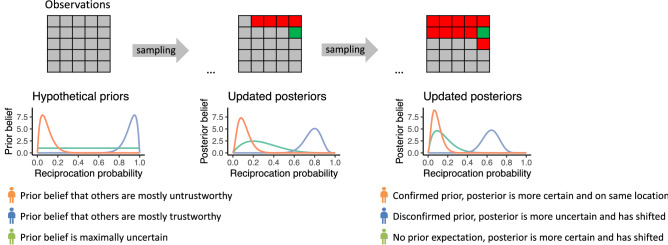
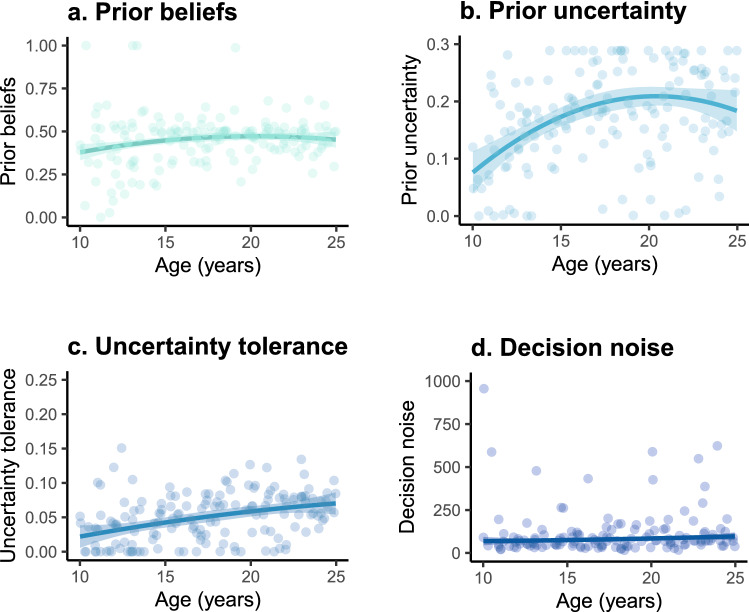
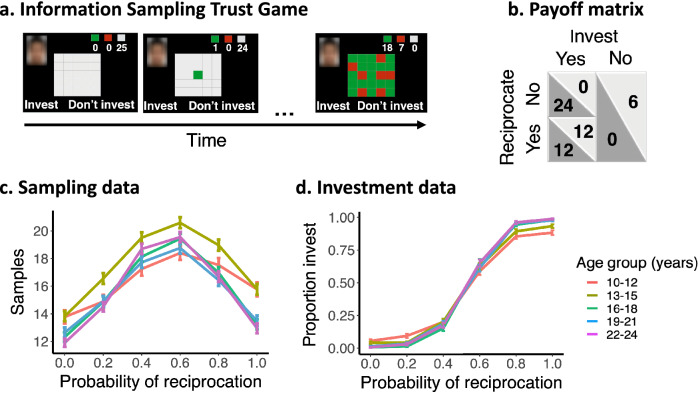
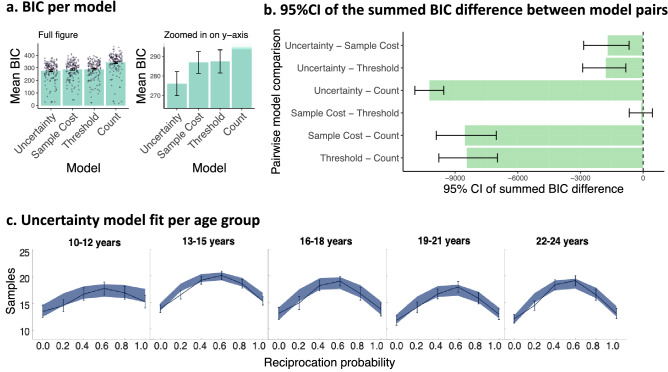
Adolescence is a key life phase for developing well-adjusted social behaviour. An essential component of well-adjusted social behaviour is the ability to update our beliefs about the trustworthiness of others based on gathered information. Here, we examined how adolescents (n = 157, 10-24 years) sequentially sampled information about the trustworthiness of peers and how they used this information to update their beliefs about others' trustworthiness. Our Bayesian computational modelling approach revealed an adolescence-emergent increase in uncertainty of prior beliefs about others' trustworthiness. As a consequence, early to mid-adolescents (ages 10-16) gradually relied less on their prior beliefs and more on the gathered evidence when deciding to sample more information, and when deciding to trust. We propose that these age-related differences could be adaptive to the rapidly changing social environment of early and mid-adolescents. Together, these findings contribute to the understanding of adolescent social development by revealing adolescent-emergent flexibility in prior beliefs about others that drives adolescents' information sampling and trust decisions.
青春期是形成良好社交行为的关键阶段。良好社交行为的一个重要组成部分是,根据收集到的信息,更新我们对他人可信度的信念的能力。在这里,我们研究了青少年(n=157,10-24 岁)如何依次对同伴可信度的信息进行抽样,以及他们如何利用这些信息来更新对他人可信度的信念。我们的贝叶斯计算建模方法揭示了青少年时期对他人可信度的先验信念不确定性的增加。因此,早期到中期青少年(10-16 岁)在决定进一步抽样信息以及决定信任时,逐渐较少依赖先验信念,而更多地依赖收集到的证据。我们认为,这些与年龄相关的差异可能是对早期和中期青少年快速变化的社会环境的适应性。总之,这些发现通过揭示青少年对他人的先验信念的新兴灵活性,为理解青少年的社交发展做出了贡献,这种灵活性推动了青少年的信息抽样和信任决策。