Dayan Avraham, Fleminger Gideon, Ashur-Fabian Osnat
The School of Molecular Cell Biology and Biotechnology, George S. Wise Faculty of Life Sciences Israel.
The Department of Human Molecular Genetics and Biochemistry, Sackler School of Medicine, Tel Aviv University Ramat Aviv 69978 Israel
RSC Adv. 2018 Mar 1;8(17):9112-9119. doi: 10.1039/c7ra13777j. eCollection 2018 Feb 28.
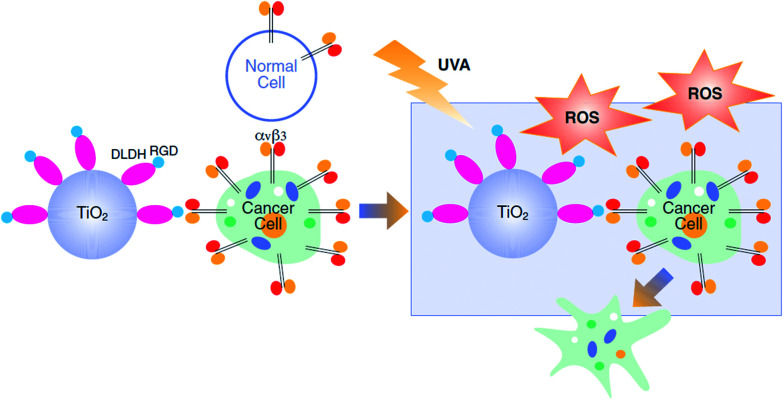
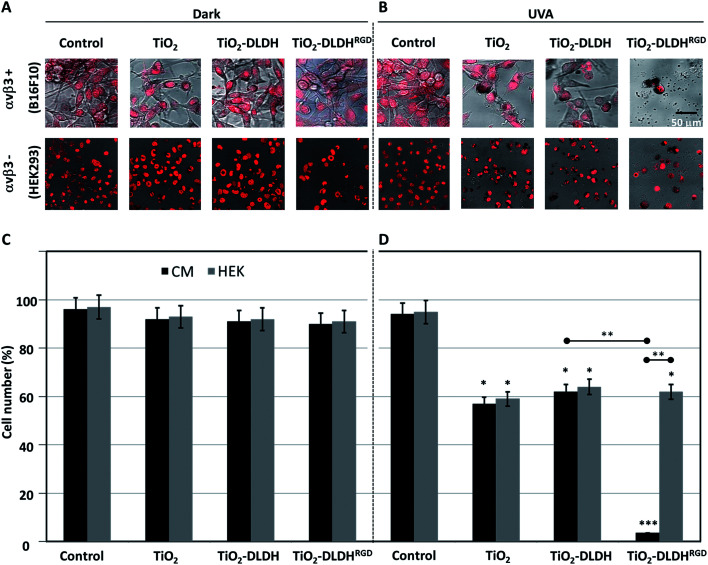
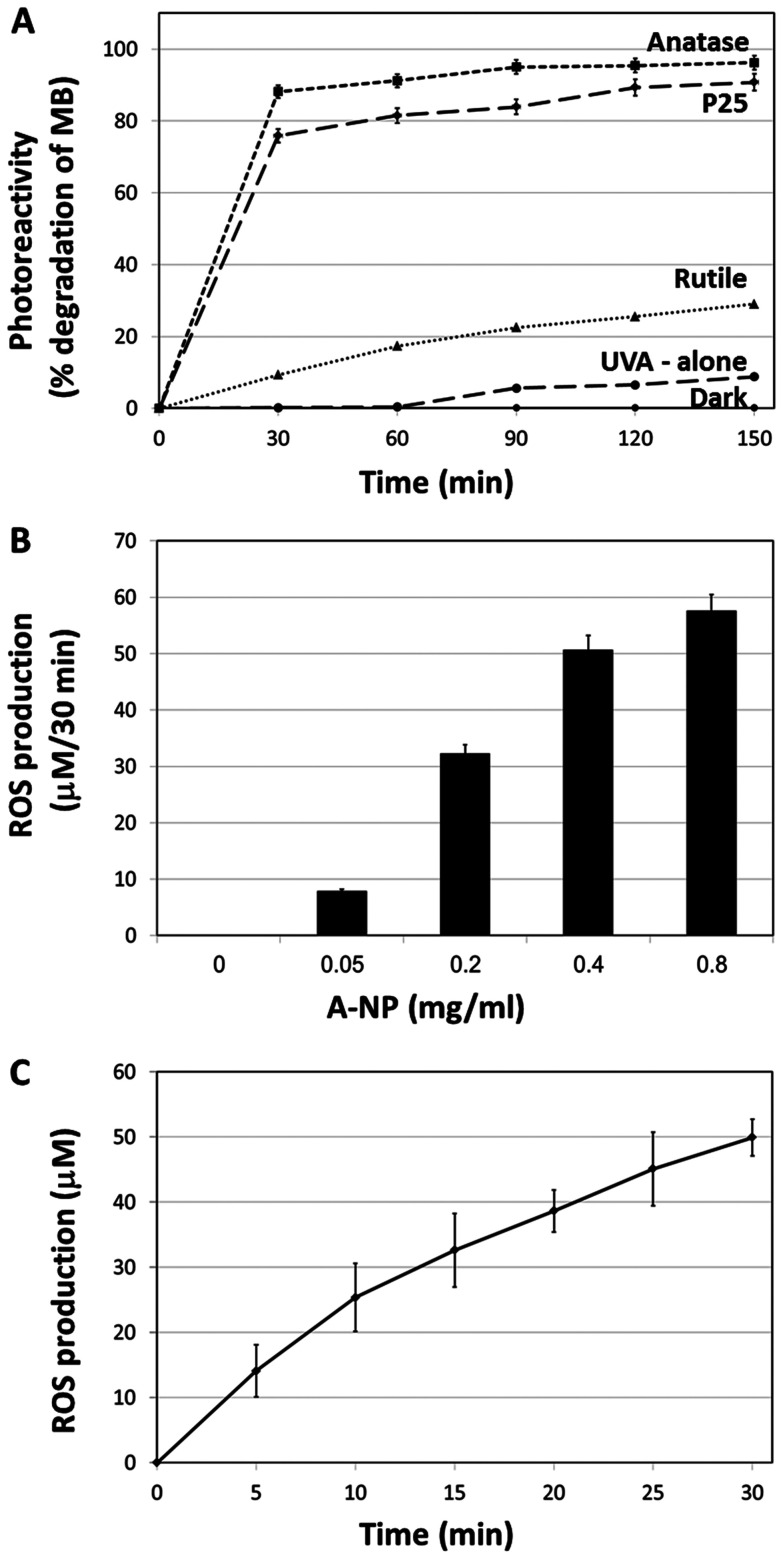
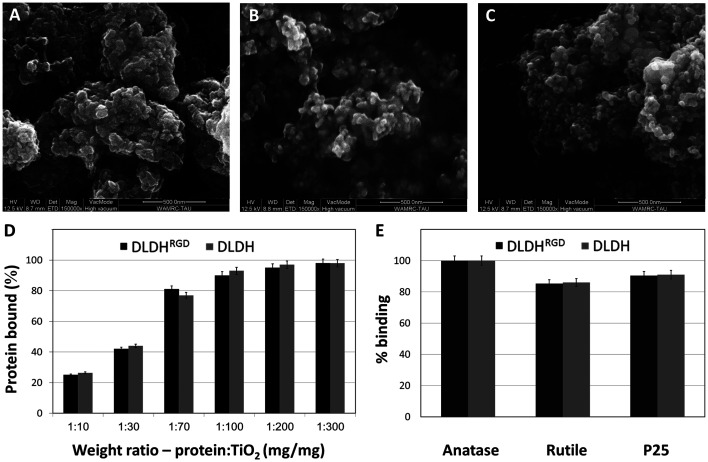
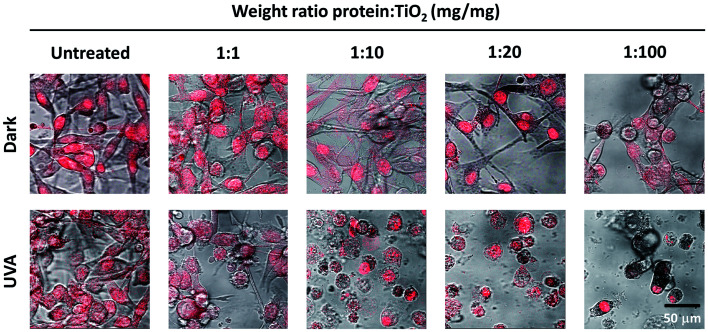
The photocytotoxic effect of UVA-excited titanium dioxide (TiO), which is caused by the generation of reactive oxygen species (ROS), is often used in medical applications, such as cancer treatment. Photodynamic-therapy (PDT) is applied in several cancer models including cutaneous melanoma (CM), however the lack of selectivity causing damage to surrounding healthy tissues limits its applicability and novel targeted-delivery approaches are required. As cancer cells often overexpress integrin receptors ( αvβ) on their cell surface, targeted delivery of TiO nanoparticles (NPs) an Arg-Gly-Asp (RGD) motif would make PDT more selective. We have recently reported that the mitochondrial enzyme dihydrolipoamide dehydrogenase (DLDH) strongly and specifically conjugates TiO coordinative bonds. In this work we have modified DLDH with RGD moieties (DLDH), creating a molecular bridge between the integrin-expressing cancer cells and the photo-excitable TiO nanoparticles. Physicochemical assays have indicated that the hybrid-conjugated nanobiocomplex, TiO-DLDH, is producing controlled-release ROS under UVA illumination, with anatase NPs being the most photoreactive TiO form. This drug delivery system exhibited a cytotoxic effect in αvβ integrin-expressing mice melanoma cells (B16F10), but not in normal cells lacking this integrin (HEK293). No cytotoxic effect was observed in the absence of UV illumination. Our results demonstrate the feasibility of combining the high efficiency of TiO-based PDT, with an integrin-mediated tumor-targeted drug delivery for nanomedicine.
由活性氧(ROS)生成所导致的UVA激发的二氧化钛(TiO₂)的光细胞毒性效应,常用于医学应用,如癌症治疗。光动力疗法(PDT)已应用于包括皮肤黑色素瘤(CM)在内的多种癌症模型中,然而,缺乏选择性导致对周围健康组织的损伤限制了其适用性,因此需要新的靶向递送方法。由于癌细胞通常在其细胞表面过度表达整合素受体(αvβ₃),将带有精氨酸 - 甘氨酸 - 天冬氨酸(RGD)基序的TiO₂纳米颗粒(NPs)进行靶向递送会使PDT更具选择性。我们最近报道,线粒体酶二氢硫辛酰胺脱氢酶(DLDH)能通过配位键与TiO₂强烈且特异性地结合。在这项工作中,我们用RGD部分修饰了DLDH(DLDH-RGD),在表达整合素的癌细胞和可光激发的TiO₂纳米颗粒之间建立了一个分子桥。物理化学分析表明,杂合共轭纳米生物复合物TiO₂-DLDH-RGD在UVA照射下产生可控释放的ROS,锐钛矿型NPs是最具光反应性的TiO₂形式。这种药物递送系统在表达αvβ₃整合素的小鼠黑色素瘤细胞(B16F10)中表现出细胞毒性作用,但在缺乏这种整合素的正常细胞(HEK293)中没有。在没有紫外线照射的情况下未观察到细胞毒性作用。我们的结果证明了将基于TiO₂的PDT的高效率与整合素介导的肿瘤靶向药物递送相结合用于纳米医学的可行性。