Xu W J, Chen L M, Wei Z Y, Wang P Q, Liu J, Dong J J, Jia Z X, Yang J, Ma Z C, Su R B, Xiao H B, Liu A
Institute of Chinese Materia Medica, China Academy of Chinese Medical Sciences Beijing 100700 China
Research Center for Chinese Medical Analysis and Transformation, Beijing University of Chinese Medicine Beijing 100029 China
RSC Adv. 2018 Jan 22;8(7):3760-3767. doi: 10.1039/c7ra12725a. eCollection 2018 Jan 16.
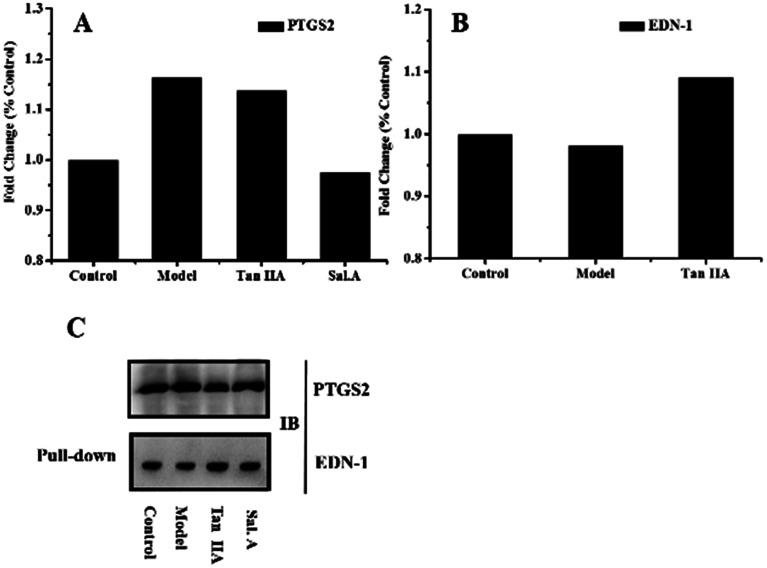
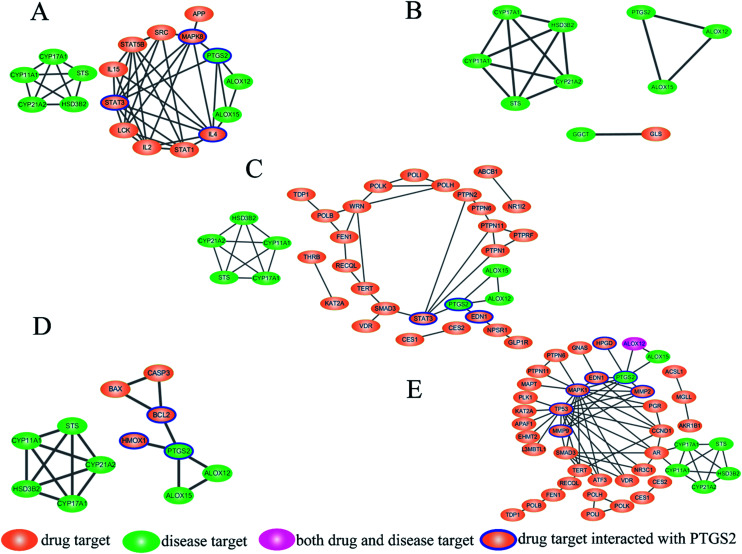
The identification of network targets is one of the core issues used to reveal the molecular mechanism of traditional Chinese medicine (TCM) and is also the grand challenge of modernization of TCM. In this study, a protein-protein interaction (PPI) network was constructed based on the integration of network pharmacology and metabolomics, which was used as an effective approach to elucidate the relationship between disease pathway proteins and the targets of active small-molecule compounds. The intermolecular transfer process of the drug effect of active compounds in (SM) was revealed and visualized using the PPI network. Our study indicates that PTGS2 was the most important disease protein regulated by the active compounds in SM. Furthermore, the drug targets that can be linked to PTGS2 were regarded as direct targets and the direct targets of the active compounds were identified, respectively. Western blot and co-immuno precipitation (Co-IP) were used to verify the results of the network analysis and reveal the intermolecular transfer process of the effect of Tan IIA. Biological validation revealed that Tan IIA-EDN1-PTGS2-anandamide was a major intervention way of Tan IIA on early atherosclerosis (AS). This work provides a new perspective for the discovery of drug targets and the specific approaches regulated by the active compounds in SM on disease pathway proteins, which is beneficial for understanding the mechanism of action of bioactive compounds and expanding their clinical applications.
网络靶点的识别是揭示中药分子机制的核心问题之一,也是中药现代化的重大挑战。在本研究中,基于网络药理学和代谢组学的整合构建了蛋白质-蛋白质相互作用(PPI)网络,作为阐明疾病通路蛋白与活性小分子化合物靶点之间关系的有效方法。利用PPI网络揭示并可视化了活性化合物在(SM)中的药物效应分子间传递过程。我们的研究表明,PTGS2是SM中活性化合物调控的最重要疾病蛋白。此外,将可与PTGS2连接的药物靶点视为直接靶点,并分别鉴定了活性化合物的直接靶点。采用蛋白质免疫印迹法和免疫共沉淀法(Co-IP)验证网络分析结果,并揭示丹参酮IIA作用的分子间传递过程。生物学验证表明,丹参酮IIA-内皮素-1-PTGS2-花生四烯乙醇胺是丹参酮IIA对早期动脉粥样硬化(AS)的主要干预途径。这项工作为发现药物靶点以及SM中活性化合物对疾病通路蛋白的特定调控途径提供了新的视角,有助于理解生物活性化合物的作用机制并拓展其临床应用。