Department of Dermatology and Venereology, Institute of Clinical Sciences, Sahlgrenska Academy, University of Gothenburg, Gothenburg, Sweden.
Department of Dermatology and Venereology, Region Västra Götaland, Sahlgrenska University Hospital, Gothenburg, Sweden.
J Eur Acad Dermatol Venereol. 2022 Oct;36(10):1758-1765. doi: 10.1111/jdv.18209. Epub 2022 May 21.
Basal cell carcinoma (BCC) is the most common cancer in the world and has a rising incidence. Current guidelines for low-risk BCC including superficial BCC (sBCC) recommend several treatment options including destructive treatment methods, such as cryosurgery with or without prior curettage or curettage and electrodesiccation. Curettage only (i.e. without subsequent cryosurgery or electrodesiccation) is a simple and quick destructive treatment method used for many benign skin lesions but has not been sufficiently evaluated for the treatment of sBCCs.
The objective was to compare the effectiveness of curettage vs. cryosurgery for sBCCs in terms of overall clinical clearance rates after 1 year as well as wound healing times.
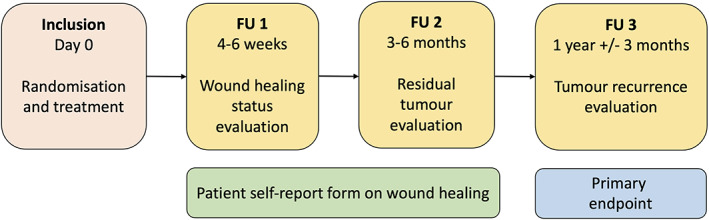
A single-centre non-inferiority clinical trial was conducted. Non-facial sBCCs with a diameter of 5-20 mm were randomised to either cryosurgery using one freeze-thaw cycle or curettage. At follow-up visits, treatment areas were evaluated regarding the presence of residual tumour after 3-6 months and recurrence after 1 year. Further, wound healing times were assessed.
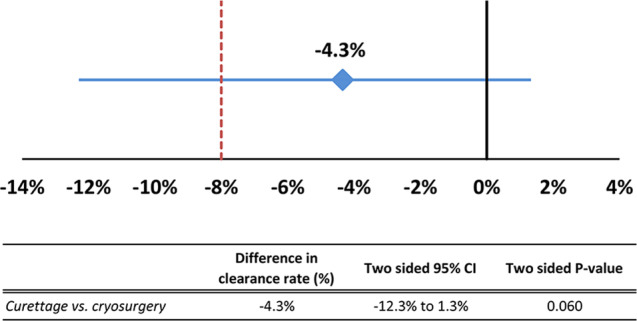
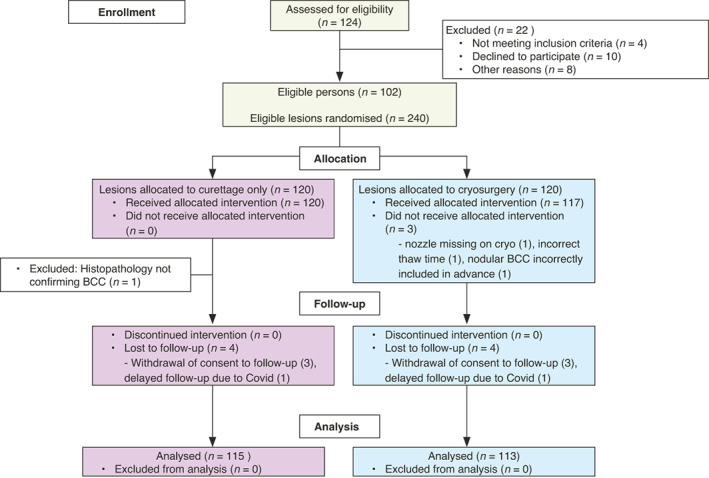
In total, 228 sBCCs in 97 patients were included in the analysis. At 3-6 months, no residual tumours were seen in any of the treated areas. After 1 year, the clinical clearance rates for curettage and cryosurgery were 95.7% and 100%, respectively (P = 0.060). However, the non-inferiority analysis was inconclusive. Wound healing times were shorter for curettage (4 weeks) compared to cryosurgery (5 weeks; P < 0.0001). Overall, patient satisfaction at 1 year was high.
Both treatment methods showed high clinical clearance rates after 1 year, whilst curettage reduced the wound healing time.
基底细胞癌(BCC)是世界上最常见的癌症,其发病率呈上升趋势。对于包括浅表基底细胞癌(sBCC)在内的低危 BCC,目前的指南建议了几种治疗选择,包括破坏性治疗方法,如冷冻手术联合或不联合刮除术,或刮除术联合电干燥术。仅刮除术(即不随后进行冷冻手术或电干燥术)是一种用于许多良性皮肤病变的简单快速的破坏性治疗方法,但尚未对治疗 sBCC 进行充分评估。
比较刮除术与冷冻手术治疗 sBCC 在 1 年时的总体临床清除率以及伤口愈合时间方面的效果。
进行了一项单中心非劣效性临床试验。将直径为 5-20mm 的非面部 sBCC 随机分为冷冻手术组(使用一个冻融循环)或刮除术组。在随访时,在 3-6 个月时评估治疗区域是否有残留肿瘤,在 1 年后评估是否有复发。此外,还评估了伤口愈合时间。
共有 97 例患者的 228 个 sBCC 纳入分析。在 3-6 个月时,任何治疗区域均未发现残留肿瘤。在 1 年后,刮除术和冷冻手术的临床清除率分别为 95.7%和 100%(P=0.060)。然而,非劣效性分析结果不确定。刮除术的伤口愈合时间(4 周)比冷冻手术(5 周)短(P<0.0001)。总体而言,患者在 1 年后的满意度较高。
两种治疗方法在 1 年后均显示出较高的临床清除率,而刮除术缩短了伤口愈合时间。