Boston Children's Hospital, F.M. Kirby Neurobiology Center, Boston, MA, United States. D.P. Roberson is now with Blackbox Bio, LLC, Dallas, TX, United States. R. González-Cano is now with the Department of Pharmacology, University of Granada, Granada, Spain . N.K. Wimalasena is now with Decibel Therapeutics, Boston, MA, United States. N.L.M. Quintão is now with the Postgraduate Programe in Pharmaceutical Science, Universidade do Vale do Itajaí (UNIVALI), Itajaí, Santa Catarina, Brazil . V. Fattori is now with the Laboratory of Pain, Inflammation, Neuropathy, and Cancer, Department of Pathology, Londrina State University, Londrina, Paraná, Brazil . A.B. Wiltschko is now with the Google Research, Brain Team, Cambridge, MA, United States. N.A. Andrews is now with the Salk Institute for Biological Studies, La Jolla, CA, United States.
Department of Neurobiology, Harvard Medical School, Boston, MA, United States.
Pain. 2022 Dec 1;163(12):2326-2336. doi: 10.1097/j.pain.0000000000002680. Epub 2022 May 11.
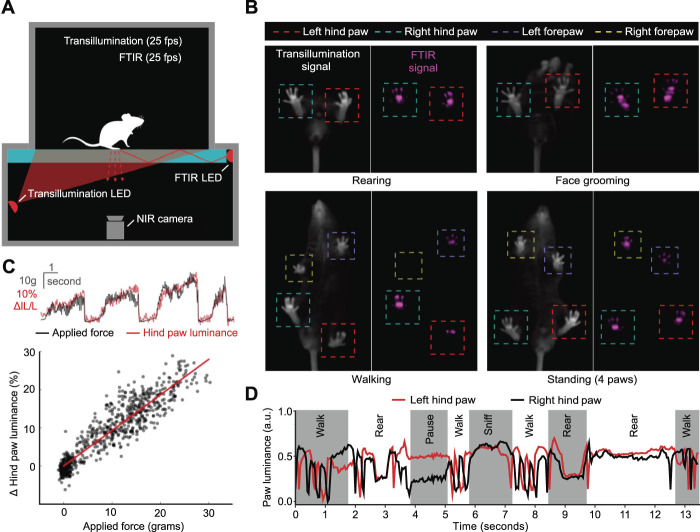
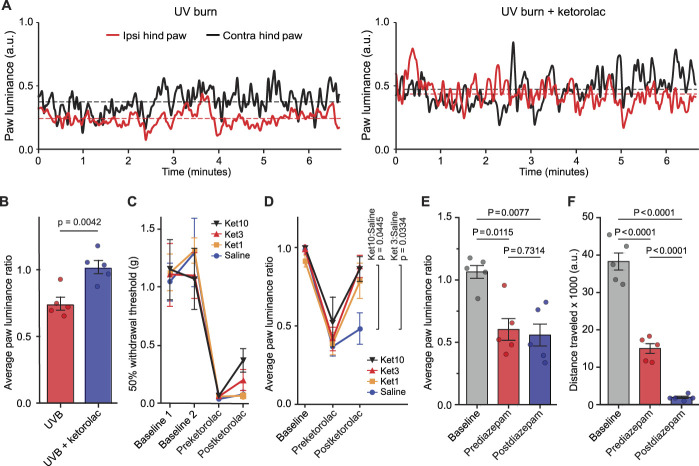
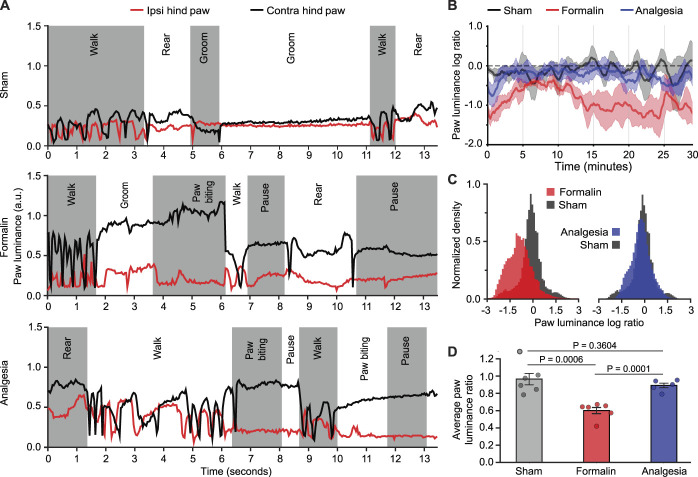
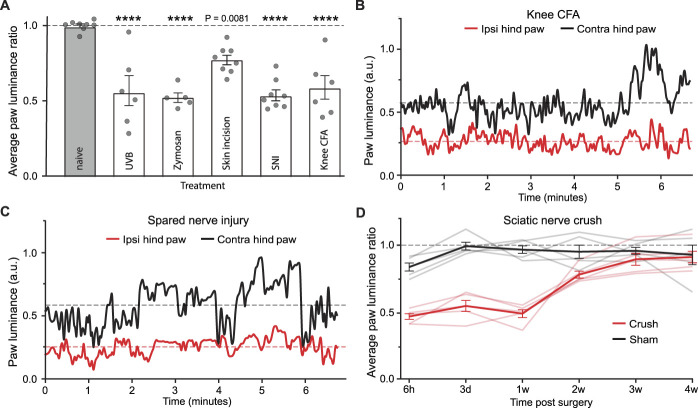
The lack of sensitive and robust behavioral assessments of pain in preclinical models has been a major limitation for both pain research and the development of novel analgesics. Here, we demonstrate a novel data acquisition and analysis platform that provides automated, quantitative, and objective measures of naturalistic rodent behavior in an observer-independent and unbiased fashion. The technology records freely behaving mice, in the dark, over extended periods for continuous acquisition of 2 parallel video data streams: (1) near-infrared frustrated total internal reflection for detecting the degree, force, and timing of surface contact and (2) simultaneous ongoing video graphing of whole-body pose. Using machine vision and machine learning, we automatically extract and quantify behavioral features from these data to reveal moment-by-moment changes that capture the internal pain state of rodents in multiple pain models. We show that these voluntary pain-related behaviors are reversible by analgesics and that analgesia can be automatically and objectively differentiated from sedation. Finally, we used this approach to generate a paw luminance ratio measure that is sensitive in capturing dynamic mechanical hypersensitivity over a period and scalable for high-throughput preclinical analgesic efficacy assessment.
在临床前模型中,缺乏敏感和稳健的疼痛行为评估一直是疼痛研究和新型镇痛药开发的主要限制。在这里,我们展示了一种新颖的数据采集和分析平台,该平台以独立于观察者且无偏倚的方式提供了自然发生的啮齿动物行为的自动、定量和客观测量。该技术记录在黑暗中自由活动的小鼠,可长时间连续采集 2 个并行视频数据流:(1)近红外光受抑全内反射,用于检测表面接触的程度、力和时间;(2)同时对整个身体姿势进行持续的视频绘制。使用机器视觉和机器学习,我们可以自动从这些数据中提取和量化行为特征,以揭示瞬间变化,从而捕捉多种疼痛模型中小鼠的内部疼痛状态。我们表明,这些与疼痛相关的自愿行为可以通过镇痛药逆转,并且可以自动和客观地区分镇痛和镇静作用。最后,我们使用这种方法生成了一个爪子亮度比测量值,该值可以敏感地捕捉一段时间内的动态机械性超敏反应,并且可扩展用于高通量临床前镇痛效果评估。