Department of Molecular and Cellular Biology and Center for Brain Science, Harvard University, Cambridge, Massachusetts, USA.
Program in Neuroscience, Department of Neurobiology, Harvard Medical School, Boston, Massachusetts, USA.
Nat Commun. 2022 May 11;13(1):2573. doi: 10.1038/s41467-022-29765-9.
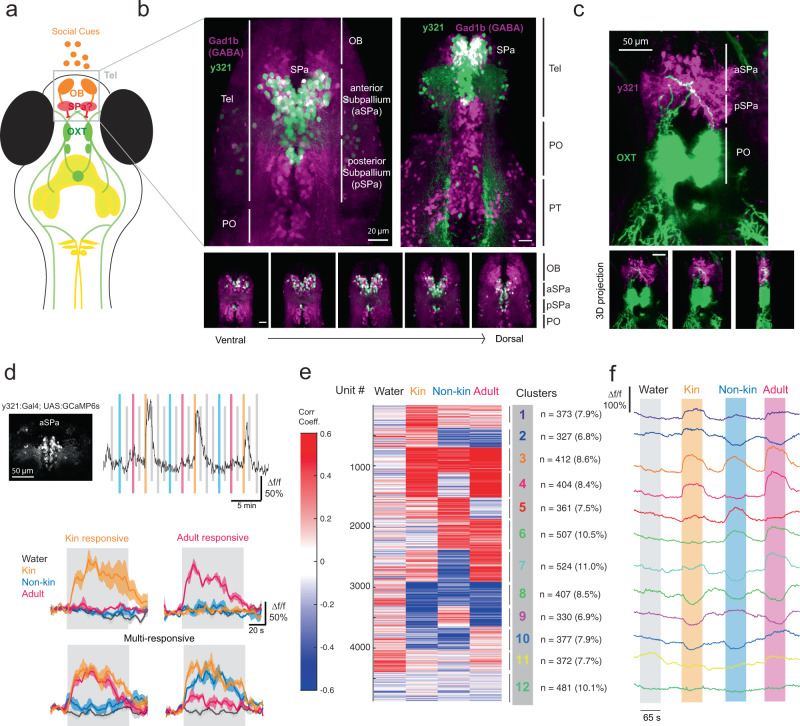
Animal brains have evolved to encode social stimuli and transform these representations into advantageous behavioral responses. The commonalities and differences of these representations across species are not well-understood. Here, we show that social isolation activates an oxytocinergic (OXT), nociceptive circuit in the larval zebrafish hypothalamus and that chemical cues released from conspecific animals are potent modulators of this circuit's activity. We delineate an olfactory to subpallial pathway that transmits chemical social cues to OXT circuitry, where they are transformed into diverse outputs simultaneously regulating avoidance and feeding behaviors. Our data allow us to propose a model through which social stimuli are integrated within a fundamental neural circuit to mediate diverse adaptive behaviours.
动物大脑已经进化到可以对社交刺激进行编码,并将这些表现转化为有利的行为反应。但是,我们对这些表现的物种间的共性和差异还不是很了解。在这里,我们发现社会隔离会激活幼虫斑马鱼下丘脑的催产素能(OXT)、伤害感受性回路,并且来自同种动物的化学线索是该回路活动的有力调节剂。我们描绘了一条从嗅觉到下皮层的通路,该通路将化学社交线索传递给 OXT 回路,在那里它们被转化为多种输出,同时调节回避和进食行为。我们的数据使我们能够提出一个模型,通过该模型,社交刺激可以在一个基本的神经回路中整合,从而介导各种适应性行为。