Ebrahimkhani Mo R, Levin Michael
Department of Pathology, School of Medicine, University of Pittsburgh, A809B Scaife Hall, 3550 Terrace Street, Pittsburgh, PA 15261, USA.
Department of Bioengineering, Swanson School of Engineering, University of Pittsburgh, Pittsburgh, PA, USA.
iScience. 2021 May 4;24(5):102505. doi: 10.1016/j.isci.2021.102505. eCollection 2021 May 21.
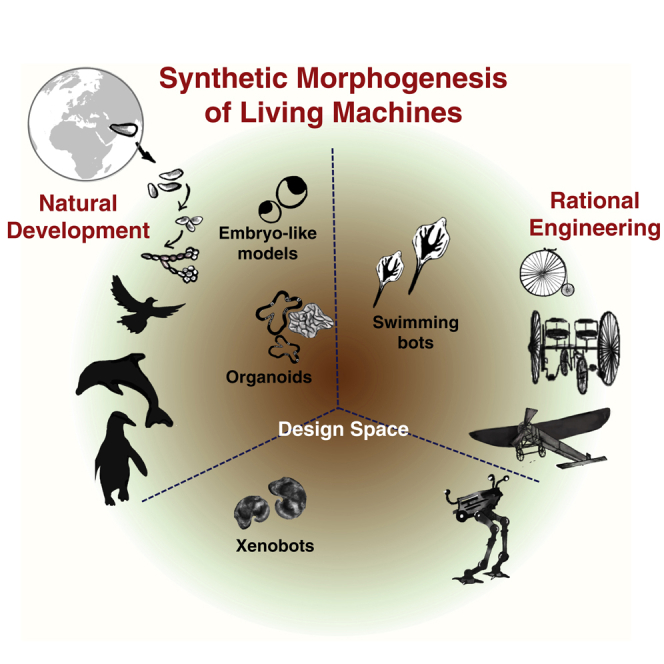
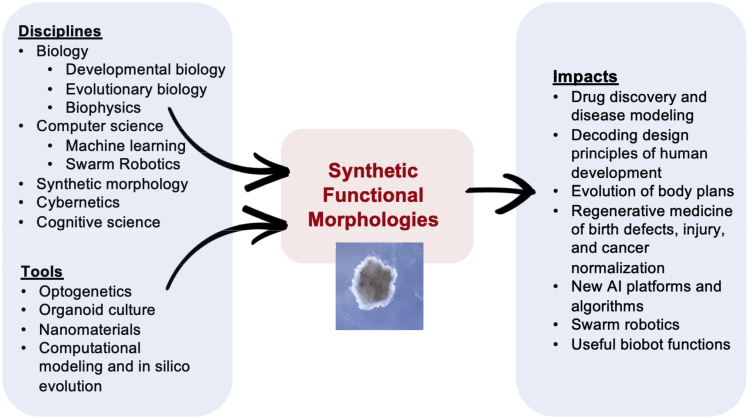
Increased control of biological growth and form is an essential gateway to transformative medical advances. Repairing of birth defects, restoring lost or damaged organs, normalizing tumors, all depend on understanding how cells cooperate to make specific, functional large-scale structures. Despite advances in molecular genetics, significant gaps remain in our understanding of the meso-scale rules of morphogenesis. An engineering approach to this problem is the creation of novel synthetic living forms, greatly extending available model systems beyond evolved plant and animal lineages. Here, we review recent advances in the emerging field of synthetic morphogenesis, the bioengineering of novel multicellular living bodies. Emphasizing emergent self-organization, tissue-level guided self-assembly, and active functionality, this work is the essential next generation of synthetic biology. Aside from useful living machines for specific functions, the rational design and analysis of new, coherent anatomies will greatly increase our understanding of foundational questions in evolutionary developmental and cell biology.
加强对生物生长和形态的控制是实现变革性医学进步的关键途径。修复出生缺陷、恢复缺失或受损器官、使肿瘤正常化,所有这些都依赖于了解细胞如何协作形成特定的功能性大规模结构。尽管分子遗传学取得了进展,但我们对中尺度形态发生规则的理解仍存在重大差距。解决这个问题的一种工程方法是创造新型合成生命形式,将可用的模型系统大大扩展到进化的动植物谱系之外。在这里,我们回顾了合成形态发生这一新兴领域的最新进展,即新型多细胞生物体的生物工程。这项工作强调涌现的自组织、组织水平的引导自组装和主动功能,是合成生物学必不可少的下一代。除了具有特定功能的有用活体机器外,对新的、连贯的解剖结构进行合理设计和分析将极大地增进我们对进化发育和细胞生物学基础问题的理解。